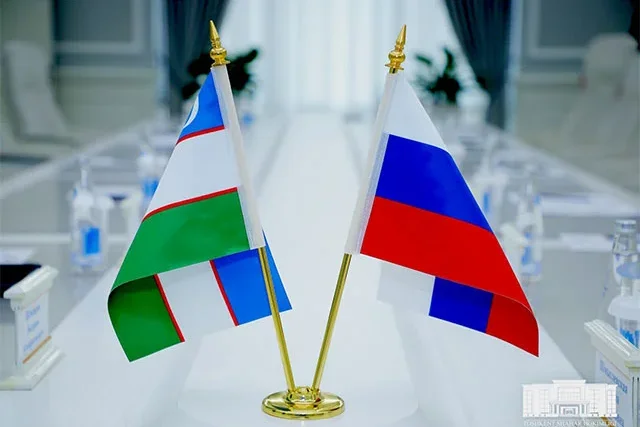
Tashkent, Uzbekistan (UzDaily.uz) — A Moscow-Tashkent video conference titled "Uzbekistan's Water Strategy to 2050: Science, Technology, and International Cooperation" took place at the Sputnik Uzbekistan multimedia press center.
Participants in the discussion included Khurshid Rakhmatullaev, deputy chairman of the board of Uzsuvtaminot JSC; Botirzhon Abdullaev, professor and head of the Department of Ecology and Water Resources Management at the Tashkent Institute of Irrigation and Agricultural Mechanization Engineers National Research University; and Urinboy Mamurov, chief specialist at the National Committee on Ecology and Climate Change of the Republic of Uzbekistan. Moscow was represented by Vladimir Kvint, academician and head of the Department of Economic and Financial Strategy at Lomonosov Moscow State University.
One of the main topics was the development of Uzbekistan's National Strategy for Rational Water Use and Environmental Protection through 2050. According to Vladimir Kvint, work on the document is being conducted with the participation of Russian specialists who have collaborated with Uzbekistan for several years.
Previously, the Moscow State University team participated in preparing the drinking water supply strategy that served as the foundation for establishing Uzsuvtaminot, and also developed an industrial water use strategy for the Navoi Mining and Metallurgical Combine. That accumulated experience is now being applied to the creation of the new strategic document.
Kvint emphasized that the core concept of the new strategy remains unchanged: human needs must be at the center of all decisions. For this reason, the document integrates issues of rational water resource management and environmental protection.
A concept featuring 9 strategic contours and 43 priorities based on Uzbekistan's competitive advantages has already been prepared.
The expert also highlighted workforce training as a key component. Moscow State University's textbook "Economic and Financial Strategy" and the two-volume "Concept of Strategizing" have been translated and published in Uzbek, enabling the start of specialist training in strategizing at universities in Uzbekistan.
At the same time, the academician believes a culture of rational water use must be fostered from childhood. In his view, it is important to engage not only schools and universities but also local neighborhoods, or mahallas.
"When children are taught why water must be conserved, they begin monitoring usage at home themselves. In this way, the habit of careful water use gradually becomes part of the entire family's culture," Kvint noted.
Another initiative under consideration is the establishment of an ecological-economic council in Uzbekistan to regularly evaluate the implementation of the water strategy and propose adjustments as needed.
The practical implementation of the strategy is already accompanied by the adoption of new technologies. Khurshid Rakhmatullaev, deputy chairman of the board of Uzsuvtaminot, explained that specialists are studying global experience, including practices from Russia, when selecting technical solutions.
According to Rakhmatullaev, gallery-type water treatment facilities represent one of the most promising approaches for Uzbekistan's conditions. These facilities purify water naturally, require fewer chemical reagents, and cost less to construct and operate.
In parallel, Uzbekistan is continuing to modernize its drinking water quality control laboratories. The country currently operates 85 such laboratories, and plans are underway to make testing results publicly accessible online.
Residents will be able to check online where their local water originates and whether it meets established quality standards. According to Rakhmatullaev, this initiative will make the water supply system more transparent and increase public trust.