Mirziyoyev Launches Future Technologies Center Project

Mirziyoyev Launches Future Technologies Center Project
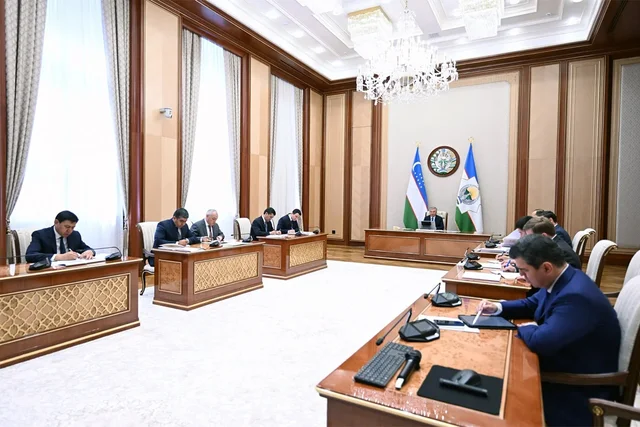
Tashkent, Uzbekistan (UzDaily.uz) — President of Uzbekistan Shavkat Mirziyoyev took part in the groundbreaking ceremony for the Future Technologies Center in Nurafshan and launched a number of new innovation projects.
Addressing the ceremony, the president said every stage of human development had been linked to fundamental scientific discoveries. He noted that algorithms whose theoretical foundations were laid by the renowned scholar Muhammad al-Khwarizmi now underpin the global economy and have become an integral part of everyday life.
Mirziyoyev said global competition is accelerating and warned that countries delaying digital transformation, the adoption of artificial intelligence technologies and investment in innovation risk falling behind.
"It is impossible to ensure development without taking the digitalization of every sphere of our lives seriously. We must all clearly understand that without it, we have no future," he said.
The president also said venture capital investment in Uzbekistan has increased fivefold since the beginning of this year, while the value of the country's startup ecosystem has reached nearly US$4.5 billion.
To support innovative entrepreneurship, Mirziyoyev announced the launch of a startup competition with a prize fund of US$5 million. He said the initiative is intended to encourage the development and implementation of promising technological solutions in the country.
Around US$500 million will be invested in the construction of the Future Technologies Center in Nurafshan. Covering 36 hectares, the innovation complex will integrate education, scientific research, technology testing and high-tech manufacturing within a single ecosystem.
Officials said Nurafshan was selected for the project because of its existing scientific and educational base. The city is home to Cyber University, which trains around 1,000 highly qualified specialists in cybersecurity and information protection.
An innovation cluster is planned around the university and is intended to serve as a model for the development of high-tech ecosystems across the country.
The cluster will include six laboratories specializing in cybersecurity, artificial intelligence, cloud technologies and cryptography. The project also provides for the construction of a data center for artificial intelligence systems and an engineering cluster.
The center will also include production facilities for secure computers, data transmission equipment and high-tech tokens, as well as a specialized testing ground for unmanned aerial vehicles and robotic systems.
With support from the Asian Development Bank, a platform will be established to commercialize domestic technologies and promote national high-tech products in international markets.
The center will be supported by energy infrastructure with a capacity of 5 megawatts. More than 5,000 highly skilled jobs are expected to be created once the complex becomes operational.
Mirziyoyev said exports of digital services from the Tashkent Region are expected to reach US$50 million for the first time in 2026. He added that construction of modern IT Park buildings has begun in Nurafshan and Chirchik to support further development of the digital economy.
"Our irreversible reforms, carried out with long-term vision and sincere conviction, will become a solid foundation for the future of the young people who are building New Uzbekistan. A 'Digital Uzbekistan' will be a worthy legacy that we leave to future generations," the president said.
He added that the Future Technologies Center should become the Tashkent Region's leading platform for artificial intelligence and digitalization, as well as a modern complex where young people can gain new knowledge, develop professional skills and realize their potential.
The ceremony also marked the launch of construction of nine new production facilities with a combined value of US$465 million. The projects will be implemented with the participation of companies from China, Russia and Germany.
Once the facilities become operational, they are expected to create around 5,000 new jobs and significantly improve the quality of social services provided to the population.