Mirziyoyev Announces Mahalla Reform and New Funding Push

Mirziyoyev Announces Mahalla Reform and New Funding Push
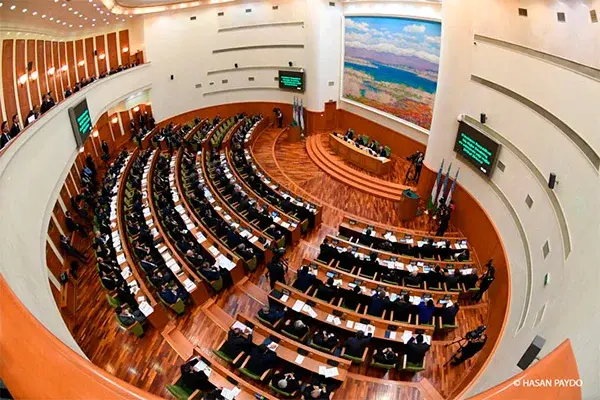
Tashkent, Uzbekistan (UzDaily.uz) — President Shavkat Mirziyoyev chaired a videoconference meeting on creating a new environment in mahallas, or neighborhood communities, and reforming the work of the "mahalla seven" — the team of seven officials assigned to each neighborhood.
The head of state noted that this year districts received an average of 250 billion soums each, and each mahalla 5.5 billion soums, to develop infrastructure and create favorable conditions for residents and businesses.
Expanded powers granted to district governors and mahalla chairs in generating revenue have nearly doubled the additional funds remaining at the disposal of local territories. On average, each district received about 22 billion soums in additional resources, while mahalla budgets grew by 150–200 million soums.
"To put it briefly, today the governor, the mahalla chair and every member of the 'mahalla seven' have both the necessary powers and the resources to solve local problems. What is lacking is responsibility and initiative," the president said.
At the same time, analysis shows that in many mahallas residents' problems are still not resolved in a timely manner. Since the beginning of the year, People's Reception Offices have received more than 200 appeals from each of 87 mahallas.
According to the head of state, this is because mahalla chairs are not developing master plans for their territories, are not converting vacant land and real estate into economic assets, and are unable to clearly formulate tasks for officials at the district, regional and national levels.
In addition, although 7.5 trillion soums was allocated this year under the Initiative Budget program, not a single project won funding in 2,136 mahallas. The president stressed that residents' cohesion, engagement and initiative should be judged precisely by such practical results.
The meeting took a critical look at expanding the number of small projects in mahallas and creating new jobs. Over the past six months, banks have channeled 18.5 trillion soums into financing small projects.
These funds supported 110,000 microprojects that provided employment for 259,000 people. However, only two microprojects each were launched in 47 mahallas.
In a number of districts, the share of low-income families involved in ongoing projects does not reach even 15%. The districts of Karauzyak, Markhamat, Mirishkor, Nurabad and Termez were cited as examples.
The situation in 32 mahallas home to 960 low-income families is of particular concern: not a single person in need there has been placed in permanent employment. In another 883 mahallas, bank employees conducted no door-to-door visits, developed no projects and held no meetings with entrepreneurs.
As a result, 152 officials have been dismissed since the beginning of the year for unsatisfactory organization of work in mahallas, and about 700 more have faced disciplinary action.
Separate attention was paid to tax revenues, crime prevention and the prompt resolution of residents' problems. The president stressed that the mahalla must become a genuine "center of trust, support and opportunity" for people.
A new mechanism for boosting employment and household incomes was presented using the example of the Yangi Kuva mahalla. The neighborhood has 51 unemployed residents, four of whom graduated from an agricultural technical college and have household plots of 10 hundredths of a hectare each.
The mahalla chair is to instruct the bank employee to arrange financing for the construction of light greenhouses on these plots to grow flower seedlings.
For the remaining unemployed residents, the chair must determine who intends to go into business, which families want to raise their incomes, and who needs a loan, equipment or a land plot, and then set specific tasks for the bank employee.
Because Yangi Kuva lacks a kindergarten, 50 children have to attend a preschool in a neighboring mahalla, even though the territory has a vacant plot of 70 hundredths of a hectare. In this connection, mahalla chairs will be given the right to put land plots up for auction for the construction of private kindergartens, schools, clinics and sports facilities.
The president stressed that the mahalla chair should initiate projects aimed at addressing social issues, keeping neighborhoods clean and raising residents' incomes.
Each "mahalla seven" will receive a grant of 10 million soums to implement such initiatives. If a project of this kind is carried out in all 8,992 mahallas across the country, the situation on the ground will change noticeably.
A total financial pool of 240 billion soums will be formed for this purpose.
The head of state said the mahalla chair must become a full-fledged leader of the territory. To that end, the chair will approve the weekly and monthly work plans of the governor's assistant, the women's affairs activist, the youth leader, the social worker, the crime prevention inspector, the tax inspector and the mahalla bank employee. The chair will set specific tasks for each member of the "seven" and regularly monitor their fulfillment.
In addition, a National Institute for Mahalla Development will be established to provide methodological support for the "mahalla seven" and scientific backing for solving local problems. The institute will train members of the "seven" and develop evidence-based solutions to the most pressing issues of mahalla development.
The meeting also announced a fundamental change in how bank employees assigned to mahallas will work.
The president cited successful examples from the regions. In the Yangiobod mahalla of Angor district, a two-kilometer irrigation canal was covered over, and 110 service-sector facilities opened in its place, giving 1,225 residents permanent jobs and stable incomes.
In the Bakhtli mahalla of Arnasay district, a bank employee provided loans of 50 million soums each to the owners of 20 homes, enabling them to open guesthouses. Each guesthouse earns up to 100 million soums in a single season. The success has prompted another 80 families to begin setting up similar accommodation facilities.
Going forward, banks must identify each mahalla's "growth points," find enterprising residents and expand the number of income-generating projects. From now on, one bank employee will be assigned to no more than three mahallas.
Over the next two weeks, 400 new bank employees are to be selected for mahalla work from among enterprising university graduates and young professionals with a modern outlook. For a month they will undergo practical training in model mahallas, studying successful approaches to organizing the work.
An additional 2 trillion soums in soft loan resources has been allocated this year for family entrepreneurship projects. For so-called "difficult" mahallas, the interest rate on loans has been reduced from 17.5% to 12%.
Bank employees assigned to mahallas will now be able to use these funds to finance projects they identify and prepare themselves. The president instructed that the mechanism be put into practice from 1 August.
Key performance indicators will be set for mahalla bankers, covering business development, support for entrepreneurship, job creation and income growth. District and city governors, together with mahalla chairs, must set specific targets for each bank employee by the end of this year.
State-owned banks this year proposed specializing 100 mahallas. Last year, nine state-owned banks took part in establishing Agrostar companies to develop the agro-industrial sector in mahallas.
Banks will now go beyond simply specializing mahallas. Working with Agrostar companies, they must build a complete production chain — from growing produce to processing, storage, packaging and sales.
The president instructed that a corresponding program be prepared within a month and its implementation launched in 1,000 mahallas.
The meeting also presented new initiatives to strengthen the financial independence of mahallas. Initial plans for this year envisaged that mahalla budgets would retain about 600 billion soums.
Under a presidential decree adopted in June, the share of land and property tax revenues remaining at the disposal of mahallas was raised from 10% to 15%. In addition, 10% of fines for violating sanitary regulations and for illegal construction will now also be credited to mahalla budgets.
Mahallas have also been given the right to independently put up for sale vacant buildings of up to 5,000 square meters. This measure is expected to bring mahalla budgets an additional 405 billion soums.
Furthermore, another 5% of land and property tax revenues paid by owners of non-residential real estate will remain directly with mahallas, allowing them to retain roughly 400 billion soums more each year.
At the end of the year, the 200 mahallas with the best results in registering new businesses, creating jobs, generating tax revenues and expanding the tax base will each receive a prize of 2 billion soums.
Overall, thanks to the new initiatives, revenues to mahalla budgets will rise to 1.6 trillion soums this year and reach 2 trillion soums from next year.
The president stressed that effective work must be matched by fitting rewards. New annual awards will therefore be established: "Most Exemplary Apartment" in apartment buildings, "Best-Maintained Household" in the mahalla, and "Best-Maintained Street" and "Most Exemplary Mahalla" at the district and regional levels.
Winners will receive tax benefits: owners of the best apartments will be exempt from property tax, and owners of individual homes from land tax.
It was also noted that members of the "mahalla seven" who achieve the best results and introduce effective practices will be rewarded, with their experience serving as a model for other territories. The president underscored the need for wide coverage of successful initiatives implemented in mahallas.
Work has already begun in the regions to improve territories adjacent to railway lines. Along the Tashkent–Khiva railway alone there are 285 mahallas, and the route passes through 45 districts.
The president instructed the governors of the remaining regions to conduct, within one week, a full inventory of territories along the highways and railways passing through their regions, including nearby residential buildings and commercial facilities.
Within two weeks, they are to develop a comprehensive program to bring these territories to an exemplary state and ensure practical results.
"The mahalla is the level of government closest to the people. Citizens' everyday issues must be resolved right here — quickly and without unnecessary bureaucracy," the president said.
At present, about 100 government services are provided to the population through the "mahalla seven" system. Going forward, all government services will be gradually transferred to the mahalla level.
During a visit to Namangan region, the successful experience of the Yangi Namangan mahalla in Naryn district was studied. An Information and Service Center established there provides 980 government services in one location to residents of eight remote mahallas.
A similar center is being created in the Kakhramon mahalla of Khavast district, based on the Hungarian "smart village" model.
By the end of the year, the experience of Naryn and Khavast districts is to be introduced in the Kungrad, Kanimekh, Baysun, Kamashi, Kushrabad, Tuprokkala, Gijduvan, Farish, Besharyk, Jalakuduk and Akhangaran districts.
In addition, the Smart Mahalla project implemented in the Olimpia mahalla of the city of Urgench will be extended to ten more mahallas in each region of the country.
The meeting also discussed expanding the range of social services provided at the mahalla level. The president criticized cases of citizens being unjustifiably denied inclusion in the social register or unjustifiably removed from it.
As a result, families in need lose access to state social assistance and guaranteed services, including placing children in kindergartens and extracurricular clubs. In 184 mahallas, all 2,000 applications received within a single month were rejected without justification.
Such violations, the meeting noted, are found especially often in the Bustan, Altynkul, Khavast, Tashlak, Sharaf Rashidov, Uchkuduk and Dekhkanabad districts. As a result, the number of appeals to the president over inclusion in the social register has grown 1.5-fold since the beginning of the year, from 30,000 to 46,000.
The Prosecutor General's Office has been instructed to establish strict oversight of how the social register is maintained. Shakhnoza Mirziyoyeva, first deputy director of the National Agency for Social Protection, has been tasked with regularly reporting to the president on the accuracy of the register's data.
The responsible agencies have been tasked with transferring 25 types of social services to the mahalla level by the end of the year, including early detection of disability, home adaptation for people with disabilities and the provision of social housing.
Within three months, day care and home-based care, along with Madad homes for people with dementia and intellectual disabilities, are to be organized in 250 mahallas. An Active Life program for elderly citizens requiring constant care will be introduced in another 75 mahallas. Support centers will also be created for children left without parental care and for victims of violence.
It was noted that the crime prevention system established in mahallas is already producing positive results. Of the 1,162 mahallas with the most difficult crime situations over the past three years, 571 have recorded no crimes at all this year.
This was achieved through the installation of surveillance cameras, the creation of safe streets and lanes, an evidence-based approach to resolving residents' problems, and psychological support for families.
A special methodology based on the experience of model mahallas will be developed together with the scientific organizations responsible for crime prevention. Over the course of a year, prevention inspectors from mahallas in the "red" and "yellow" categories will undergo on-site training in this methodology.
The experience of Namangan region, where prevention inspectors were issued body cameras integrated with tablets, has also shown positive results. This automated the processes of verifying citizens' identities, drawing up administrative reports and submitting case files to court.
As a result, the workload on prevention inspectors decreased, and in some mahallas the number of crimes fell from 10 to five cases.
The president instructed that this experience be fully rolled out in Namangan region by the end of the year and extended to another 448 mahallas with the most difficult crime situations in other regions.
Closing the meeting, the head of state noted that it had addressed important tasks for developing mahallas, improving living conditions and strengthening families.
It was emphasized that such constructive measures are fostering an atmosphere of mutual respect, good neighborliness, cohesion, attentiveness to one another and a healthy social environment in mahallas.
"People's confidence in the future is growing stronger, reforms are gaining new momentum, and social and economic issues are finding simpler and more effective solutions.
Peace and harmony prevail in families and homes. Young people are being raised in a spirit of devotion to the homeland and respect for national values.
Most importantly, no one will be left without attention," the president said.
The meeting concluded with reports from responsible officials.