Uzbekistan Cargo Turnover Rises 43% in First Half of 2026

Uzbekistan Cargo Turnover Rises 43% in First Half of 2026
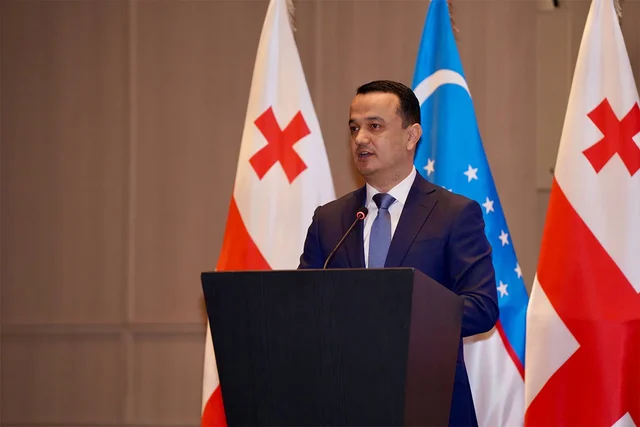
Tashkent, Uzbekistan (UzDaily.uz) — The total cargo turnover of Uzbekistan grew by 43% during the first half of 2026, while transit cargo transport increased by 35%. The Minister of Transport, Ilhom Mahkamov, and the Chairman of the Customs Committee, Akmalhuja Mavlonov, announced the figures during an interview with the Uzbekistan 24 television channel.
According to Mahkamov, Uzbekistan's transit potential is expanding daily, which is directly linked to the high growth rates of the national economy and a corresponding increase in export-import operations. The minister emphasized that the president has designated the development of international cargo transport as a priority area for the Ministry of Transport. The head of state was presented with the implementation results of previously adopted decrees and resolutions, along with proposals for additional measures to support the industry.
A key factor driving cargo turnover growth will be the construction of the China–Kyrgyzstan–Uzbekistan railway. Mahkamov noted that a task has been set to determine the necessary additional infrastructure facilities, specifically identifying sections of railways and highways that require expansion to accelerate Uzbekistan's transformation into a fully-fledged transit hub. The president directed the development of a unified program for this purpose.
Among other major projects involving Uzbekistan, the minister highlighted the development of the Trans-Afghan multimodal corridor and the country's participation in the Middle Corridor. He noted that while implementing these initiatives, the country must ensure not only international transit but also the internal distribution of cargo with its timely exit beyond national borders, a process directly connected to logistics infrastructure development.
Mahkamov stated that 27 logistics centers currently operate in the country, 24 of which are included in the UN ESCAP registry. However, because not all of them meet modern standards, a draft resolution has been developed to provide additional support for building new Class A international logistics centers. The president has approved the document for signing, which the minister noted will create additional incentives for entrepreneurs working with logistics hubs.
The head of the Customs Committee, Akmalhuja Mavlonov, highlighted a sharp rise in the workload at border customs posts driven by the expansion of external trade. Over the past three years, the flow of cargo trucks across the border increased by 70%, averaging more than 5,000 vehicles per day. Five existing customs logistics centers are no longer able to handle the entire volume of transport, while nine additional centers are currently under construction.
The president issued directives to urgently complete the construction of all nine logistics centers, fully reconstruct border checkpoints, and establish proper infrastructure for truck drivers, including dining facilities and overnight accommodations. To increase throughput capacity, instructions were given to implement a "single window" principle by establishing joint border posts instead of separate checkpoints maintained by two neighboring states.
Mavlonov stated that while 5,100 cargo trucks currently pass through the borders daily, this figure will exceed 10,000 once the upgrades are completed, generating jobs and expanding the economic potential of Uzbekistan.
According to the presidential press service, Uzbekistan contains 4,000 kilometers of international transit corridors and a railway network spanning 4,700 kilometers. Logistics centers and dry ports are being developed in Tashkent, Navoi, and Namangan, with Navoi Airport functioning as a cargo hub on Eurasian routes. The construction of the China–Kyrgyzstan–Uzbekistan railway is expected to reduce cargo delivery times to eight days and open access to the Indian Ocean via the ports of Karachi and Gwadar, as well as to South Asian markets with a population of approximately 2 billion people.
At the same time, Uzbekistan's transit potential is not yet fully utilized, as the country's share in the cargo turnover between China and Europe does not exceed 1% to 2%. Attracting an additional 15 million to 20 million tonnes of international cargo per year is estimated to be capable of generating US$400 million to US$600 million in revenue, attracting US$3 billion in investments, and creating 50,000 jobs. The main limiting factors cited include the restricted capacity of border checkpoints, a shortage of Class A warehouses, refrigerated spaces, and customs capacities, along with low levels of containerization and digitalization across the industry.