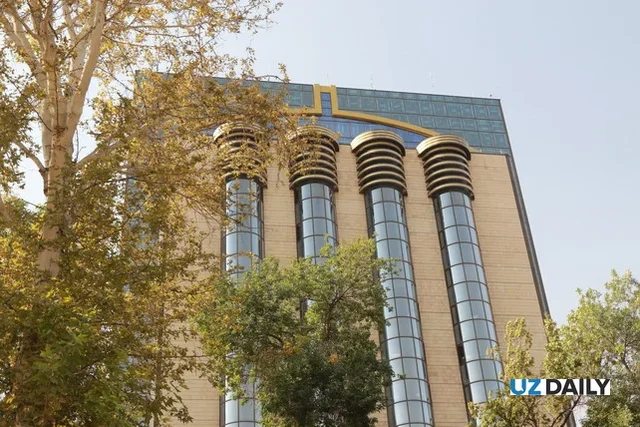
Fitch upgrades Ipoteka Bank outlook to positive

Tashkent, Uzbekistan (UzDaily.uz) — International rating agency Fitch Ratings has revised the outlook on Ipoteka Bank’s Long-Term Issuer Default Ratings (IDRs) from Stable to Positive, while affirming the bank’s foreign- and local-currency ratings at BB.
Fitch also affirmed Ipoteka Bank’s Shareholder Support Rating at bb and upgraded its Viability Rating from b to b+.
The outlook revision follows a similar recent revision to the outlook on Uzbekistan’s sovereign rating.
Fitch attributed the upgrade of the bank’s Viability Rating to an improved operating environment for Uzbek banks, progress by Ipoteka Bank in addressing asset-quality problems, a recovery in sustainable profitability and a significant strengthening of capitalisation.
Fitch expects the positive trend to continue in the near term.
Ipoteka Bank’s ratings also take into account potential support from its parent company, OTP Bank Plc. In assessing OTP’s ability and willingness to provide support, Fitch considered its controlling stake, the bank’s inclusion in the OTP resolution group, potential reputational risks for the parent company in the event of a subsidiary default and the relatively low cost of providing the necessary support.
At the same time, Ipoteka Bank’s Shareholder Support Rating and Long-Term Foreign-Currency IDR are capped by Uzbekistan’s country ceiling at BB. Fitch links this to potential transfer and convertibility restrictions that could prevent support from the parent bank from being used to service foreign-currency obligations.
Fitch revised its assessment of the operating environment for Uzbek banks from b/Positive to b+/Stable. The agency noted progress in banking-sector reforms over the past two years, particularly stronger regulation and work to address legacy risks.
Another factor is Uzbekistan’s economic growth. In the first half of 2026, the country’s GDP increased by 8.5% year on year. Fitch expects improved operating conditions for the banking sector, combined with strong economic growth, to support further business expansion, profitability and banks’ ability to build capital independently.
Ipoteka Bank is Uzbekistan’s seventh-largest bank. At the end of the first half of 2026, it accounted for about 6% of the banking sector’s assets. The bank holds a leading position in the mortgage lending market, with a 21% share. More than 80% of its gross loan portfolio consists of retail loans.
OTP Bank owns 73% of Ipoteka Bank’s shares. Fitch said OTP’s involvement had contributed to improvements in corporate governance and the implementation of the bank’s strategy. Another factor was the acquisition by the International Finance Corporation (IFC) of a 9% stake in Ipoteka Bank through the conversion of a credit line.
The bank’s loan growth was moderate in 2025, at 6%, amid debt write-offs and repayments of corporate loans. Fitch forecasts that loan portfolio growth will accelerate to 15% in 2026, driven primarily by retail lending.
At the same time, foreign-currency risks continue to decline. The share of foreign-currency loans fell to 14% at the end of the first half of 2026, compared with the banking-sector average of 39%.
Ipoteka Bank has also adapted its risk-management system to OTP’s approaches, which Fitch said had improved the quality of new loans. However, the agency noted that the new borrower-assessment standards had not yet been tested through a full credit cycle.
Asset quality remains one of the bank’s weaknesses, although indicators are improving. The share of Stage 3 impaired loans under IFRS 9 fell to 19.7% at the end of 2025 from 23% at the end of the first half of 2024.
Fitch expects the ratio to continue declining and fall below 13% by the end of 2026. This will be driven by further resolution of legacy problem assets and a resumption of loan growth.
The share of Stage 2 loans also declined to 8.4% at the end of 2025 from 17.8% a year earlier. Fitch views this as evidence of limited risk of new problem-loan formation.
In 2025, the bank’s reserves covered 0.8 times the volume of impaired loans. Fitch considers this level acceptable, taking into account collateral backing some of the problem loans.
The agency expects Ipoteka Bank to maintain high profitability. According to its forecast, the ratio of operating profit to risk-weighted assets will exceed 6% in 2026, compared with 5.8% in 2025.
Results will be supported by wider margins, improved operating efficiency as the business grows and recoveries of previously written-off loans. Fitch considers the decline in net interest margin from 9% in 2024 to 7.6% in 2025 temporary and attributes it to higher funding costs.
In 2026, Fitch’s base-case forecast sees net interest margin recovering to 8% as deposit rates decline. The cost-to-income ratio is expected to be around 45%, compared with 48% in 2025.
The bank’s capitalisation has also strengthened significantly. Fitch Core Capital increased from 12% at the end of 2024 to 18.5% at the end of 2025. This was driven by the bank’s strong ability to generate capital, the absence of dividend payments and a lower risk-weighted asset density following the resolution of problem loans.
Fitch forecasts a further increase in the ratio to about 22% by the end of 2026. Key factors will include high profitability, the reinvestment of earnings and the recent acquisition by IFC of shares from a new issuance.
The Common Equity Tier 1 (CET1) capital adequacy ratio stood at 17.6% at the end of the first half of 2026, compared with 17.3% at the end of 2025. This was significantly above the minimum requirement of 9.5%, providing the bank with a substantial buffer to absorb potential losses.
At the same time, Ipoteka Bank remains dependent on non-deposit funding. At the end of 2025, its loans-to-deposits ratio stood at 229%, and Fitch expects it to decline in 2026, although it will remain above 200%.
State funding remains the bank’s main source of funds. At the end of the first half of 2026, government-related long-term funding accounted for 39% of Ipoteka Bank’s liabilities. Another 21% came from market borrowings, while 35% consisted of non-government deposits.
Fitch assesses the bank’s liquidity as adequate. At the end of the first half of 2026, liquid assets covered half of non-government funding. In addition, Ipoteka Bank has access to liquidity support mechanisms from OTP.
An upgrade of the bank’s ratings could follow an increase in Uzbekistan’s country ceiling, provided OTP’s ability and willingness to support Ipoteka Bank remain unchanged or improve.
An upgrade of the Viability Rating would require further improvement in the operating environment, continued reduction of legacy problem assets, sustained high profitability and stable capitalisation.
At the same time, the rating could be downgraded if Uzbekistan’s country ceiling is lowered or if OTP’s ability or willingness to support its subsidiary weakens significantly. The Viability Rating could also deteriorate if profitability or asset quality declines significantly.
Fitch also identifies a decline in FCC below 10% as a potential risk, resulting from excessively rapid loan growth or an aggressive dividend policy, although this scenario is not part of the agency’s base-case forecast.
Ipoteka Bank’s Short-Term Foreign- and Local-Currency IDRs were affirmed at B. The rating of the bank’s senior unsecured debt was.