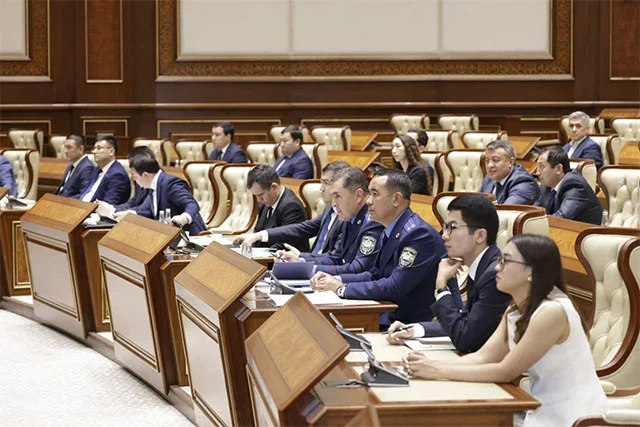
Tashkent, Uzbekistan (UzDaily.uz) — The XIX Session of the European-Asian Legal Congress has opened in Yekaterinburg under the theme “The Synthesis of Law and Technology: Towards Technological Leadership,” providing an international platform for presenting Uzbekistan’s experience in the legal regulation of technology and digital transformation.
Akmal Saidov, Director of the National Human Rights Centre of the Republic of Uzbekistan and an academician, delivered a presentation outlining the country’s ongoing reforms aimed at improving the legal and regulatory framework in the context of the digitalization of the economy and public administration.
The two-day forum is organized by the Russian Lawyers Association and the V.F. Yakovlev Ural State Law University. Held annually since 2007, the congress is regarded as one of the largest legal forums in the Eurasian region. It brings together more than 1,500 participants from over 20 countries, including academics, legal practitioners, government officials, business representatives, and international organizations.
The participation of the Uzbek delegation reflects growing international interest in the country’s experience in providing legal support for technological development and highlights the strengthening of international cooperation within Eurasian integration processes, including cooperation through the Shanghai Cooperation Organisation (SCO) and BRICS+ platforms.
The 19th session includes 41 events, ranging from plenary meetings and panel discussions to roundtables, the Alexeyev Readings, meetings of specialized expert councils, and a youth legal forum.
A central element of the business program is the strategic “Techno-Regulation” project, which focuses on the legal support of technological development. Participants are discussing the role of legislation in achieving technological leadership, the integration of artificial intelligence, big data technologies, and information and communication solutions into legal practice and education, as well as the application of modern social technologies in the legal sphere.
Experts noted that the rapid development of digital technologies requires flexible and effective legal mechanisms capable of balancing innovation, human rights protection, and state interests.
In this context, the exchange of national experiences is becoming increasingly important and contributes to the development of modern approaches to regulating technological processes.
Following the congress, a special edition of the international peer-reviewed journal European and Asian Law Review is expected to be published, featuring the key conclusions and recommendations of forum participants.
Uzbekistan Showcases Legal Tech Experience at Eurasian Congress


Askar Yakubov
Askar Yakubov is a professional photojournalist with extensive experience in news and reportage photography. He specializes in fast-paced coverage of social, political, cultural, international, business, and community events, with a sharp eye for capturing expressive shots and conveying the atmosphere of an event under tight time constraints. His skill set spans reportage, portrait, and documentary photography, along with image editing and color correction, and preparing photo materials for media and digital platforms. He is known for his professionalism, adherence to editorial standards, and ability to work both independently and as part of a shooting team.