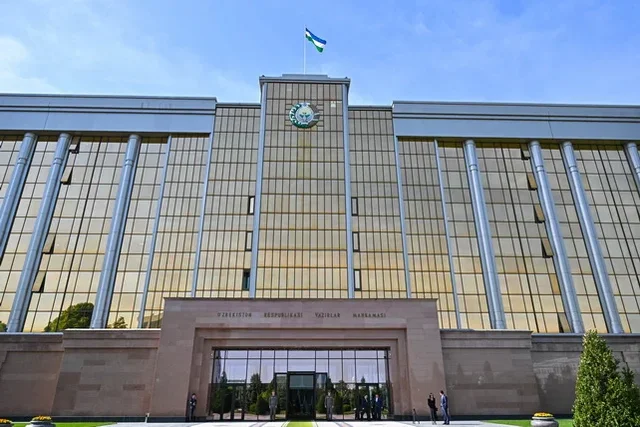
Tashkent, Uzbekistan (UzDaily.uz) — The Agency for Industrial Cooperation and Public Procurement held another open meeting with local producers and business representatives on 14 August 2026.
The event took place in Tashkent and focused on expanding the participation of domestic producers in public procurement, developing industrial cooperation, and identifying systemic problems faced by entrepreneurs.
During the open dialogue, participants discussed specific business proposals and possible practical mechanisms for addressing them.
About 200 entrepreneurs and local producers took part in the event, including 70 participants in Tashkent in person and more than 120 regional representatives who joined online.
The meeting was also attended by agency leadership, operators of electronic public procurement systems, representatives of international organizations and the expert community, oversight bodies, and ministries and agencies.
Participants reviewed ongoing reforms in public procurement and industrial cooperation, opportunities created for domestic producers, ways to expand their participation in public procurement, the use of electronic trading platforms, and practical problems faced by businesses.
Open dialogue with entrepreneurs becomes a systemic mechanism
The latest meeting continued the agency's work on organizing systemic dialogue with the business community.
To date, open meetings with entrepreneurs have been held in all regions of the republic, covering 208 districts and cities. A total of 2,710 entrepreneurs have taken part.
In addition, specialized open dialogues were organized in agriculture and food processing, light industry, and pharmaceuticals to examine business problems and proposals in these sectors in more detail.
These events involved 450 entrepreneurs, who raised 30 issues, of which 20 were resolved on the spot.
The open meetings made it possible to systematically study the problems, proposals and initiatives of entrepreneurs across regions and industries as part of preparations for the Sixth Open Dialogue of the President of the Republic of Uzbekistan with Entrepreneurs.
During the regional meetings, 447 problems and proposals were raised. Of these, 155 issues were resolved on the spot, 75 received legal and practical clarifications for entrepreneurs, and appropriate measures with follow-up monitoring were determined for the remaining 214.
Most of the appeals concerned placing products on electronic platforms and their moderation, certification and licensing requirements, specific requirements set by government customers, delayed payments under contractual obligations, promotion of domestic products in the public procurement system, and use of electronic procurement systems.
New opportunities for domestic producers
Under Presidential Decree No. UP-17 of 4 February 2026, a new system was introduced to support local production, expand industrial cooperation and make effective use of domestic demand to develop domestic industry.
Under this system, additional opportunities and preferences have been created for local producers to actively participate in public procurement.
In particular, when local producers compete alongside foreign suppliers in public procurement by budget-funded customers, a price preference mechanism of 8 to 15 percent is provided, depending on the number of local producers involved.
Producers with high and medium sustainability ratings receive a 50 percent discount on the intermediary fee for participating in procurement, as well as the option to forgo additional collateral.
In addition, budget-funded customers and local producers can hold tenders in the form of a "local auction."
For supplies with a localization level of 30 percent or higher, advance payments proportional to the localization level are permitted.
At the meeting, entrepreneurs also received explanations on how to make effective use of these opportunities, expand demand for domestic products, establish cooperation ties with government customers, and increase the participation of local producers in public procurement.
Public procurement: competition and business participation
In the first half of 2026, the volume of public procurement in Uzbekistan totaled 188.4 trillion soums. Competitive procurement accounted for about 113 trillion soums, with 7.8 trillion soums saved as a result of procurement procedures.
At the same time, the figures point to significant potential for further engaging entrepreneurs in public procurement.
More than 646,000 business entities currently operate in the country. Of these, about 344,000 are registered in electronic public procurement systems. However, only about 126,000 entrepreneurs actually participate in public procurement, and around 36,000 business entities sign contracts as a result of procurement procedures.
In this regard, particular attention during the open dialogue was paid to expanding the participation of small and medium-sized businesses, local producers, and women entrepreneurs in public procurement.
Participants discussed improving entrepreneurs' skills in working with electronic platforms, expanding their participation in competitive procurement, and making more effective use of existing mechanisms to bring domestic products to the public procurement market.
From problems to systemic solutions
Following the open dialogue, agreement was reached on joint work to address entrepreneurs' problems and proposals, with the participation of responsible organizations, and to define specific timelines and subsequent practical steps.
The agency will systematize the appeals received from entrepreneurs in the regions, by sector, and directly during today's meeting, by relevant area.
Systemic measures aimed at removing existing barriers and further expanding opportunities for business will be developed jointly with interested ministries and agencies to address the issues identified.
Proposals whose implementation requires improvements to current legislation will be subject to separate analysis. Corresponding proposals will be prepared for these in due course.
The open dialogue with local producers served as another platform for direct interaction between the government and business, allowing not only the identification of existing problems but alsoing but also the identification of specific mechanisms for their that but also the identification of specific practical mechanisms for their resolution.