Tashkent Aims to Attract $9 Billion in Investments in 2026

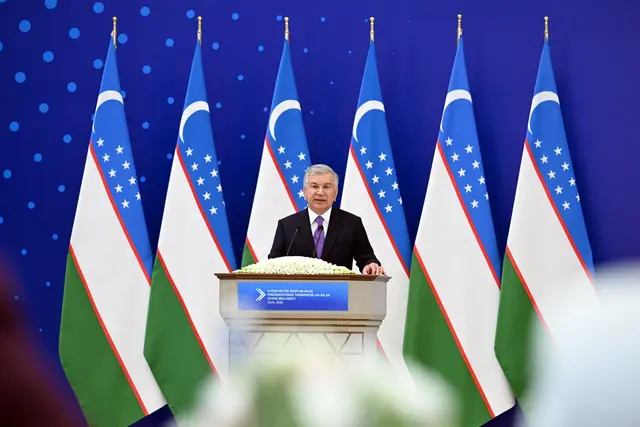
Tashkent, Uzbekistan (UzDaily.uz) — Tashkent expects to attract $9 billion in investments and expand its export volume to $4 billion by the end of 2026, Tashkent Mayor (Khokim) Shavkat Umurzakov announced during a ceremony launching new urban projects alongside President Shavkat Mirziyoyev. During the first eight months of 2026, the capital city had already secured $5.6 billion in investments.
By comparison, Tashkent attracted $2.7 billion in investments in 2024. Umurzakov attributed the accelerated growth targets to high-technology projects and the development of high-value-added manufacturing facilities. President Mirziyoyev highlighted the scale of the capital's investment strategy, stating that Tashkent should serve as a model for regional development across Uzbekistan.
A central initiative in the capital's expansion strategy is a multimodal logistics complex developed in partnership with Dubai-based DP World. Leadership from the Emirati company invited President Mirziyoyev to attend the groundbreaking ceremony scheduled for October. The terminal is designed to handle up to 120 million tons of cargo and 150,000 containers.
Fourteen upcoming projects were highlighted during the ceremony, including four industrial enterprises and two tourism facilities. Upon reaching full capacity in approximately three years, these facilities are projected to produce $3 billion worth of goods annually while contributing $1.5 billion to export volumes.
Progress was also reported on the special industrial zone opened by the president in November 2024. Municipal authorities plan to launch 22 additional projects valued at $500 million within the zone by the end of 2026. Overall, the zone's project portfolio has reached $1.2 billion across 26 initiatives, ten of which are scheduled for operational launch before the end of the year.
The DP World project involves constructing a multimodal logistics hub valued at over $288 million through a joint venture, DP World Tashkent, formed between DP World (85%) and municipal entity Tashkent Invest (15%). The complex spans 82 hectares within the Yangi Avlod Special Industrial Zone, managed by China's CAMCE. The planned infrastructure features a rail-connected dry port, bonded customs facilities, Grade-A warehousing, vehicle storage areas, and transshipment terminals.
Phase One of the logistics hub focuses on a rail terminal with a annual capacity of 150,000 TEUs and 63,000 square meters of warehouse space. The hub aims to strengthen trade links between Central Asia, the Middle East, and Europe by integrating directly into Uzbekistan's railway system, main highway networks, and Tashkent International Airport.
Umurzakov also noted that global management firm Boston Consulting Group (BCG) ranked Tashkent among the world's top three fastest-changing cities—alongside Shenzhen and Riyadh—attributing the recognition to ongoing structural reforms and economic modernization.