Mirziyoyev Holds Business Dialogue in Khorezm
GalleryMirziyoyev Holds Business Dialogue in Khorezm
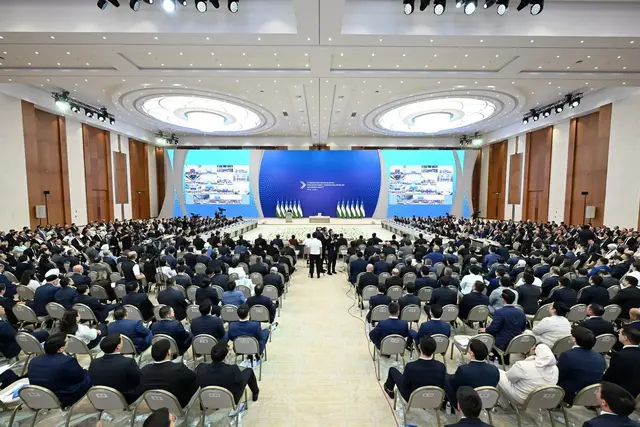
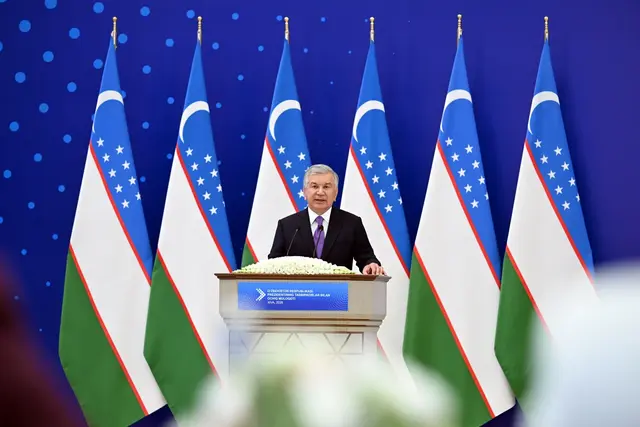
Tashkent, Uzbekistan (UzDaily.uz) — President Shavkat Mirziyoyev held an open dialogue with entrepreneurs in the Khorezm region, an event that for the first time drew roughly 25,000 business owners taking part from district-level studios. The president congratulated the country's business community — now numbering 1.2 million entrepreneurs — on Entrepreneurs' Day, marking the fifth anniversary of the open-dialogue tradition, during which 84 laws and 861 decrees and resolutions have been adopted to remove obstacles to business development.
"Why? To create conditions for our entrepreneurs, increase the number of new jobs and give our people the opportunity to earn an income without moving far from home, right in their own mahalla," Mirziyoyev said.
Over the past five years, the credit portfolio allocated to business has nearly tripled to reach 450 trillion soums, while entrepreneurs have benefited from tax and customs incentives worth 650 trillion soums. Business representatives have independently attracted US$1 billion from foreign banks to finance their projects, which the president called another milestone reached by Uzbek entrepreneurs. "Today our entrepreneurs are moving from the 'starting a business' stage to the 'capital accumulation' stage," he said.
Enterprise investment in fixed capital has tripled over five years to 363 trillion soums. The number of districts where industrial output exceeds US$100 million has grown from 66 to 116, while the number of districts where services rendered exceed 1 trillion soums has risen from 41 to 152, driven by rapid growth in information technology, fintech and other service sectors; 3,500 enterprises now work with leading international marketplaces. More than 550 entrepreneurs who started businesses in their mahalla have since opened dozens of branches nationwide, and more than 300 entrepreneurs have created their own national brands.
Supplies of copper, gold, rolled metal, polyethylene, PVC, kaolin and other raw materials have been increased in recent years, driving a major leap in industries including electrical engineering, construction materials, pharmaceuticals, textiles and furniture manufacturing. New sectors have emerged, including electric vehicle production, polymers and household chemicals, green energy and jewelry manufacturing, with modern car plants such as BYD, ADM Jizzakh and Sirdaryo Asaka Motors bringing new expertise and technology to the industry.
Mirziyoyev noted that entirely new opportunities for entrepreneurship have also been created in Khorezm in recent years. The region has attracted US$4 billion in foreign investment and launched 10,000 new production facilities in a short period. The Khazarasp special economic zone and 31 industrial zones have been established, and power plants with a combined capacity of 275 megawatts have been built in Toproqqala and Yangiarik to provide enterprises with stable energy supply. Small business now accounts for 72% of Khorezm's economy, and its share of exports has reached 81%, putting the region first in the country. The number of weekly flights has grown from 16 to 102, and the number of weekly rail services from 8 to 41.
The Tashkent–Khiva high-speed train has been launched, and a new 35-kilometer Urgench–Khiva highway is being brought into operation. A 25-hectare "Arda Khiva" tourism complex has been built, and entrepreneurs have organized 331 hotels and guesthouses with a combined capacity of 7,000 beds; Khorezm is expected to receive 3 million foreign tourists this year. A "Desert Star" tourism complex, including hotel, retail and entertainment facilities, will also be built in Khiva. "In a word, Khorezm is today becoming a center of new opportunities for entrepreneurs," the president said.
Despite the difficult global situation, Uzbekistan's economy grew 8.5% in the first half of the year, and international rating agencies Fitch and Moody's each raised the country's sovereign credit rating by one notch. Uzbekistan ranked 31st in the World Bank's report on investment and business climate, results the president attributed primarily to reforms carried out jointly with entrepreneurs.
This year, institutional reforms have been carried out in cooperation, public procurement, standardization, food security and urbanization. Under the "National Industrial Chain" project, private enterprises have received orders worth 4 trillion soums from major state companies. Strategic enterprises have published a list of more than 650 new types of products for localized production, creating an additional market worth US$1 billion for entrepreneurs. The threshold for switching to value-added tax payment has been raised from 1 billion to 5 billion soums. Cafes and restaurants have received 100 billion soums in VAT cashback, and farmers have retained 400 billion soums thanks to the introduction of a zero VAT rate on agricultural products. Kazakhstan has lifted restrictions on imports of 11 types of construction materials, a mutual duty-free trade regime has been launched with Turkmenistan, and preferential trade agreements covering hundreds of product types have been signed with Jordan, Pakistan, Iran and Afghanistan.
Major projects set to give a significant boost to economic growth are also under way, including a nuclear power plant in the Jizzakh region, a fourth copper-processing plant in Almalyk, and modern highways linking Tashkent to Samarkand and Tashkent to Andijan. Khorezm is building a complex to produce eco-friendly aviation fuel, the Surkhandarya region a modern 940-hectare greenhouse complex, and the Yukorichirchik district the "New Tashkent" airport. This year will see the launch of 105 new industrial and infrastructure projects worth a combined US$27 billion. New residential districts designed to accommodate 3 million people in total are being built across all regions of the country, and local entrepreneurs wishing to participate in such projects with their own goods and services will be given equal conditions with foreign investors.
In transport logistics, customs duties and recycling fees on imported trucks have been abolished, and the VAT rate on providing railcars for international transport will be cut to zero. Next year a logistics center with a capacity of 500,000 tons will open at the Georgian port of Poti, and practical work will begin on the Anaklia port project; major transport and logistics centers will be created in Alat, Termez, Yangiyul, Akhangaran and Khanabad. Next year will also see the launch of the Tashkent International Financial Center and the "Enterprise Uzbekistan" international digital technology center, which are expected to open opportunities to attract US$20–25 billion in capital along with new knowledge and technology.
The president announced a series of new initiatives developed in response to issues raised by entrepreneurs, organized around five priority areas.
The first is ensuring a sustainable growth trajectory for entrepreneurship. Small business's share of banks' credit portfolios has grown from 45% to 63%, and 76.5 trillion soums in resources were allocated to small and medium-sized businesses in the first half of this year alone. A "unified digital credit services portal" was recently launched, under which an entrepreneur submits a single application and banks compete for the client; starting entrepreneurs will be able to obtain online loans of up to 5 billion soums. A comprehensive ecosystem will now be built to match each stage of business development: a "Business Start" program for beginning entrepreneurs, "Business Lift" for those who have launched production, and "Business Ascent" for entrepreneurs moving to a new growth stage. Under "Business Start," entrepreneurs will be able to use artificial intelligence to learn project development, credit documentation preparation and reporting; 100 billion soums will be allocated for this purpose, and entrepreneurs will be provided with ready-made business plans and unsecured loans of up to 200 million soums. "We will create not a system that simply issues a loan to an entrepreneur, but a comprehensive system that will accompany them from the first step to becoming a major business," Mirziyoyev said.
To address collateral, one of the most pressing issues for small business, a "counter-guarantee" system will be introduced allowing loans to be issued based on an assessment of a business's real value. For loans of up to 10 billion soums, the state will assume 30% of the collateral, the Entrepreneurship Guarantee Company another 30%, and banks 15%, leaving the entrepreneur to provide collateral for the remaining 25%. A "Virtual Tax Consultant" artificial-intelligence portal has been launched to help entrepreneurs cut costs and reduce errors, and similar AI-based assistants will be introduced next year in construction, labor relations, foreign trade and public services.
The second area is expanding "business opportunities" in the regions. The president stressed that thousands of hectares of vacant land and underused state assets create real value only when converted into projects that generate jobs and boost exports. When purchasing state assets, the down payment will be reduced from 30% to 15%, with a 25% discount for those who pay in full within six months; an entrepreneur who pays half the price can pay the remainder in interest-free installments over seven years. If state property is not sold within three months, its starting price will be reduced in stages by up to 10%, and the duration of the auction process will be halved. Entrepreneurs buying land at auction will no longer need to spend six months to a year gathering documents before starting construction, as local authorities (khokimiyats) will now put land plots up for auction as a "ready-made package" including a construction permit, an architectural and planning assignment, and a design; the buyer will be able to begin construction immediately. The advance payment on infrastructure fees will be reduced from 20% to 5%. Sales of 2,500 real estate properties with a combined book value of 9 trillion soums currently on banks' balance sheets will be allowed at preferential prices, with no down payment and interest-free installments, and buyers of such properties will be exempt from land and property tax for one year.
A list of 50 priority goods has been drawn up for localized production, and "bonded industrial zones" will be created within the Navoi, Jizzakh, Namangan, Urgut and Khazarasp special economic zones to develop them. Imports of raw materials and components into these zones will be exempt from all tax and customs payments, and preferential terms will also apply once localization levels exceed 30–40% for products sold domestically. Modern R&D centers, laboratories and engineering and technological services will operate as a single chain within the bonded industrial zones, and US$50 million will be allocated to provide entrepreneurs with ready-made buildings equipped with the necessary infrastructure. In response to complaints that 100% advance payment for electricity and gas strains working capital, enterprises connected to the ASKUE and ASKUG metering systems and with no record of payment violations will now face an advance payment of just 15%. "Overall, we are fundamentally changing the energy management system. A new system focused on entrepreneurs' current needs and future plans will be introduced in all districts," Mirziyoyev said.
Starting next year, a new approach will be introduced in construction to encourage contractors and designers: regardless of where construction takes place, an amount equal to 5% of the minimum wage will be allocated per person-hour worked. State construction estimates will provide contracting organizations with a 7% profit margin, and design work will be allocated 4% to 7% of a facility's cost depending on construction complexity.
The third area the president identified is building an "artificial intelligence — management efficiency — new investment" ecosystem. "Today's market of tomorrow belongs to the entrepreneur who increases added value, boosts productivity with artificial intelligence and works to reduce costs," Mirziyoyev said. According to an analysis cited, demand rose sharply for 54% of entrepreneurs who adopted modern management approaches and AI-based solutions, costs fell for 25%, and wages rose more than 10% for 40% thanks to increased revenue. The Digital Government project management center has launched its first supercomputer cluster, whose capacity will be tripled next year. A "AI Partner for 10,000 Enterprises" program will be launched, under which the state will cover 50% of enterprises' costs for adopting artificial intelligence; businesses developing an AI model for a new product will be able to use the supercomputer free of charge, and research costs will also be covered from the budget. Ready-made AI-based solutions for entrepreneurs will be placed on an open platform, with at least US$100 million allocated to the program's first phase. The approach used in the textile industry will be extended to electrical engineering, construction materials and the food industry, where the state will cover 50% of the cost of adopting automated management systems.
This year, for the first time, a 30% stake in the National Investment Fund, which holds assets in 13 strategic companies, was listed on the Tashkent and London stock exchanges, opening a path to external capital markets for the private sector. An acceleration program will now be launched together with leading investment banks to bring local enterprises to capital markets, selecting 50 enterprises with annual revenue above 1 trillion soums each year; half the cost of preparing these enterprises for IPOs and bringing their reporting in line with international standards will be covered, enabling private enterprises to raise at least US$1 billion a year from abroad. Mirziyoyev noted that high-tech investment projects worth US$50 billion are implemented annually and stressed that workforce training must be a mandatory component of each one. In Urgench, drawing on the experience of Germany and China, a career-guidance system for schoolchildren has been introduced across 10 fields, including green energy, construction, nursing, agronomy and electrical engineering, an approach that will be extended nationwide. Spending by entrepreneurs who establish technical colleges or take over management of state technical colleges to train personnel to international standards will be deductible from taxable income. The system aims to train 1 million young people in modern professions and secure them high-paying jobs.
The fourth area is boosting export potential and bringing national brands to foreign markets. According to research cited, 40% of exporters struggle to find foreign clients, 36% struggle to meet standards and certification requirements, 37% lack sufficient financial tools, and 33% lack marketing, market and brand-development skills. An "export navigator" system will be introduced to provide comprehensive services at every stage of entering foreign markets, and a list of 100 high-demand export goods will be compiled, with tailored solutions developed for each product based on foreign competitors, tariff systems and logistics. The production processes of 2,000 enterprises will be adapted to the requirements of foreign markets and specific buyer segments. Entrepreneurs will have half the cost of hiring foreign brand-development specialists covered, up to US$500,000, and subsidies of up to US$50,000 will be provided to promote national brands abroad and bring them into line with international requirements. Half the cost of warehousing and marketplace sales will be covered, along with 80% of consulting costs for participation in international tenders, and at least US$1 billion will be directed to a unified export-support system. "The fight for markets in the world is becoming fiercer by the day. In these conditions, an entrepreneur entering a foreign market must never feel alone," Mirziyoyev said, instructing ambassadors to prioritize supporting entrepreneurs and guiding them toward new opportunities and markets. An "export ambassadors" initiative — chosen by the entrepreneurs who export the most to each market — will be launched in 20 countries accounting for 60% of exports plus five additional high-potential countries, with travel and accommodation costs covered; the export ambassadors will assist other entrepreneurs with retail networks, certification and marketing. New relief measures will also address overdue export debt: foreign currency deposited to settle such debt by year-end will count as export revenue, export restrictions will be lifted even without payment for goods, the requirement for 50% advance payment on invoices will be abolished, and the deadline for securing foreign-currency earnings through trading houses and distributors will be extended from 180 to 365 days.
The fifth area is a sharp reduction in administrative pressure on business. Over the past three years the tax burden has fallen from 13.4% to 12%, and over the past decade the shadow economy's share has fallen from 50% to 26%. "Bringing the economy out of the shadows should happen not through inspections, but through helping entrepreneurs and teaching them to run their businesses properly," Mirziyoyev said. Of 5,000 entrepreneurs analyzed, more than half faced tax inspections two to three times a year, and another 21% faced four or more, compounded by repeat inspections from fire, construction, sanitary, quarantine and energy authorities. "One thing must be understood: where there is no calm, there will be neither freedom, nor development, nor a drive toward innovation," the president said.
A three-year moratorium will be declared on inspections of small businesses unless they involve a threat to health or violate other entrepreneurs' interests. If a medium or large business voluntarily conducts a preventive audit of its operations, the results will be recognized by tax authorities, and an entrepreneur who fixes identified deficiencies will not be fined; a repeat inspection within a year will require permission from the Business Ombudsman. Currently 51 agencies have authority to impose financial fines, and the president criticized the practice at some agencies of retaining a portion of fine revenue, which creates a flawed incentive of "inspect to scare, scare to collect." "A fine should serve not to raise funds, but to maintain order and prevent violations in the relevant sector," he said. Fine amounts across the board will be cut roughly in half. The return of deposits to entrepreneurs on goods purchased by state enterprises will be automated. Starting next year, a "presumption of the entrepreneur's innocence" will apply in disputes between entrepreneurs and the state: until guilt is proven in court, an entrepreneur will be considered innocent and will not face fines or other measures. A "warning for a first violation" rule will also be introduced, giving an entrepreneur who violates a requirement for the first time — without causing harm to life, health or property — 10 days to correct it. Regulatory bodies will pay the state fee at each court instance after the court of first instance, and the Chamber of Commerce and Industry's expert council will be given the right to review disputes in customs, construction, sanitary control, quarantine and veterinary matters as well.
Uzbekistan has received 8 million foreign tourists since the start of the year, with their average stay rising to eight days, and the president said tourism reforms should be reflected more strongly in household incomes. US$50 million will be allocated for hotel construction, reconstruction and equipping, with entrepreneurs offered loans in local currency at 16% annually over 10 years. The deadline for subsidies on building three-, four- and five-star hotels will be extended by two years, and the requirement for a foreign company's certification to confirm a hotel's category when applying for a subsidy will be abolished. The tax break under which hotels pay land and property tax at a rate ten times lower than standard will be extended to 2030, and hotels with more than 50 rooms will have banks independently install ATMs that accept foreign cash currency. Services provided by tour operators to foreign tourists will be treated as exports and exempted from value-added tax. Customs relief on imports of tourist buses, electric buses and minibuses will be extended for another year, and the recycling fee on such vehicles will also be waived.
Closing the dialogue, Mirziyoyev set out the country's main goals for the economy's next stage of development. "We are a nation of 40 million people. To keep raising living standards, we must maintain high rates of economic growth," he said. This year's targets are GDP of more than US$180 billion and exports of more than US$40 billion, with all necessary conditions to be created for entrepreneurs to generate high-paying jobs, increase added value and expand into foreign markets. He said Tashkent should become a new growth point through export-oriented business; the Andijan, Ferghana and Namangan regions through full-cycle textile production and machine-building; and the Samarkand, Bukhara and Khorezm regions through tourism, creative industries and agro-industrial brands. The Navoi and Tashkent regions were tasked with building long value chains in mining, metallurgy and scientific chemistry; the Kashkadarya and Surkhandarya regions with developing agro-industry and oil-and-gas chemistry; and Karakalpakstan with making green energy, information technology and artificial intelligence its economic drivers. The Jizzakh and Syrdarya regions will develop competitive clusters in the automotive industry, electrical engineering and construction materials production.
"Then our people will not have to go abroad in search of work, and the entrepreneurs of New Uzbekistan will move to a new stage of development. I am confident we have the strength, opportunities and potential for this," Mirziyoyev said.
During the open dialogue, the president also heard proposals and initiatives from entrepreneurs. "Talking with you, I have once again become convinced of one thing. Our country is forming a new generation of entrepreneurs who think in modern terms and strive to introduce innovations to grow their businesses. Never stop striving forward, growing, developing and introducing new things. Behind you always stand a strong state, a law that protects your rights and interests, and a president who supports your initiatives and goals and helps bring them to life," he said in closing. Mirziyoyev again congratulated participants on Entrepreneurs' Day and wished them good health, success in their work and family well-being.