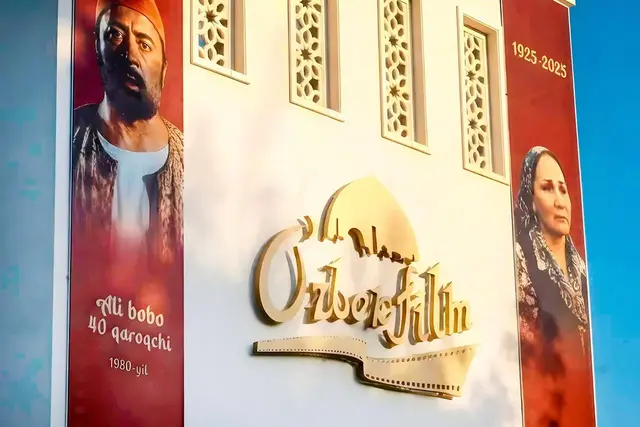
Tashkent, Uzbekistan (UzDaily.uz) — Uzbekistan will abolish its Cinematography Agency and transfer responsibility for implementing state policy on cinema to the Ministry of Culture. A new national film company, Uzbekfilm, will replace the existing state institution and operate under a modern business model, with film production moving entirely to the private sector.
President Shavkat Mirziyoyev announced the changes on 26 October during a meeting with representatives of the film industry at the Uzbekfilm studio.
Under the new system, responsibility for policymaking, financing and film production will be clearly separated. A Department of Cinematography will be established within the Ministry of Culture, with its head holding a status equivalent to that of a deputy minister. Officials have been instructed to organise the department’s operations and abolish the Cinematography Agency and its subordinate organisations within one month.
The new national film company Uzbekfilm will not produce films itself. Instead, it will select and finance projects, promote and distribute films, and support their entry into international markets and film festivals. Mirziyoyev described the company as a central institution for building a national film brand and developing a modern film industry. Its operations are to be organised within one week.
The reforms are intended to address problems highlighted by the president during the meeting. He said Uzbekistan still lacked an integrated system linking film production with distribution and reaching audiences.
Foreign films continue to attract full audiences in cinemas, Mirziyoyev noted. “This means viewers have not turned away from films or going to the cinema — only their tastes and expectations have changed. Do our national films meet these demands? Unfortunately, they do not!” he said.
The president also criticised the state procurement system for film production, saying it failed to meet the needs of a modern industry. Individual directors were assigned as many as six projects, while some authors were given up to seven. Almost half of the commissions went to state film studios, limiting competition from private filmmakers.
As a result, Mirziyoyev said, the priority had become completing assignments quickly rather than developing strong scripts and producing high-quality films. He argued that works of art should not be procured through technical specifications in the same way as ordinary goods or construction projects. He also noted that the views of professional film critics were not being given sufficient consideration.
Over the past decade, Uzbekistan has adopted two presidential decrees and eight resolutions to support the film industry, while the Uzbekfilm studio has undergone a complete reconstruction. State budget allocations for film production rose from 10bn soums in 2016 to 218bn soums in 2026.
According to the president, the number and quality of national films have increased during this period, and dozens of private film studios have emerged.
Mirziyoyev described cinema as an instrument of “soft power” that can strengthen Uzbekistan’s international standing. He urged filmmakers to portray not only historical figures but also contemporary people, including teachers, doctors, athletes, military personnel, entrepreneurs, builders and young people.
He also outlined his idea of “O‘z” in the context of cinema: “Being aware of our identity, we should tell the world our own story in our own voice.”