Coca-Cola Panel at TIIF Maps Uzbekistan's Circular Economy Road

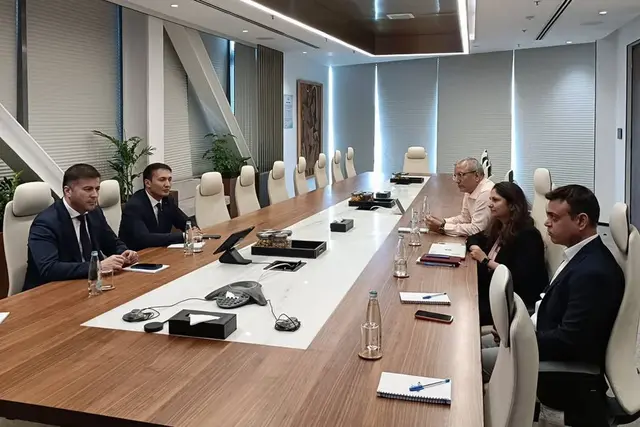
Tashkent, Uzbekistan (UzDaily.uz) — Global corporations and Uzbek government officials called Wednesday for accelerating the country's transition to a circular economy, presenting a sweeping agenda spanning waste infrastructure, water resilience, and urban decarbonization, at a high-level panel organized by The Coca-Cola Company on the sidelines of the Tashkent International Investment Forum.
The session, moderated by Begüm Yontar Avcı, Senior Director Sustainability at Coca-Cola's Eurasia and Middle East operating unit, convened senior executives from Veolia, Suez, ODAS Group, I-Environment Investments, the Global Environment and Technology Foundation, and Uzbekistan's Waste Management and Circular Economy Development Agency — six organizations spanning public regulation, private infrastructure, impact investment, and civil society.
Mrs. Yontar Avcı noted that traditional linear economic models—take, make, use, and dispose—have driven growth for decades but are no longer sustainable in a world of finite resources. In response, TCCC’s sustainability strategy focuses on reducing reliance on virgin materials and strengthening long‑term resource security through initiatives such as sustainable packaging and water stewardship.
She highlighted that moving toward a circular economy can deliver clear benefits for countries like Uzbekistan, including greater domestic resource resilience, increased attractiveness to sustainability‑driven investment, and the creation of new industries such as collection systems, recycling, and materials innovation. These outcomes align with TCCC’s goals to advance circular packaging and strengthen sustainable supply chains.
She concluded that now is the perfect time to invest in circular economy solutions to support sustained growth in Uzbekistan while protecting the resources that businesses and communities depend on.
Government Centralizes Waste System, Eyes 2050 Strategy
Sharifbek Hasanov, Director of the Waste Management and Circular Economy Development Agency, outlined a government approach built on centralized billing, state-controlled money flows, and a phased national infrastructure buildout conducted through public-private partnerships.
Uzbekistan is currently constructing six municipal solid waste recycling plants with five more in progress, and is rolling out 11 incineration facilities across all regions capable of processing approximately 505 million tons of waste annually and generating around two billion kilowatt-hours of electricity. The agency has identified 14 distinct categories of waste and is developing tailored strategies for each, with municipal solid waste as the near-term priority given its direct connection to daily community life.
Hasanov was candid about why incineration — rather than source segregation — was chosen as the entry point. "We have not developed such a culture from the beginning. We only have dumpsites. We just dump about 144 million tons of waste each year, and we have to get rid of it," he said, adding that waste-to-energy provides a practical first step while segregation habits and recycling infrastructure are developed over time under a strategy running to 2050.
The agency is preparing to launch a formal extended producer responsibility framework under a presidential directive, modeled on European rather than Russian practice. Producers who cannot demonstrate their own recycling capacity will pay a utilization fee into a national ecology fund, which the agency will use to attract and subsidize investors who establish recycling operations on their behalf. A parallel program for end-of-life vehicles targets the processing of 3,000 cars this year, with the government covering the gap between vehicle acquisition cost and the value of its disaggregated parts to make the economics viable for operators. Informal waste collectors — referred to by Hasanov as scavengers in current practice — will be formalized as paid employees of licensed collection operators under the new system.
A nationwide network of reverse vending machines for beverage containers is being developed under a government program, building on an existing collaboration with Coca-Cola on bottle to bottle recycling.
Digital Innovation and the Informal Sector
Alexandra Scott, President of the Global Environment and Technology Foundation and Managing Director of Project Last Mile and Next Mile Ventures, described findings from the Partnership for a Circular Tomorrow — a platform supported by the Coca-Cola Foundation operating across five countries including Uzbekistan, Turkey, Saudi Arabia, Kazakhstan, and Azerbaijan.
The innovations emerging from the platform cluster heavily around digital infrastructure: on-demand collection applications; virtual marketplaces connecting waste generators in hotels, restaurants, and cafes with recyclers seeking post-consumer PET; and traceability systems covering sorting, collection, volume measurement, and payment — tools Scott said would become essential compliance infrastructure as EPR frameworks take effect.
Artificial intelligence-based material sorting and contamination identification systems are also part of the regional innovation landscape, Scott said.
Her most pointed intervention concerned the role of informal waste collectors. "There is a huge opportunity to harness the power of community-led collection," she said. "Enterprises can bring innovation to provide back-end digital technology to help formalize them and bring them into the formal job sector. The workforce will be transformational for PET collection in the circular economy." Small and medium enterprises operating in this space, she added, hold something larger players cannot easily replicate: community trust, geographic reach, and the ability to operate efficiently in remote locations.
Veolia's US$1.44 Billion Tashkent Transformation
The most data-rich account of circular economy principles in practice came from Sebastien Daziano, Executive Vice President at Veolia, who described the company's district heating network modernization in Tashkent as a replicable blueprint for the country's broader infrastructure challenges.
Veolia inherited the contract in July 2022 — the first 30-year public-private partnership of its kind in Uzbekistan and, Daziano said, the first in the region. The network serves 1.2 million residents across nearly 2,000 kilometers of pipe. At the point of handover, nearly half of all heat generated was lost before reaching consumers.
The transformation rests on three pillars: people, finance, and digital. On the people side, Veolia is retraining field workers from reactive maintenance roles into network management professionals capable of running the infrastructure for the next three decades. On the finance side, a US$1.44 billion modernization program is structured so that operational efficiency gains directly fund further infrastructure investment, creating what Daziano described as a circular financial model in its own right. On the digital side, the company is deploying smart metering and advanced monitoring platforms to convert legacy infrastructure into an active, demand-responsive system.
The results to date are substantial. CO2 emissions on the Tashkent asset have been reduced by 46 percent, equivalent to removing 200,000 cars from the city. Heat loss has dropped from 41 percent to 27 percent. Water efficiency improvements have yielded savings of 33 million cubic meters annually — equivalent to 1,300 Olympic-size swimming pools.
"In four years, we achieved huge results regarding heat and water losses," Daziano said, adding that he sees the Tashkent model as directly scalable to water and waste infrastructure elsewhere in the country.
Suez: Non-Revenue Water Loss as a Hidden Crisis
Silvère Delaunay, CEO for Central Asia, Caucasus and Turkey at Suez, drew attention to what he called a structural but underappreciated dimension of Uzbekistan's water challenge: the volume of treated water lost through leaking pipes before it reaches consumers.
When Suez digitalized Tashkent's water network, it found approximately 8,000 to 9,000 kilometers of pipes — significantly more than the 5,000 kilometers authorities had estimated. The company identified an additional three billion cubic meters of water lost annually beyond what its operating partner had previously accounted for. To put that figure in perspective, Delaunay said, three billion cubic meters is the annual water consumption of a city of six million people. Tashkent's official population is approximately 3.5 million, with projections toward seven million.
"Taking care of your network to avoid leaks is important — and it is also an investment selling point," Delaunay said. "If you avoid leaks, you have to build fewer production facilities for potable water. If you have fewer production facilities, you need fewer wastewater facilities."
Suez is also developing a wastewater treatment facility for Tashkent designed to European discharge standards, with effluent quality sufficient for direct agricultural reuse — reducing pressure on freshwater sources. Delaunay cited Singapore's model of reinjecting treated wastewater into aquifers as the upper end of what circular water management can achieve, suggesting Uzbekistan could move incrementally in that direction.
He argued that successful non-revenue water reduction requires political leadership at the head-of-state level, not merely technical investment. "To reform a sector, you need leadership from the top," he said. "If you don't change the operation, you can invest every year and change nothing." Noting that President Shavkat Mirziyoyev holds a degree from an irrigation institute, Delaunay expressed confidence in the political awareness needed to drive that reform.
ODAS Group: Water Quality as an Economic Risk
Zehra Zeynep Dereli, International President of ODAS Group and board member of the multinational conglomerate, brought an investor's perspective from the ground in Uzbekistan, where the company has operated a combined cycle gas-to-power station in the Fergana region since 2021 — the second company to sign a PPP agreement with the Uzbek government.
Dereli focused on water quality rather than quantity as an underappreciated dimension of Uzbekistan's resource challenge. In the Fergana Valley, she said, water is becoming increasingly saline — a consequence of intensive agricultural use in one of Central Asia's most productive farming regions, where approximately 80 percent of rice cultivation occurs.
"Companies are starting to realize that this is not just a policy issue. It has become an economic issue," she said, noting that ODAS has made significant investments in closed-loop water treatment systems, real-time water quality monitoring, and membrane technology at its Fergana facility. The company also conducts employee training programs on water stewardship that extend into the broader community. "If we are causing any problems to the water quality in the region where there is agriculture, then it is going to be on us," she said.
Dereli was among the most vocal advocates for what she called the "golden triangle" — the intersection of policy commitment, private investment, and civil society engagement — as the only framework capable of delivering a genuine circular transition. She added a pointed observation about timing: "When you're starting late in the game, it's not a bad thing, it's a wonderful thing, because technology has progressed. Now you can utilize AI, all the different platforms, and have a great start without wasting time — or waste."
What Makes a Project Bankable
Belinda Knox, Managing Director of I-Environment Investments, a wholly owned subsidiary of Itochu Corporation — a Japanese trading house with a 160-year history and the investment philosophy of Sampo Yoshi, meaning good for the seller, good for the buyer, and good for society — offered the most explicit account of what international capital requires before committing to circular economy projects in Uzbekistan.
Security of cash flows is paramount, she said, noting that waste-to-energy projects typically carry multiple revenue streams — gate fees for incoming waste and electricity sales from outgoing power — that span different government ministries. Coordination across those ministries is essential to make a project financeable. A guaranteed or exclusive waste supply, either by volume or quality commitment, is a further prerequisite. And for projects seeking international finance from institutions or Japanese capital, the livelihood protection of existing informal sector participants is a non-negotiable condition. "We do not wish to substitute their livelihoods," Knox said.
She drew a cautionary comparison with the United Kingdom, where deposit return scheme pilots produced disappointing results, delaying rollout. EPR legislation, now being enacted at the national level, is beginning to attract investment — but directed toward high-technology materials recovery facilities rather than energy-from-waste, reflecting the maturation of the recycling market. "I hear from Uzbekistan that we are working more on SMEs for EPR, and that may provide a much better result, because it might incentivize people to a greater extent," Knox said.
On the question of accelerating water investment specifically, Knox argued that legislation mandating the purchase of recycled outputs — treated sludge or recovered materials — would create the revenue certainty needed to attract private capital into water projects, mirroring the model she described for waste.
Coca-Cola's Own Framework
TCCC’s environmental goals are anchored in its sustainability strategy and guided by the company’s purpose to Refresh the World and Make a Difference. At a global level, these goals focus on three core priorities: collecting and recycling the equivalent of its packaging in the markets where it operates; returning the water used in its finished products back to nature and communities; and reducing carbon emissions across its operations.
Mrs. Yontar Avcı emphasized that circularity is central to TCCC’s business model, underpinning the company’s priorities on sustainable packaging, water stewardship, and supply chain resilience. The company recognizes that long‑term business continuity depends directly on the health and sustainability of the natural resource systems it relies upon.
A Message to the President
Closing the session, Mrs. Yontar Avcı invited each panelist to address a final message to President Mirziyoyev.
Scott urged the creation of positive incentives to strengthen the ecosystems and value chains that support both economy and environment simultaneously.
Daziano said Tashkent's district heating transformation demonstrated a scalable model for the rest of the country across three dimensions: infrastructure replicability, decarbonization, and local human capital development.
Dereli called for sustained and predictable legislation, noting that abrupt regulatory changes had occasionally caught investors off guard.
Delaunay praised the Swiss challenge procurement model and the Foreign Investors Council's responsiveness to private sector concerns, urging continuation of both.
Knox, whose parent company Itochu has been present in Uzbekistan for 30 years through the mining and resources sector, said the company was ready to make its first infrastructure investment and wanted to accelerate. "The network effects of making the first infrastructure investment create further infrastructure investment," she said.
Mrs. Yontar Avcı closed by noting that Coca‑Cola’s experience with EPR schemes and water replenishment programs across markets offers proven best practices the company is ready to share, creating a clear opportunity for collective actions with the industry partners to scale solutions and maximize impact together.