Uzbekistan Launches ANORA Platform to Draw US$1.5 Billion in Agrifood Investment

Tashkent, Uzbekistan (UzDaily.uz) — Uzbekistan has officially launched ANORA, the Agrifood Investment Opportunities for Resilient Agriculture platform, a state investment mechanism developed jointly with the European Bank for Reconstruction and Development and the Food and Agriculture Organisation of the United Nations that targets US$1.5 billion in investment by 2030 to transform the country's agrifood sector into a climate-resilient, low-carbon system.
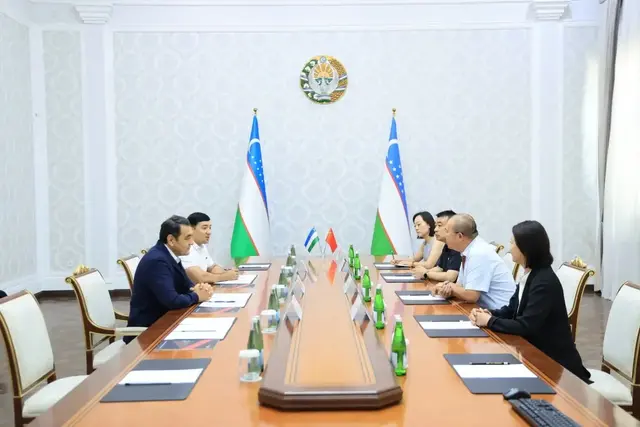
The announcement was made at a dedicated session of the Tashkent International Investment Forum, where Uzbekistan's Minister of Agriculture Ibrokhim Abdurakhmonov, government officials and international partners signed a memorandum of understanding formalising the partnership.
ANORA addresses critical sector challenges including land degradation, water scarcity, climate change and fragmented financing. The session moderator, Sung-Ah Kyun of the EBRD, described the initiative as one of the first integrated country-level agrifood platforms of its kind in the world.
The financing gap
Mobilising finance is the central task facing ANORA. Gianpiero Nacci, the EBRD's managing director for climate strategy and delivery, outlined a substantial global financing shortfall.
Annual damage caused by climate-related events — droughts, floods and storms — amounts to approximately US$100 billion worldwide, with 50% of that impact falling on Asia. This is equivalent to 4% of the agricultural sector's GDP. Maintaining agrifood sector resilience in line with the Paris Agreement and biodiversity loss targets requires approximately US$1.1 trillion annually. Yet the global financial system, including multilateral development banks, currently channels only US$100 billion per year toward this goal — a gap of ten to one.
The agricultural sector is responsible for one third of global greenhouse gas emissions but receives only 7% of global climate finance. Annual agricultural subsidies worldwide amount to US$1 trillion, but only 13% of that is directed toward innovation and infrastructure support — precisely the areas ANORA aims to develop.
"This disproportion is what prevents the sector from advancing along the lines of sustainability and climate responsibility, but it is also connected to competitiveness and economic resilience," Nacci said.
Policy foundations and ambitions
ANORA is built on a policy and institutional foundation established over recent years. The process began with Uzbekistan's first Nationally Determined Contribution in 2017 and ratification of the Paris Agreement in 2018, followed by a series of sectoral strategies including the Agrifood Sector Development Strategy for 2020–2030.
Uzbekistan has committed to liberalising the agricultural sector and improving its resilience while simultaneously advancing food security and export growth. Abdurakhmonov described a shift in the government's approach: from a purely market-oriented model to one that combines market mechanisms with a focus on people.
"Uzbekistan will pursue market-oriented plus people-oriented agriculture. We will apply all innovations, but with care for the human dimension, with care for ethics, agricultural ethics, with care for creativity," he said.
The minister identified three primary challenges ANORA is designed to address: microplastics in agriculture, arising from the use of plastic in mulching and other intensive farming methods as Uzbekistan moves toward more intensive production; the interconnection between water, climate and natural resources; and antimicrobial resistance.
Targets and scale
ANORA has set ambitious targets through 2030: attracting US$1.5 billion in agrifood sector investment; converting a significant area of land to sustainable agricultural practices; achieving a substantial reduction in greenhouse gas emissions; and improving water and land productivity, which are critical to sector profitability.
For context, Uzbekistan's agricultural sector encompasses approximately four million smallholder farm families, who produce more than 90–95% of the country's meat and dairy, around 85% of vegetables and approximately 70% of all fruit. EU Ambassador to Uzbekistan Toivo Klaar noted that these smallholders generate output worth around US$3,000 per hectare on family farms — six times the productivity of large commercial farms, which average US$500 per hectare.
However, smallholders face significant constraints in accessing finance, technology and markets. Expanding rural finance access is a key priority.
The platform's three-pillar architecture
ANORA is structured around three pillars defined by the EBRD. The first is financing: the platform aims to attract both domestic and international funding, including concessional and development finance, with active private-sector participation rather than reliance on public funds alone. The second is policy and regulation: the platform creates an interface among project developers, the financial sector and the government to identify the regulatory frameworks and standards that must be addressed to unlock additional investment. The third is enabling infrastructure, covering both physical and digital infrastructure needed to resolve the productivity challenge.
The architecture is designed to align the interests of diverse stakeholders, ensure policy predictability and provide access to information about investment opportunities.
From strategy to implementation
Alisher Shukurov, First Deputy Minister of Agriculture, stressed that the agrifood sector strategy developed with international partners in 2019 must now be translated into practice."The strategy is not simply an approved document — it is a living process. We already have nine priorities established in the agrifood sector. We want our strategy to work on the ground, in real conditions for producers and farmers," Shukurov said.
Turning the strategy into bankable projects requires joint work among all partners: the Ministry of Agriculture, development agencies, the private sector, research institutions and academic organisations. "Without the private sector, ANORA cannot truly function as a platform. That is why coordination is the third element I want to highlight," Shukurov said.
The FAO's contribution
Jacopo Monzini, the FAO's senior officer for natural resources and investment, identified the key evolution in approach that ANORA represents: a shift from project-by-project thinking to a comprehensive process.
"This allows us to truly look at which actions are priorities, which project is best suited for financing, but also what is needed to make a project financeable. In many cases we have excellent ideas from other countries or the region, but then we need to assess how feasible an investment is before it becomes financeable," Monzini said.
The FAO has nearly 80 years of agricultural experience and has worked in Uzbekistan for 20 years. The organisation will bring ANORA lessons drawn from more than 130 countries facing comparable challenges, helping to avoid repeating approaches that have failed elsewhere. Monzini also highlighted human capital as a precondition for project delivery, with academic and training institutions needing to be embedded in the process of preparing the workforce required for agrifood system transformation.
The role of multilateral development banks
The Asian Development Bank and the EBRD are playing critical roles in financing and coordination. Kanokpan Lao-Araya, head of the ADB's office in Uzbekistan, outlined several ways the bank can support ANORA: coordinating development finance to ensure it is aligned with national priorities and avoids duplication among partners; providing digital tools such as a geospatial platform accessible to all partners for tracking current and planned projects; and offering both policy-oriented programmes to address regulatory issues and grant financing linked to reform milestones.
Lao-Araya emphasised the importance of learning from existing coordination platforms in the country and ensuring long-term sustainability through the transfer of functions to the government.
Private sector readiness
Ekler Orsolya, chief financial officer and board member of SQB, the Green Investment Bank of Hungary, identified three criteria her institution applies when deciding whether to finance projects under ANORA. The first is financeability: the project must demonstrate sustainable cash flows, commercial viability, a sound business model and market demand. The second is sustainability: as a green bank, SQB prioritises projects that improve productivity, resource-use efficiency and food security. The third is risk management, covering operational, environmental and market risks, which requires strong project governance and reliable sponsors.
"ANORA is very useful for us. We hope for transparency and stronger project operations, helping to connect key stakeholders, investors, financial institutions and project developers. We are ready to deploy capital if a project is ready to attract capital," she said.
Temur Ali Dad Khan of Extrafos identified a critical and frequently overlooked problem: not the challenge of directing finance toward farmers, but the mutual comprehension gap between farmers and capital markets.
"The primary risk is that farmers need to become more legible to capital. The fundamental problem is that there are no programmes or platforms for banks to assess farmers directly. Farmers often do not understand the process of accessing finance," he said.
He recommended an educational approach in which farmers are introduced to ANORA's opportunities while banks learn to explain to farmers what level of understanding and preparation is required to access funding. "This should be the first step: data, transparency and accessible information for farmers," he said.
Sector challenges
Bahodir Umirshaikhov, chairman of the Association of the Food Industry of Uzbekistan, set out the acute pressures facing the sector. Approximately 50% of irrigated land is subject to degradation. Around 60% of irrigation systems are inefficient, with only 33% of water resources used effectively, resulting in annual losses of 18 to 20 million cubic metres. Some 78% of energy production in the agricultural sector depends on natural gas, supplies of which are gradually declining.
Umirshaikhov noted that approximately four million people are actively employed in the agricultural sector, making the rapid implementation of ANORA critical to their livelihoods.
Implementation commitments
Panellists set out their institutions' commitments for the next 12 to 24 months. The government, through Deputy Minister Shukurov, committed to selecting a set of high-impact projects for demonstration and beginning their implementation, with a focus on programmatic rather than standalone interventions. The FAO will identify lessons from more than 130 countries to prevent costly errors and will draw on its global agricultural database to support decision-making. The ADB will review its existing country project portfolio in light of ANORA to identify synergies, with particular attention to ongoing work on land degradation in Karakalpakstan and support for sanitary and phytosanitary standards to develop exports. SQB will provide financial expertise, risk assessment and clear financing pathways for ANORA projects. Private sector organisations will act as a bridge between financial institutions and farmers, providing field-level data and improving communication between the two sides.
The next 12 to 24 months will be critical in demonstrating the platform's ability to deliver real projects and investment on the ground.