Mirziyoyev: Management, Not Funding, Is Energy Sector's Core Problem

Mirziyoyev: Management, Not Funding, Is Energy Sector's Core Problem/Photo: Press-service of the President of Uzbekistan
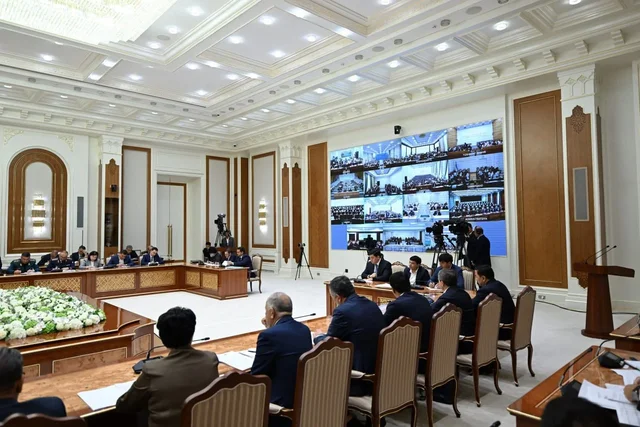
Tashkent, Uzbekistan (UzDaily.uz) — President Shavkat Mirziyoyev chaired a video conference on priority tasks in the fuel and energy sector.
The head of state said that over the past decade, large-scale reforms have been carried out in the energy sector. Laws and decisions were adopted to expand the participation of the private sector and foreign investors.
The president noted that he has personally met with investors on multiple occasions and listened to their proposals. Conditions were created and guarantees provided for the implementation of every major project.
As a result, US$23 billion in foreign investment was attracted to the energy sector, and power plants with a combined capacity of 9.5 gigawatts were commissioned across the regions. This has created generating capacity that fully covers the country's domestic electricity needs.
In recent years, 30 trillion soums has been allocated for the modernization of electric and gas networks, substations, transformers and gas distribution equipment — six times more than was allocated for these purposes over the previous 25 years.
"It must be said openly: the problem in the energy sector is not funding, since we find and allocate as much funding as is needed. The problem is in the management of the system," the president said.
It was noted that networks in different regions are in roughly the same condition, yet some districts operate stably while others regularly experience accidents. This is linked to differences in the level of oversight and discipline.
The work of the leadership of the Ministry of Energy and its territorial divisions was criticized for lacking diligence and accountability. As a result, the public and entrepreneurs are extremely dissatisfied with the current work of the officials responsible for the system.
"I repeat: the work of every head of the system must first of all be felt in people's daily lives and ease the problems faced by entrepreneurs," the head of state said.
Every summer and winter, accidents occur at dozens of substations, causing hundreds of transformers to fail. In June and July alone, around 4,000 accidents occurred, leaving the public and entrepreneurs without electricity for 8 to 10 hours.
Over the past five years, electricity consumption has more than doubled in the city of Shirin and in the Yangihayot, Yakkasaray and Ohangaron districts. However, the officials and hokims responsible failed to anticipate that the existing networks would not be able to withstand such a load.
The president criticized the absence of calculations on the damage that each power outage causes to entrepreneurs and the economy. He also noted that because hokims lack a precise understanding of the energy consumption balance, billions of soums are being wasted.
Some hokims currently have no specific plans for improving infrastructure.
Network losses stand at 17.2 percent. In the first six months of this year, 4.8 billion kilowatt-hours of electricity was lost.
In the city of Andijan and in the Asaka, Yangiabad, Kasan, Koqdala, Boysun, Oltinsoy, Kushtepa, Toshlok, Koshrabot and Samarkand districts, loss levels exceed 25 percent.
Although more than four years have passed since the introduction of the ASKUE and ASKUG metering systems, 300,000 gas meters and 234,000 electricity meters installed in households are not transmitting data. As a result, some regions are seeing an increase in accounts receivable instead of a decrease.
It was also noted that many officials understand efficiency improvements solely as the installation of solar panels. However, if a building is not energy-efficient, the funds spent will continue to be wasted.
The meeting criticized the incorrect assessment of the site chosen for construction of a combined-cycle power plant in Surkhandarya region. Delivering gas to the plant will now require an additional US$300 million.
Insufficiently thorough review of the terms of the contract signed with the project's initiator has created a risk of additional costs. Those responsible have been instructed to revise the terms of the contract.
The minister of energy and the head of Hududiy Elektr Tarmoqlari were dismissed from their positions over serious shortcomings in the operation of the system. The heads of Milliy Elektr Tarmoqlari, Issiqlik Elektr Stansiyalari, Transgaz and Hududgaz were placed on probation until the end of the year; they will also be dismissed if no results are achieved.
It was emphasized that the new minister of energy, Sherzod Khodjaev, the new head of Hududiy Elektr Tarmoqlari, Sardor Isakulov, and the new head of the Energy Inspectorate, Ahad Isokjonov, must implement a new style of work starting today.
"Hokims also have no right to sit back calmly and say, 'This is the energy workers' job.' The requirements will be strict," the president said.
The Yangiyul district was presented as an example of how work should be organized locally. The district has 1,400 kilometers of electricity networks and 422 transformers.
Over the past five years, household electricity consumption grew from 68 million to 102 million kilowatt-hours, a 1.5-fold increase. However, only 60 transformers and 240 kilometers of networks were upgraded during this period. Since the start of the year, electricity losses have reached 30 million kilowatt-hours, and 37 accidents have occurred on the networks.
Due to insufficiently enforced payment discipline, accounts receivable have reached 43 billion soums, of which 9.4 billion soums is considered unrecoverable debt.
In the district, 829 consumers have meters that do not meet ASKUE system requirements, and another 2,000 meters are not transmitting data. Meanwhile, 48 businesses that reported "zero" figures to tax authorities consumed 871,000 kilowatt-hours of electricity over six months.
A similar situation exists in gas supply. Because more than 5,000 gas meters are not transmitting data, debt has reached 188 billion soums.
A special task force will be established to ensure stable electricity and gas supply for the public and entrepreneurs in Yangiyul district. It will be headed by Minister of Energy Sherzod Khodjaev, with district hokim Sanat Jumaniyozov serving as deputy head.
Within two weeks, officials will study the monthly, quarterly and annual needs of the public and entrepreneurs across all 51 mahallas in the district. This will form the basis for an "energy consumption balance."
It will be clearly determined in which mahallas transformers or gas distribution equipment need to be replaced, and where new networks need to be laid. Meters that do not meet ASKUE and ASKUG system requirements will be replaced, and uninterrupted connectivity will be ensured for devices not transmitting data.
A separate program will be developed to halve electricity and gas losses. It will clearly specify what portion of the required funds will be allocated by energy sector enterprises and what portion will come from additional local budget revenues.
Enterprises with high energy consumption will undergo energy audits. Banks will allocate the necessary resources to help transition them to energy-saving technologies. The energy consumption of all kindergartens, schools, technical colleges, hospitals and clinics will be analyzed and categorized accordingly.
A diagnostic assessment of heating systems in apartment buildings will be carried out, and targeted work will be organized street by street to eliminate debt.
All work must be completed by 1 October, after which the Yangiyul district is planned to become a model district for electricity and gas supply.
The system developed in Yangiyul district will be introduced in all districts and cities of the country. Each energy sector official will be assigned one of the most problematic districts in each region.
Together with hokims, they must implement the new system of work in their assigned territories by the end of the year. The Reform Task Force, deputy prime ministers, ministers, and heads of industries and banks will also travel to the regions.
Problems faced by the public and entrepreneurs related to electricity and gas supply will be studied. Officials will be given clear tasks to complete by the end of this year and next year, along with defined funding sources for these measures.
Specific opportunities will be identified locally for improving electricity and gas metering and sharply reducing network losses and accounts receivable.
The head of state stressed the need to "open the eyes" of electricity and gas service officials in regions and districts, and to increase their accountability for achieving concrete results.
Hududiy Elektr Tarmoqlari currently employs 25,000 people, and Hududgaz employs 16,000. However, due to the absence of digital management of employee activity, the heads of neither the electricity network nor the gas supply organization know exactly what their employees are doing during the working day.
As a result, labor productivity is 1.5 to 2 times lower than in other countries, and the time needed to fix accidents is 3 to 4 times longer.
A Center for Digitalization of the Fuel and Energy Sector and Artificial Intelligence Implementation will be established within the Ministry of Energy.
The center will conduct a "stress audit" of the entire chain of production, transmission, distribution and supply, as well as of coal, liquefied gas and fuel oil supply systems. Based on this, several sector development scenarios will be developed.
A system will be created that uses a digital algorithm to manage the daily work of every employee. ASKUE and ASKUG data will be analyzed using artificial intelligence, and a platform will be launched to detect suspicious changes.
Ten key performance indicators will be set for 106,000 employees in the system. Key criteria will include emergency and planned outages, losses, accounts receivable, capacity reserves and the fulfillment of repair programs.
The meeting also addressed preparations for the autumn-winter period. There are currently 1,916 mahallas where natural gas delivery is difficult.
Officials have been instructed to carry out calculations within three months to determine what infrastructure and additional electricity volumes will be required to convert heating systems in these mahallas to electricity.
A separate program will first be developed for mahallas requiring funding.
Currently, 3.7 million households use liquefied gas. Although this system has been digitized and significantly streamlined in recent years, the problem of timely gas delivery has not been fully resolved.
A proposal to involve the private sector in liquefied gas supply was approved, starting with Andijan region.
In Andijan region, 41,000 tons of liquefied gas was delivered over six months, versus a planned 48,000 tons. In 318 mahallas, deliveries are behind schedule.
Entrepreneurs will now be able to supply the public and businesses with liquefied gas that they import themselves or purchase on the exchange. Since the start of the year, the private sector has imported 157,000 tons of liquefied gas.
Families included in the Social Registry will receive a subsidy for purchasing liquefied gas. The "Andijan experience" in this area is planned to be formalized by the end of the year.
A task was set to increase liquefied gas production to 606,000 tons by the end of the year, up from a planned 520,000 tons.
Gas is currently supplied to the public in standard 20-kilogram cylinders. However, while some households need only 5 to 6 kilograms per month, others require cylinders with a capacity of 30 to 40 kilograms.
The system for transporting, storing and distributing liquefied gas will be revised within a month, taking into account international experience and standards.
The head of state noted that modern personnel are needed across all sectors, including energy, for the economy to shift to a technological and innovation-driven growth model.
Currently, 25 technical universities train 5,500 specialists annually in this field.
"Frankly speaking, because education is not linked to practice, it takes a graduate two to three years to fully settle into their job," the president said.
Officials have been instructed to fully update educational programs for the fuel and energy sector at universities within a month. Adaptation of laboratories and training grounds to new requirements will begin by 1 September.
Starting from the new academic year, half of third-year students and all fourth-year students will be covered by dual education. This is due to the fact that in the next two to three years, there will be a need for thousands of specialists in fields such as solar and wind energy, electric vehicle charging equipment and other modern energy technologies.
Saudi Arabia's ACWA Power has equipped the Shirin Energy College and trains 220 young people annually in new professions. Starting from the new academic year, this experience will also be implemented in one technical college in each of three territories: Karakalpakstan, and the Bukhara and Navoi regions.
Officials gave reports at the meeting.