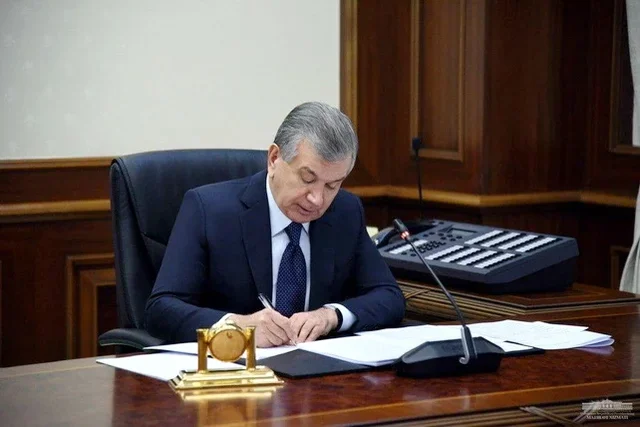
Tashkent, Uzbekistan (UzDaily.uz) — Uzbekistan’s revised Latin alphabet will take effect on 22 April 2027 under a law signed by President Shavkat Mirziyoyev on 21 October 2026.
Documents, national currency and securities issued before the law takes effect will remain valid and may continue to circulate even if they contain letters from the previous version of the alphabet.
Existing symbols and insignia used by government bodies and organisations, relief images of the state emblem on buildings, signs and geographical name markers, as well as other items and materials to be specified by the Cabinet of Ministers, may continue to be used until they wear out or until a deadline set under a special implementation programme.
The government has been instructed to develop and approve the programme within two months.
The revised alphabet will contain 28 letters and an apostrophe. The letter combinations Sh and Ch, along with the spellings Oʻ and Gʻ, will be replaced by the individual letters Ş, Ç, Ö and Ğ. The Ng combination will be removed. The previous version contained 26 letters and three letter combinations.
Uzbekistan introduced the Latin script for the Uzbek language in 1993. The original version contained 33 letters and an apostrophe, as well as characters with diacritical marks. In 1995, some letters were replaced with the combinations Sh, Ch, Oʻ, Gʻ and Ng, while the letter C was removed.
The full transition from Cyrillic to Latin script was originally scheduled for completion by 2000. However, both writing systems are still used in Uzbekistan.
In October 2020, the president signed a decree on developing the Uzbek language and improving language policy that envisaged completing the transition to the Latin script.