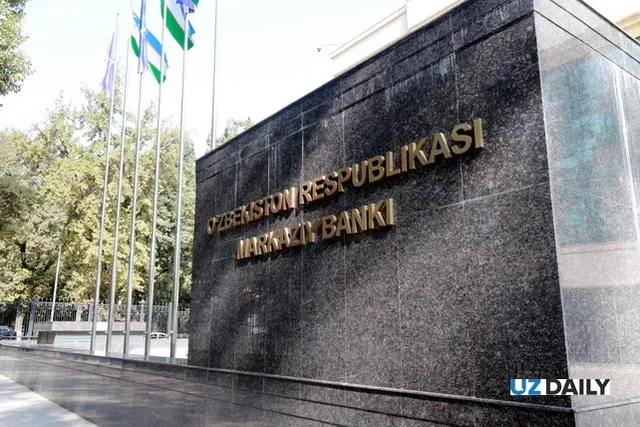
Tashkent, Uzbekistan (UzDaily.uz) — Uzbekistan plans to expand lending and savings in soums to reduce the economy's dependence on foreign currencies and limit currency risks, Central Bank Chairman Timur Ishmetov said.
Ishmetov outlined the tasks assigned to the regulator at a meeting chaired by President Shavkat Mirziyoyev on 13 November. The meeting discussed the draft state budget for 2027, key macroeconomic forecasts and economic policy priorities, Gazeta.uz reported, citing an interview with Ishmetov on Uzbekistan 24 television.
According to the Central Bank chairman, 2027 will be an important stage in achieving the country's long-term economic goals. This will require stable prices, more effective monetary policy and continued banking sector reform.
One of the Central Bank's main priorities is to reduce the economy's dependence on foreign currencies.
"The main issue is reducing the level of dollarisation and increasing confidence in the soum. By strengthening confidence in the national currency, we must expand borrowing and lending in soums, as well as increase the share of household deposits and loans denominated in soums," Ishmetov said.
He said dollarisation needed to be reduced to limit the risks associated with foreign currency transactions and borrowing. When the soum weakens, the cost of servicing foreign currency loans in soum terms increases. This particularly affects borrowers who earn their income in soums but owe money in US dollars or other currencies.
Another task for the regulator is to make monetary policy instruments more effective. The Central Bank plans to expand its capacity to manage liquidity and develop domestic financial markets.
"We will introduce new instruments in both the foreign exchange and interbank markets. Overall, we will improve the effectiveness of the Central Bank's monetary policy instruments," Ishmetov said.
The Central Bank was also instructed at the meeting to slow inflation and achieve its medium-term price stability target. During discussions on the budget, the regulator was given a target of keeping inflation at no more than 6% next year, followed by a reduction to 5%.
The Central Bank previously presented a draft of its main monetary policy guidelines for 2027–2029. Under the baseline scenario, inflation is expected to fall to the 5% target in the second half of 2027.
The draft предусматривает improvements to the management of bank liquidity, a review of the interest rate corridor and a stronger role for the UZONIA rate as a benchmark for the money market. It also предусматривает the development of instruments to hedge interest rate and foreign exchange risks.
The regulator also plans to develop the derivatives market. These financial instruments will allow market participants to protect themselves against unfavourable fluctuations in exchange rates and interest rates.
Accelerating state bank reforms
Ishmetov separately said the transformation of state-owned banks and the privatisation of some of them needed to be accelerated.
"The second area is accelerating the transformation of state-owned banks and the privatisation of individual banks. This is necessary to take economic growth to a new level over the next 10 years and improve the quality of the economy. To achieve this, we need an appropriate banking system," he said.
According to Ishmetov, modernising banks is considered one of the conditions for the economy to move to a new stage of development.
An official statement following the meeting also said the banking system needed to attract more private capital, increase lending resources and improve financing for investment projects.
Privatisation is under way, but banks with state participation continue to account for a large share of the market.
As of 1 October 2026, they held 60.8% of the banking system's assets, or 634.9 trillion soums out of a total of 1.045 quadrillion soums, according to Central Bank data.
State-owned banks also accounted for 64.6% of the total loan portfolio, with 425.8 trillion soums out of 659.1 trillion soums. Their share of banking capital was 57.8%, or 88.3 trillion soums out of 152.9 trillion soums. They held 50.2% of deposits, totalling 251.5 trillion soums out of 501 trillion soums.
As of 1 October, commercial banks had issued loans worth 659.1 trillion soums, including 252.3 trillion soums in foreign currencies.
The share of foreign currency loans fell by 1 percentage point over the year, from 39.3% to 38.3%.
However, the value of foreign currency loans in soum terms increased by 10.3%, from 228.7 trillion to 252.3 trillion soums. Their share declined because the overall loan portfolio expanded, not because the volume of such lending decreased.
Dollarisation is declining faster in deposits. As of 1 October, bank deposits totalled 501 trillion soums, including 93.1 trillion soums in foreign currencies.
The share of foreign currency deposits fell from 22.5% to 18.6% over the year, a decrease of 3.9 percentage points. However, their value increased from 83.7 trillion to 93.1 trillion soums.
Foreign currency loans still account for more than one-third of all bank lending.