Tashkent, Uzbekistan (UzDaily.uz) — Uzbekistan plans to increase the annual number of foreign tourists to 20 million by 2030 and raise tourism service exports to US$10 billion, the presidential press service said following a presentation on tourism development and cultural heritage preservation.
On 26 November, President Shavkat Mirziyoyev reviewed projects and plans for developing the tourism sector. Particular attention was given to Bukhara’s historic centre, regional tourist routes and new infrastructure.
Bukhara heritage preservation projects
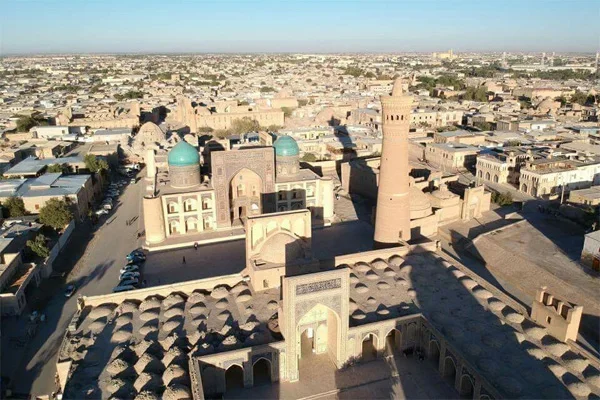
The presentation included a master plan for developing Bukhara’s historic centre. It provides for the restoration of the Ark Museum-Reserve, the renewal of its museum exhibitions, the restoration of the Kosh Madrasah architectural complex, the reconstruction of the Bukhara Musical Drama Theatre and improvements to the Samanid Park.
Plans were also presented to establish a State Museum of Jadid Heritage and a Bukhara State Art Museum with modern exhibition spaces.
Commercial properties and service businesses in the historic centre are expected to adopt a unified architectural style. Conditions for pedestrians will also be improved. All work must comply with UNESCO requirements.
The presentation also covered a concept for the second Bukhara International Biennial, scheduled for 2027. It proposes creating a 2.3-kilometre cultural walking route connecting Samanid Park, the Ark Fortress, the Poi Kalyan complex and the Lyabi-Hauz ensemble.
Uzbekistan is also implementing projects with organisations from the United States and South Korea to digitise monuments, create 3D models, preserve archaeological artefacts and improve specialists’ skills.
Tourism figures and targets for 2030
Uzbekistan received 11.6 million foreign tourists between January and October 2026. This was 20% more than in the same period last year and almost matched the total recorded for the whole of 2025.
Tourism service exports increased 1.5 times to US$6.1 billion. Average spending by foreign tourists rose by 26%.
The targets for 2030 are to:
- increase annual foreign tourist arrivals to 20 million;
- raise tourism service exports to US$10 billion;
- increase employment in the tourism sector to 2 million people;
- raise tourism’s share of GDP to 7%.
At the president’s instruction, meetings were also held in the regions with more than 2,000 tourism entrepreneurs. They raised concerns about electricity capacity shortages in tourist areas, high advance payments for electricity and gas, access to currency exchange services in hotels and the organisation of bus transport in mountainous areas.
Entrepreneurs proposed encouraging the use of alternative energy sources, providing guarantees for loans, allowing instalment payments for land plots and introducing additional incentives for hotels and the entertainment industry.
Mirziyoyev instructed the relevant agencies to examine the proposals and prepare specific solutions.
New destinations and regional projects
The authorities intend to expand the range of tourist destinations to reduce pressure on traditional tourism centres. Promising areas include ecotourism, ethnographic, agricultural, gastronomic, adventure, medical and business tourism, as well as film tourism.
The government also plans to introduce the principle of “One mahalla – one tourism product”. Mahallas and villages will be included in tourist routes, allowing visitors to learn about local lifestyles, traditions, crafts and national cuisine.
A total of 34 regional tourism development master plans are scheduled to be drawn up in 2026–2027. Thirteen have already been prepared.
Initiatives presented include creating an open-air museum and recreation area near the ancient Koriz water structure in Nurata district, developing flower tourism in Namangan and improving resort areas.
The presentation also covered a development concept for the Tudakul tourism and recreation zone. Hotels, leisure and health facilities are planned along the reservoir’s shore. The project also envisages developing ecotourism and building modern infrastructure that takes the natural landscape into account.
Tourism infrastructure financing
To implement new projects, the authorities plan to put land plots with a combined area of 5,000 hectares up for auction.
A total of 3.1 trillion soums is expected to be allocated for tourism infrastructure development by 2030.
In addition, a Tourism Projects Support Fund is planned for establishment next year, with initial funding of 100 billion soums.
The fund is expected to support the development of new tourist facilities, provide entrepreneurs with concessional loans, compensate part of their interest expenses and subsidise the introduction of modern entertainment services.
The authorities also intend to step up international promotion of Uzbekistan’s tourism potential, expand cooperation with foreign tour operators and digital platforms, increase the number of international flights and improve transport links between regions.
The Tourism Committee, together with ministries and agencies, has been instructed to adjust the schedule of major international conferences and forums to take account of tourist seasons.
The proposal is to hold these events during periods when tourist flows are relatively low.