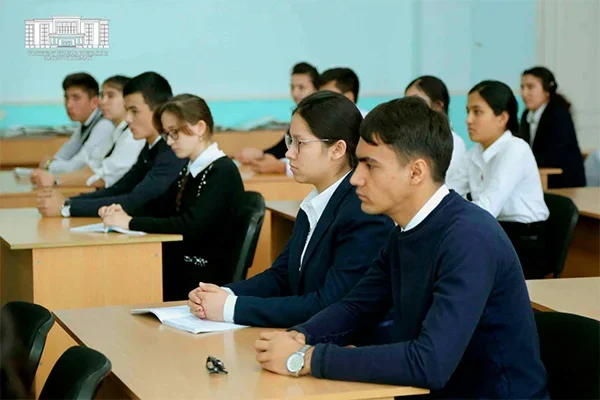
Tashkent, Uzbekistan (UzDaily.uz) — More than 4,000 schools in Uzbekistan have opened preparatory groups for six-year-old children in unused classrooms. The authorities have explained how the groups will operate and what facilities must meet, according to the press service of the Ministry of Education and Science.
The one-year school preparation programme will be organised in kindergartens and unused school premises. In remote areas without such facilities, groups may also open at Kelajak centres, technical colleges and other social infrastructure facilities, including cultural institutions.
Premises will not be selected arbitrarily. Before a group opens, representatives of the sanitary service, fire safety authorities and education administration must inspect the facilities. They will assess heating, lighting, water supply, toilets and other safety conditions.
If a facility meets the established requirements, it will be added to the register and equipped for classes. Otherwise, repairs must be completed before permission to open a group is granted.
According to the ministry, preparatory groups are already operating in unused premises at more than 4,000 schools. Another 246 groups are expected to open soon at 191 schools.
Groups will not be established at schools with high occupancy rates. Instead, authorities will select institutions with available rooms and suitable facilities.
Children attending kindergartens will complete their preparation there, with classes taught by the kindergarten's own educators. Separate teachers will be recruited for groups based in school buildings.
Eligible teachers will include educators with higher education qualifications and final-year university students studying preschool education. Existing schoolteachers will not be taken away from their regular lessons.
Preparatory classes will be free of charge at state kindergartens and schools. Private educational organisations will also be able to open such groups. Parents may choose a private institution under a contract, with the decision left to each family.
All groups will follow a single curriculum, regardless of the format in which classes are delivered. It will use play-based methods and focus on physical development, speech and communication, basic reading and writing skills, cognitive development and creativity.
The same curriculum will apply to regular and short-term kindergarten groups, as well as groups operating in unused school classrooms. The format of classes is therefore not intended to affect the content of the preparation programme.
Currently, 98% of six-year-olds in Uzbekistan — 726,921 children — are covered by school preparation programmes. Of these, 489,172 attend kindergartens, 19,910 take part in short-term and mobile groups, 215,003 receive preparation at schools and 2,836 are covered through other formats.
Over seven years, the coverage rate has risen from 37% to 98%. Achieving full coverage will require around 800 additional groups and nearly 20,000 places. The associated expenditure is expected to be included in the 2027 state budget.
The authorities also plan to improve the quality of preparation, strengthen teachers' professional capacity and integrate the programmes with primary school education. After the relevant law is adopted, secondary legislation will be drafted to establish mechanisms for addressing these issues.
The introduction of a one-year preparatory stage is intended to ensure continuity in education and bring its duration closer to international standards. Education programmes are also expected to be adapted gradually to international requirements.
The Presidential Schools and the Beruni specialised school were cited as examples of existing practice. They use programmes that have received international accreditation at ISCED-1 level.
According to a ministry representative, international accreditation of an educational programme would remove the need for students to complete a Foundation programme.