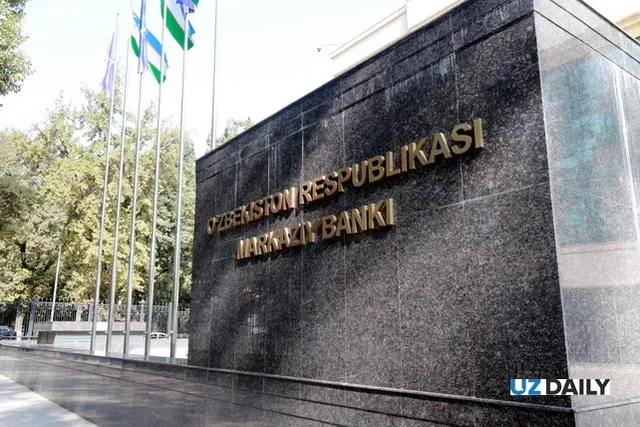
Tashkent, Uzbekistan (UzDaily.uz) — The Central Bank of Uzbekistan has proposed publishing utility tariff adjustment schedules several years in advance to help households and businesses plan their spending and reduce uncertainty over inflation expectations.
The proposal is outlined in the draft Monetary Policy Guidelines for 2027–2029.
The document says price increases for certain fuels and regulated services in 2026 exceeded the Central Bank’s initial forecasts. These included liquefied gas for households, hot water and centralised heating.
Planned tariff increases before the end of the year could add 0.8 percentage points to overall inflation, the regulator estimates.
Taking into account higher regulated prices and other factors, the Central Bank revised its end-2026 inflation forecast to 7%, from the previously projected 6.5%. Its forecast for core inflation remained at around 5.5%.
On 4 November, Central Bank Deputy Chairman Nodirbek Achilov said the updated forecast already factored in higher liquefied gas prices and proposed changes to heating tariffs.
Samigjon Inogamov, head of the Central Bank’s Monetary Policy Department, said the initial calculations had also included increases in heating and hot water charges. However, the proposed new tariffs were higher than the regulator had expected.
This was one of the factors behind the decision to keep the policy rate unchanged at 14% per annum.
Impact of tariffs on inflation
Changes in regulated prices had varying effects on inflation throughout 2026.
Consumer price growth slowed in the first half of the year as the initial impact of the 2025 energy tariff increases gradually dropped out of the annual inflation calculation.
As a result, inflation fell to 5.5% in May. However, following another increase in energy tariffs in June, inflation accelerated again, reaching 6.4% in September.
According to the Central Bank, annual growth in regulated prices slowed from 17.7% to 12.5% over this period. One reason was that energy tariff increases in 2026 were smaller than those introduced a year earlier.
Despite the slowdown, regulated prices continued to rise faster than the overall consumer price index.
The Central Bank also warned of the secondary effects of tariff increases. Higher energy and utility costs raise businesses’ expenses for production, transportation and services.
Companies may subsequently pass these additional costs on to consumers through higher prices for goods and services.
As a result, the inflationary impact of tariff reform may continue beyond the initial adjustment in utility bills.
Inflation outlook for 2027
Under its baseline scenario, the Central Bank expects the impact of previous regulated price increases on annual inflation to diminish in 2027.
The regulator estimates that this factor could contribute to a reduction in inflation of 0.8–0.9 percentage points.
This does not mean utility tariffs will return to their previous levels. The lower contribution reflects the high-base effect: after a one-off price increase, its impact on the annual inflation rate gradually disappears.
The Central Bank also expects more moderate domestic demand growth, lower inflation expectations and continued tight monetary conditions.
If these assumptions materialise, overall inflation is expected to reach the 5% target in the second half of 2027. Core inflation is projected to decline to 4–5%.
Central Bank proposes advance tariff announcements
In a separate annex to the draft monetary policy guidelines, the Central Bank examines tariff reform in the context of modernising energy infrastructure.
The regulator says bringing tariffs closer to economically justified levels creates financial conditions for upgrading the sector. However, in the short term, this increases consumer prices and production costs.
The Central Bank stressed that the success of the reform should not be measured solely by higher revenues for utility providers.
Other important indicators include service quality, the reliability of energy supplies, management efficiency and reduced technical losses.
The regulator therefore proposes announcing tariff adjustment schedules and parameters several years in advance. This would allow households and businesses to plan their medium-term spending and help stabilise inflation expectations.
The document cites practices in other countries.
In Kyrgyzstan, a schedule for electricity tariff changes through 2030 was approved in 2025. Households consuming up to 700 kWh per month are subject to an annual increase of 20%.
In the United Kingdom, regulator Ofwat sets price limits for water and sewerage companies over five-year periods. For 2025–2030, the average annual household water and sewerage bill was projected to rise from £440 to £597, excluding inflation.
Kazakhstan also has a system for approving long-term utility tariff limits for periods of five years or more. These parameters may be revised under certain conditions.
Modernisation of electricity networks remains a priority
The Central Bank noted that increasing power generation capacity alone would not resolve problems caused by ageing electricity networks, transmission losses and supply disruptions in some regions.
Between 2021 and 2025, Uzbekistan’s installed power generation capacity increased by 50%, from 16.49 GW to 24.74 GW. Over the same period, electricity supply rose by 16.3%, from 74.95 billion to 87.18 billion kWh.
The regulator therefore considers network upgrades and more reliable electricity supplies necessary alongside the commissioning of new generation facilities.
The document also warns that recurring power supply disruptions and prolonged secondary inflationary effects could require tight monetary policy to remain in place for longer.
On 1 June 2026, Uzbekistan increased electricity and natural gas tariffs for households. From 15 November, the price of liquefied gas is scheduled to rise from 2,000 to 5,000 soums per kilogram.
In October, a proposal to increase centralised heating and hot water tariffs was also submitted for public consultation. In Tashkent, the proposed increase was around 30%.
The proposal also provides for the possibility of annual tariff indexation from 2028, taking inflation into account, with increases capped at 10% per year.
One of the reform’s goals is to bring household tariffs closer to the cost of providing services by 2030.