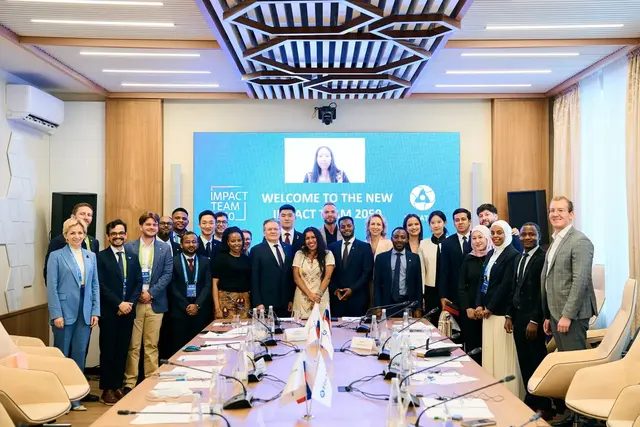
Tashkent, Uzbekistan (UzDaily.uz) — The third meeting of the Advisory Council of the International Research Centre IRC MBIR was held in Tashkent, bringing together more than 150 participants from 72 organisations across 18 countries.
Participants discussed expanding international cooperation in nuclear research using the MBIR multipurpose fast-neutron research reactor under construction in Russia.
The meeting took place on 29 September 2026 at the Institute of Nuclear Physics of the Academy of Sciences of Uzbekistan. The agenda covered testing nuclear fuel and structural materials for next-generation reactors, producing medical radioisotopes, radioactive waste management, validating computational codes and training specialists.
Petr Chakrov, head of the Research Reactor Section at the International Atomic Energy Agency (IAEA), delivered a message from the agency to participants.
He stressed the importance of materials research for the development of advanced nuclear energy and highlighted MBIR’s potential. According to the IAEA’s assessment, the reactor is expected to have the highest neutron flux of any fast-neutron research reactor in the world.
The reactor is being built in Dimitrovgrad at the site of the Research Institute of Atomic Reactors (RIAR), which belongs to Rosatom’s scientific division. The institute, which will operate the facility, has received designation from the IAEA as an International Centre based on Research Reactors (ICERR).
Installation of equipment in the primary circuit is continuing at the site. In 2026, two emergency heat exchangers, each weighing 7.3 tonnes, were installed in their designated positions.
Stepan Kalmykov, chairman of the IRC MBIR Advisory Council and vice-president of the Russian Academy of Sciences, said the centre’s research programme was important for closing the nuclear fuel cycle, reducing radioactive waste volumes and expanding the resource base for nuclear energy.
Evgeny Abakumov, Rosatom’s deputy director general for science and strategy, said the consortium had developed into an international platform for advanced nuclear research.
Arab Countries Interested in Joint Research
Developing cooperation with Arab countries was among the topics discussed at the meeting. Salem Hamdi, director general of the Arab Atomic Energy Agency (AAEA), recalled that the parties signed a strategic cooperation agreement in February 2026 covering joint scientific research and personnel training.
He said Arab countries were interested in testing materials and fuel for Generation IV reactors, producing medical radioisotopes, developing approaches to the safe management of radioactive waste and validating computational codes for regulatory authorities. The possibility of establishing a specialised Arab training centre is also under consideration.
Representatives of the atomic energy commissions of Jordan and Syria presented reports on reactor safety and operation, including the reliability of digital control systems and neutron activation analysis.
The Iraqi Atomic Energy Commission outlined opportunities to use the consortium to address national nuclear energy priorities.
Asia and Latin America Expand Participation
Brazil’s National Nuclear Energy Commission shared its experience in applying nuclear technologies outside the energy sector. Brazil’s Centre for the Development of Nuclear Technology also presented regional initiatives involving small modular reactors and microreactor technologies.
The China Nuclear Energy Association expressed its readiness to expand IRC MBIR’s experimental capabilities, participate in joint research and contribute to specialist training. The Vietnam Atomic Energy Institute presented plans for conducting research using the reactor.
Ilkhom Sadikov, director of the Institute of Nuclear Physics of the Academy of Sciences of Uzbekistan, said integrating the future MBIR’s capabilities with the country’s national research infrastructure, including the upgraded VVR-SM reactor and an accelerator complex, would create additional opportunities for applied science.
He identified materials research, computational code validation and radioisotope production as promising areas of cooperation.
Shavkat Ayupov, president of the Academy of Sciences of Uzbekistan, also pointed to growing interest among relevant organisations in cooperation through the consortium.
Fuel Research and Prospects for Small Nuclear Power Plants
During the meeting, participants reviewed research into materials and fuel for fast-neutron reactors, reactor-accelerator systems and controlled thermonuclear fusion facilities.
Representatives of Chinese research institutes and Russian company Proryv discussed tests needed to verify the properties of advanced materials and nuclear fuel.
The All-Russian Research Institute of Inorganic Materials (VNIINM) presented developments related to the fuel cycle of a molten-salt research reactor, while the Faculty of Chemistry at Lomonosov Moscow State University shared its experience applying artificial intelligence in materials science.
Vasily Konstantinov, director general of LLC Consortium Leader IRC MBIR, discussed the possibility of using technological solutions developed for the project in the design of a small nuclear power plant. He said the power unit could have an electrical capacity of around 50–55 MW.
Andrey Shadrin, representing the Science and Innovations organisation, said MBIR was intended, among other purposes, for testing accident-tolerant nuclear fuel and fuel for gas-graphite reactors, as well as for researching structural materials.
He also outlined Russia’s plans to begin reprocessing spent MOX fuel from the BN-800 reactor in 2027 and manufacture regenerated MOX fuel in 2029, with the aim of fully closing the nuclear fuel cycle.
According to Science and Innovations, more than 800 research reactors have been built worldwide, of which 234 are operating or temporarily shut down. The organisation’s analyst Nikolai Arkhangelsky noted that countries with such facilities planned to extend their service lives and build new reactors to replace those being decommissioned.
At the end of the meeting, participants refined the research requirements of developers of innovative energy systems and reaffirmed their interest in long-term scientific cooperation.
The IRC MBIR consortium is open to new members, who will be given priority access to future reactor experiments to support their national programmes for the peaceful use of nuclear energy.