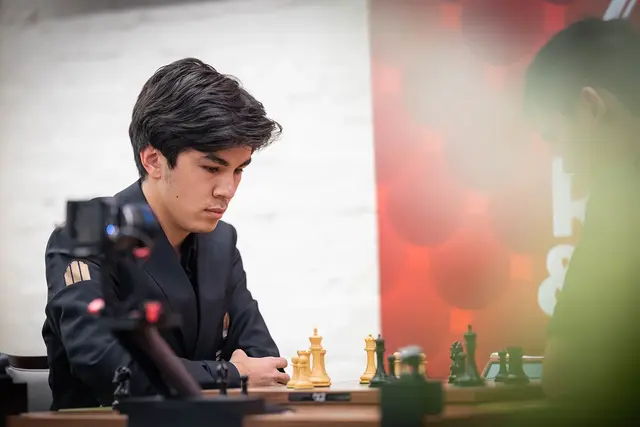
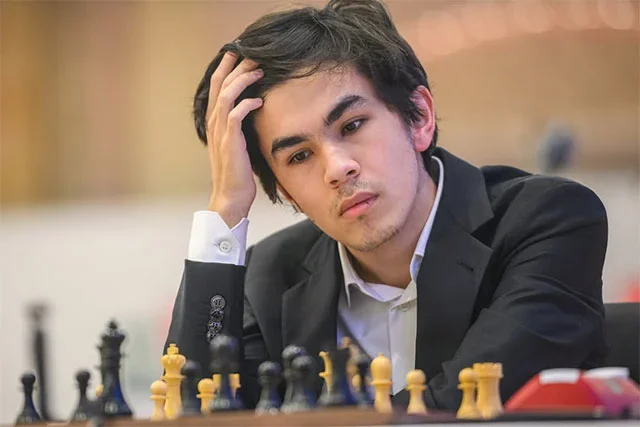
Tashkent, Uzbekistan (UzDaily.uz) — The first game of the 2026 World Chess Championship match between Uzbekistan's Javokhir Sindarov and India's Gukesh Dommaraju ended in a draw. The game took place in Geneva, with Sindarov playing White. Both players praised the quality of the game at a post-match press conference, FIDE reported.
Draw in the opening game
The game began with the Berlin Defence. Sindarov said players generally use the first game of a match to assess their opponent and adopt a cautious approach.
"If you have a chance, you always try to win, regardless of which game it is. But in the first game, you are more likely to try to understand your opponent and play safely. I did the same: I tried to keep the position under control and put pressure on the clock. But towards the end, my opponent defended very well, and a draw is not a bad result," he said.
A Chess.com representative noted that Sindarov had previously had around 20 opportunities to exchange pieces on c6 and enter the Berlin endgame, but had never done so before. The Uzbek player explained that he chose this approach because he wanted to get accustomed to the playing hall and maintain control without forcing the position.
Key moments
Sindarov identified Gukesh's move Bd7 as the first important moment. He knew the move but considered it illogical and spent a long time thinking. The Uzbek initially wanted to play Rd2 but chose c4 instead. After the game, he concluded that the rook move might have been practically stronger because it would have allowed him to conceal his intentions for longer.
Gukesh considered the 17th move the key moment. After b3, he played Bb4 and Rh6, saying he had spent considerable time finding this precise continuation. He described White's Ke1 as a very interesting move.
Sindarov admitted that he had underestimated the strength of Kf6, which allowed the black king to reach a safe position. In his view, Rb2 offered the best practical chances, as it would have left Black in a very uncomfortable position. Gukesh said he had considered Rb2 but could not remember what he had intended to play in response.
On move 19, Sindarov considered Kh2 and Ng3. He explained that he chose Ng3, hoping to launch a pawn advance with g4, f4 and f5. Asked about another variation, he jokingly demonstrated a line on the board that, in his words, led to a draw: "and you can go home".
Time management
Gukesh entered time trouble, with no additional time being granted at the first time control. However, he said the situation remained under control because he had already worked out his next moves. He acknowledged that he had played slowly before speeding up towards the end.
According to Sindarov, Gukesh spent around 40 minutes on one move. While his opponent was thinking, Sindarov went to the players' rest area.
"I'm not just passing the time. I'm thinking about what moves my opponent has," he said.
Sindarov had expected Gukesh to spend no more than 20–25 minutes considering those moves, but the position remained equal. He added that he had experience with such breaks from the Candidates Tournament.
Why the draw was not agreed immediately
Sindarov believed the position had already been repeated three times. However, the arbiter explained that the rules required a player to record the move and then offer a draw. The players made two more moves before Sindarov proposed a draw.
"Rules are rules," he said.
Match atmosphere
Sindarov acknowledged that the chess world was following the match and that the pressure was considerable, but said he was trying to concentrate solely on the game.
VIP guests arrive on the upper level of the playing hall every hour. The press conference moderator explained that spectators' phones had been approved by the organisers and were intended only for taking photographs. A Chess.com representative clarified that the devices had no SIM cards.
Gukesh said spectators enter and leave the hall as viewing groups change, and the floor sometimes creaks, but these things do not distract him. He noted that there had been even fewer spectators nearby in the glass playing enclosure in Singapore, where he contested his previous World Championship match. He described the opportunity for spectators to see the players up close as a positive feature.
Sindarov said professional players should be prepared to compete under any conditions. He added that he was pleased fans could watch the match from close range and that playing on a single board without spectators would be boring.
Asked about their behaviour at the board, Gukesh said both players had their own habits: Sindarov rocks his leg, while he himself closes his eyes. He said they behave this way at every tournament.
Sindarov added that Indian chess players often meditate at the board and that he was accustomed to this.
The second game of the match will take place the following day at 15:00 Geneva time.