Tashkent, Uzbekistan (UzDaily.uz) — A US$172.3 million project by the Asian Development Bank (ADB) is expanding access to piped drinking water in six rural districts of Karakalpakstan, with 326,000 residents set to receive round-the-clock supplies.
The project covers Amudarya, Beruni, Karauzyak, Kungrad, Nukus and Muynak districts. For many households, it is the first time they have had running water at home. Previously, residents carried water in buckets, transported it in containers on carts or pumped it from wells by hand.
Kerder, the last settlement connected to the new water supply system in Nukus district, is home to 4,000–5,000 people. Before the project, the village had no centralised water supply. It now receives water around the clock.
"Previously, there was no water in Kerder at all. People drank water from the canal or from wells using hand pumps. Today, they can use water 24 hours a day," said Azamat Saparov, regional coordinator of the ADB project implementation group in Karakalpakstan.
Residents previously had to travel long distances by cart to collect drinking water. "Imagine it raining, the streets turning to mud, and people having to travel several kilometres every day just to fetch 30–40 litres of water. Now every household has access to good-quality drinking water, and there is no longer any need for that," the project representative said.
From limited access to wider coverage
When the project was prepared, only 36.6% of Karakalpakstan's population had access to centralised water supply. In rural areas, the figure was 12.9%. According to the ADB, 40% of households received water for fewer than six hours a week, often at low pressure. Around 75% of families complained that their water was salty and hard. Others bought expensive delivered water or relied on contaminated sources.
Today, 75.1% of the republic's population has access to centralised water supply, according to Jamoliddin Sagatkaliev, deputy director of Karakalpakstan Suv Taminoti JSC.
The ADB project comprises nine construction contracts. Four have been completed and five are under way. Two new water treatment plants are being built, while two existing facilities are being expanded.
Overall, the project involves constructing or reconstructing three water treatment plants, around 300 kilometres of main pipelines, 28 water distribution centres and approximately 900 kilometres of distribution networks. Individual household connections include the installation of water meters. The project has also established laboratories to test the quality of water supplied to residents.
The next stage of cooperation with the ADB is expected to focus on sewerage, Saparov said.
Nukus district: coverage rising towards 100%
In Nukus district, an US$11.4 million project has involved laying around 256 kilometres of water distribution networks and reconstructing the Madaniyat, Abadan and Kerder water distribution centres.
The work was carried out by a contractor from Azerbaijan. Six reservoirs have been built at the centres, alongside laboratory and chlorination equipment.
Water is transported from Nukus through a 400-millimetre pipeline to the district centre of Akmangit, and then to Madaniyat, Abadan and Kerder. Residents of 35 settlements, a total of 31,100 people, have received centralised drinking water for the first time.
Before the project, 68.4% of the district's residents had access to centralised water supply. The figure has now reached 89.7%.
The remaining villages are located far from the main pipelines. The most remote, Kyzyl Uy in the Kerder citizens' assembly, has been included in the 2027 state programme. Budget funding will cover the construction of 3.5 kilometres of pipelines and a plant to desalinate groundwater. Once completed, coverage in the district is expected to reach 100%, Sagatkaliev said.
Nukus district governor Ziyauatdin Zaitov said the project had had a positive effect on residents' morale and expressed hope that improved water access would help prevent disease and improve public health.
Yuldashbay Utegenov, imam of a village mosque, recalled that residents had previously relied on a single hand-pumped water point. People gathered there and carried water home in buckets. Now, pipelines bring water into both yards and houses.
"Thank God, everything is good for us now," an elderly village resident said.
Amudarya district: water from the Amu Darya
Amudarya district has a population of 220,000, making it the most densely populated district in Karakalpakstan. Around half of its residents are connected to the central water supply. The rest rely on canals, irrigation ditches, wells and artesian boreholes.
Two projects worth a combined US$42 million are under way in the district. Once completed, they are expected to increase water supply coverage to 82%.
Previously, part of the district received water from an old facility in the district centre. Water was taken from the Arnabay canal, allowed to settle and then chlorinated. Other villages depended on a pipeline from Gurlan district in Khorezm region. Karakalpakstan Suv Taminoti paid Khorezm for the water, but there were no chlorination stations along the route.
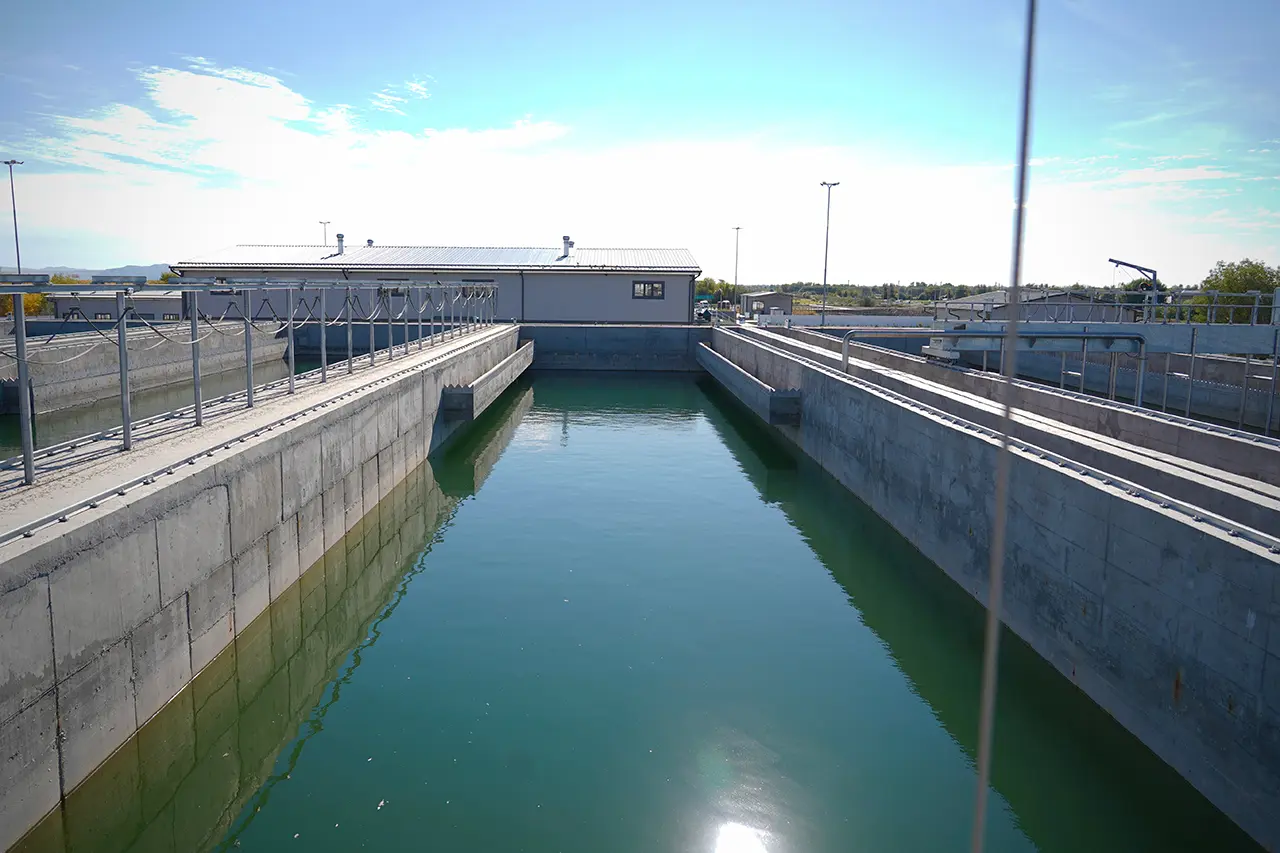
The first project involved the construction of the Mangit water treatment plant, financed by an ADB loan of around US$13 million. The facility has been built and has passed testing. It has a capacity of 40,000 cubic metres, or 40 million litres, a day — enough to supply 200,000 people.
The Amu Darya carries large amounts of suspended sediment, so a natural settling pond covering eight hectares was built next to the plant. The water then undergoes coagulation, passes through four self-cleaning horizontal settling tanks and is filtered using zeolite from Samarkand and Surkhandarya regions.
Water used to wash the filters is returned to the treatment cycle rather than discharged into the river or irrigation channels. A laboratory on the plant's second floor takes samples and tests the quality of water supplied to residents according to an approved schedule, which can include hourly checks.
From Mangit, water travels through a 900-millimetre pipeline. The route runs 16 kilometres to the district centre and then continues to the villages of Kylychbay, near the Turkmenistan border, and Kuykoprik, near the Khorezm border. Residual chlorine levels are checked at distribution centres, where additional chlorination is carried out if necessary.
The plant was designed by Uzbek company Uzbekkommunalloyihakurilish and built by local company Obi Hayot.
The second project, worth US$29 million, involves laying 260 kilometres of pipelines to deliver treated water to residents. It is being implemented by a contractor from Azerbaijan. Work is 75% complete and is scheduled to finish by the end of 2026.
Once the networks are connected, the plant is expected to supply more than 180,000 residents. Around 70,000 of them will receive centralised water for the first time.
The old facility, which currently supplies 110,000 people, will be shut down, with all users transferred to the Mangit supply line. The remaining 18% of the district's population is expected to be connected in stages through the state budget and other programmes.
On-site laboratory replaces 20-kilometre sample trips
Water supply across the republic is managed by the Tuyamuyun–Nukus Interregional Water Pipeline Operations Department. Most of its network was built during the Soviet period and is now heavily worn, resulting in substantial water losses.
Unreliable service undermines consumer confidence and willingness to pay. This, in turn, constrains tariffs and weakens the utility's finances. More than 40 measures to improve corporate governance have been introduced as part of sector reforms.
In Nukus district, the manager, an engineer and a customer service officer previously shared a room in an old, unsafe single-storey building. The project has provided a new complex.
The ground floor houses a customer service department where residents submit meter readings and pay their water bills. The second floor contains a laboratory. Nearby are a workshop equipped with welding machines and lathes, a garage for emergency vehicles and a warehouse. The district water service employs 41 people.
Villages in Karakalpakstan are located 15–30 kilometres apart. Previously, staff collected water samples in plastic bottles and transported them 20 kilometres to the main office in Nukus for testing. The new laboratory can carry out analyses on site within 1–1.5 hours.
The equipment was selected in line with ADB requirements with the involvement of international consultants and purchased through a tender. Staff said that even the main republican laboratory in Nukus city, which is outside the project, does not yet have similar equipment.
"We did not have facilities like this before," said a laboratory employee named Ortik.
Under the applicable standard, water hardness must not exceed 10 milliequivalents per litre. Tests show that the water supplied to district residents has a hardness of 4.5–5 milliequivalents per litre.
The laboratory is to recruit another three or four technicians. The equipment supplier will train them and is contractually obliged to provide a warranty for the equipment.
The project also provides for a training centre for water utility specialists, a system for processing public complaints, water loss monitoring, a geographic information system and hydraulic modelling.
Consultations with mahallas and local non-governmental organisations were held during the preparation stage. Public organisations are training residents in hygiene and water conservation. The project also has a gender equality action plan.
Why water is a critical issue for the region
Karakalpakstan lies in the Aral Sea region, which is experiencing an environmental crisis. Surface water is scarce, while groundwater is mostly saline and expensive to treat to drinking-water standards.
The ADB's project description notes a frequent link between water quality and waterborne diseases.
According to Karakalpakstan's Socio-Economic Development Strategy, presented by ADB regional cooperation specialist Bekhzod Djalilov, around 80% of arable land is affected by salinity. Only 5% of irrigation canals have concrete lining, while water losses in unlined canals reach 40%.
The exposed seabed of the Aral Sea covers more than 5.5 million hectares. More than 43 million tonnes of dust and salt are lifted from it each year.
The strategy forecasts that average annual temperatures in Karakalpakstan will rise by 3.2°C in 2041–2070 compared with 1970–2000.
Agriculture accounts for around 90% of all water use in Uzbekistan. Approximately 80% of the country's surface water resources originate in the upper reaches of rivers outside its borders.
"We inherited an old canal system from the Soviet period, designed around cotton production. This infrastructure has deteriorated badly, and we lose a lot of water," Djalilov said.
He added that the strategy would also focus on end users. "We cannot continue washing cars in garages and wasting scarce water," he said.
Project funding and timetable
Of the project's total cost of US$172.3 million, US$145 million is an ADB concessional loan and US$27.3 million comes from the government. The entire loan is allocated to Karakalpakstan.
The project was approved in May 2018, and the loan agreement took effect in May 2019. It covers six districts and 116 rural settlements. Around 178,000 of the people expected to benefit are women and children.
As of 6 August 2026, contracts worth US$136.2 million, or 94% of the loan amount, had been awarded. Disbursements stood at US$84.7 million, or 58%, according to the ADB.
When approved, the project was scheduled for completion by July 2024. The loan closing date was subsequently moved from 31 January 2025 to 31 January 2027. The regional project coordinator said a further extension into the following year was planned.
ADB senior portfolio management specialist Nilufar Nurkuziyeva said the bank's active sovereign operations in Karakalpakstan exceeded US$780 million.
"More than 40% of our current portfolio is directly or indirectly related to Karakalpakstan. This is a significant amount directed towards supporting economic and social reforms," Nurkuziyeva said.
Water supply was one of the ADB's first areas of work in the region. An urban water supply project in Nukus and Beruni began in 2001, followed in 2002 by a rural water supply programme for drought-affected communities in Karakalpakstan and Khorezm.
"We have focused heavily on Karakalpakstan over the past 30 years, with a significant share of our investment directed to this region. We pay particular attention to vulnerable people and areas, including remote districts, to ensure they do not fall behind the rest of the country," said Kanokpan Lao-Araya, director of the ADB's Uzbekistan Resident Mission.
Next steps
Another ADB project, "Climate-Resilient Water Management in the Aral Sea Basin", is directing US$64.1 million, or 43% of its loan amount, to Karakalpakstan.
The regional development strategy proposes building a new water treatment plant in Nukus to serve expanding residential areas. It also calls for resolving supply interruptions and low water pressure in the district centre of Takhtakupyr.
Another priority is replacing worn-out pipes that allow water to become contaminated on its way to consumers. The strategy also calls for checks to ensure that new networks actually provide safe drinking water from household taps.
Wastewater treatment for irrigation and industrial use is another area of focus.
"This is the future. There is no avoiding it," Djalilov said.
Karakalpakstan is currently home to more than 2.16 million people, or 5.5% of Uzbekistan's population. The region's population is forecast to increase by 400,000 by 2050.
In Kerder, residents no longer have to collect water by cart. It now flows from their taps around the clock.