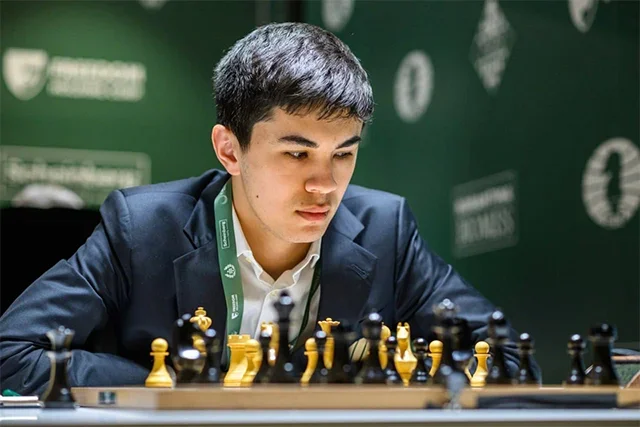
Tashkent, Uzbekistan (UzDaily.uz) — Javokhir Sindarov said he had not expected Gukesh to play the London System in the second game of their World Chess Championship match, but had analysed the variation extensively beforehand. The players discussed the game at a press conference in Geneva.
"It was not a big surprise for me because the variation is very playable," Sindarov said. The Qb6 move discussed by commentators, as well as the timing of its introduction, had been part of his preparation.
Gukesh explained that modern chess engines make almost every opening playable for both colours. He said no opening could be considered better than another, adding that the London System could provide a small surprise early in the match.
The world champion acknowledged that he knew the Qb6 move but could not fully remember what he had planned to do next. "I could have remembered more from my notes," he said. Gukesh added that failing to obtain an advantage from the opening was a normal outcome in a world championship match.
He praised his opponent, saying Sindarov had been well prepared and knew the variation despite being surprised by the opening choice.
Sindarov said his plan involved the moves Qd8 and Bb8, followed by a knight manoeuvre to e7 and f5. He said he had executed the plan at the best moment.
Gukesh admitted that he had underestimated the plan involving Be8 and Nd7. After Black played f5, he could not find a way to advance either e4 or c4, particularly after the moves f3 and Nf6.
Before playing f3, Gukesh spent about 30 minutes thinking and tried to find an opportunity with c4. Sindarov said he had been ready to play against c4 and calculate all the variations. However, at first glance, Black's position appeared sound.
After cxd5, Sindarov would have responded with Nc5. Gukesh agreed that this move would have killed White's chances of making progress.
At one point, Gukesh considered capturing the pawn on e5, which would have allowed the tactical response Ne4. He assessed that Black would have sufficient compensation in that position.
The move a5 was the top choice of both the chess engine and FIDE's prediction service. However, Gukesh said he could not see how to proceed even after that move.
Sindarov added that he would have responded with either a6 or Nh8, saying it was difficult to formulate plans in such a position.
The Uzbek player expected the game to end with repeated moves because Gukesh had spent considerable time thinking. The Indian had about 45 minutes remaining for his next 20 moves.
According to Sindarov, the position was very safe for both sides. White would find it difficult to advance e4 or c4, while Black could not play e5.
Asked why he had decided not to continue playing, Gukesh said that an opponent equalising the position did not mean he had to agree to a draw. He could not see how to create serious problems in the position, while active play would involve risks.
"You hope your opponent makes a mistake somewhere, but it is equally likely that you will get into trouble yourself," Gukesh said. He added that he might have continued playing if the c4 move had worked.
Gukesh recalled that if all the games ended in draws, the match would go to a tiebreak. He would not retain the title without winning it.
He said the right moment to take risks depended on how the match developed and that it was too early to think about it.
Asked about the two consecutive draws at the start of the match, the world champion said he would have preferred to win both games. Neither player had obtained any real winning chances, which he considered understandable after months of preparation.
The match consists of 14 games, so Gukesh said it was too early to think about the overall score. He added that he was feeling well and energetic.
Gukesh also explained why he had not responded to Qb6 with Qb3. Although the move was not bad, it would have allowed Nh5 in this position. He also knew that he needed to play Rb1, meaning he was still following his preparation.
A journalist from Lichess.org recalled that Gukesh had used the London System against Alireza Firouzja at the 2023 Norway Chess tournament. At the time, Hikaru Nakamura had suggested that Gukesh wanted to steer his opponent away from established theory.
Gukesh said the London System also contained considerable theoretical material nowadays and that he had expected his opponent to have something prepared.
"It was not some deep strategy," he said.
Gukesh added that he had played the London System extensively, probably during the pandemic lockdown. As a result, he described it as a nostalgic opening for him.
The players were also asked about so-called "quick classical" games with a time control of 45 minutes plus 30 seconds per move, used at the Total Chess tournament.
Gukesh said 45 minutes was closer to a 30-minute rapid game and questioned whether it was appropriate to classify such games as classical chess.
He cited a queen blunder at a tournament in Prague that had been counted towards the classical rating. "It is simply sad," he said, arguing that games played under this time control should not count towards the classical rating.
Sindarov agreed that the format fell somewhere between rapid and classical chess. He said he had not played under these conditions himself and would give his opinion after participating in his first tournament.
He considered the format interesting for spectators but more demanding than classical chess. Players compete in two games a day, and time runs out faster than it might seem at the beginning.
Asked whether he was getting enough sleep, Sindarov said he felt well and was sleeping normally.
While his opponent was thinking, he tried to relax a little but continued considering possible moves. He explained that calculating long variations was impossible in such positions, so he instead considered the ideas his opponent might play.
"I am always focused," the chess player said.
The moderator added that players yawn during games because of nervous tension rather than boredom.
Before the game, Sindarov spoke with his second, Nikita. He said their conversations were not about variations but about psychological matters. Sometimes, they did not discuss chess at all, allowing him to relax and avoid becoming nervous.
A journalist referred to comments by Sindarov's coach, international master Roman Vidonyak, who had said that his main reason for being in Geneva was to provide psychological support.
Sindarov explained that it was a new experience for both of them and that they were trying to understand the demands of a match at this level.
They talked about everyday life and sometimes played card games and other mini-games around midnight.
Gukesh said that his father had accompanied him in 2024, while he had travelled to Geneva with his friends Shikhar and Charmy. He described them as some of his closest friends and said spending time with them helped relieve stress.
Gaevsky was also with him in Geneva. Gukesh said it was enjoyable to spend time with him beyond their chess-related work.
Asked whether his team had changed since the Singapore match, Gukesh said Gaevsky was with him in Geneva and that he might reveal more about the rest of the team later.
He added that he felt much happier away from the chessboard than he had in Singapore and credited his friends for much of that change.
Speaking about his work with Paddy, Gukesh said they discussed general matters, including performance, behaviour at the board and preparation.
He attributed his calmness to his young age and the fact that people change over time. He said he had simply become a little calmer and that the change had not been planned.
Sindarov was asked whether he might play the King's Indian Defence against 1.d4 during the match.
"We will see. Who knows?" he replied, adding that players did not discuss such things at press conferences.
Gukesh explained that he had left the playing hall to go to the toilet before the game began.