Special project · World of Chinese Auto
Who's really behind Chinese cars
Dozens of badges, often the same factory behind them. We map the groups hiding behind the brands flooding Central Asia's roads — how many cars they build, who really owns them, and what sets one ‘clan’ apart from another.
▾ Scroll down
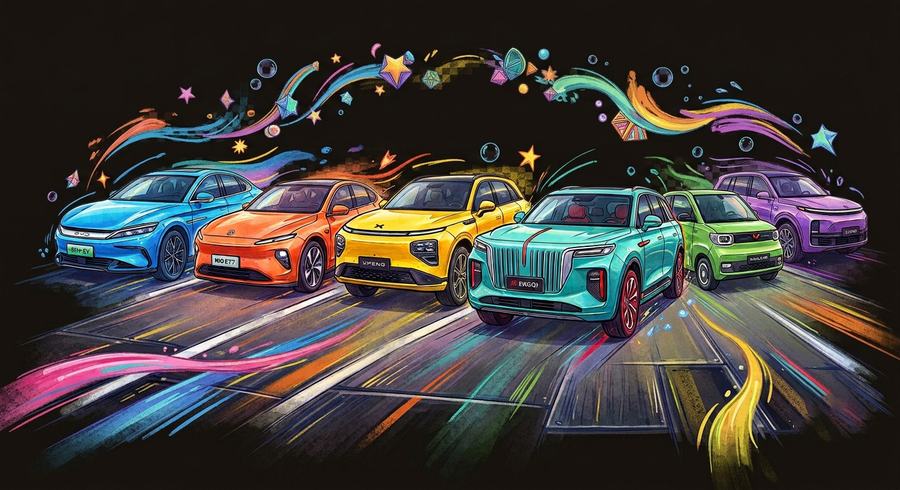
34.4M
cars sold in China in 2025 — up 9.4% year on year
8.32M
vehicles exported from China in 2025 (+30%) — world’s top exporter for the 3rd year running
>70%
share of Chinese brands in China’s domestic passenger-car market
3 of 10
Chinese groups in the world’s top 10 automakers: BYD (5th), Geely (7th), Chery (10th)
Who sells the most
Total 2025 shipments of China's major auto groups. Five state-owned groups' totals include joint-venture output with Volkswagen, Toyota, General Motors, Honda, and other foreign brands — marked with an asterisk.
Data from CPCA, MarkLines, CnEVPost, Gasgoo, and company reports for 2025; some figures are rounded.
12 groups behind the whole industry
Click a group's card to see its brands — what they sell, how much, and why it's interesting.

BYD Group
Shenzhen · since 1995 (batteries), in autos since 2003
4.60M, 2025
Geely Holding
Hangzhou · since 1986, in autos since 1997
4.12M, 2025
Chery Holding
Wuhu, Anhui · since 1997
2.63M, 2025
Great Wall Motor
Baoding, Hebei · since 1984
1.32M, 2025

Changan Automobile
Chongqing · roots dating to 1862
2.90M, 2025
SAIC Motor
Shanghai · state-owned
~4.5M, 2025*
FAW Group
Changchun · since 1953, PRC’s first plant
~3.3M, 2025*
BAIC Group
Beijing · state-owned
~2.0M, 2025*
GAC Group
Guangzhou · state-owned
~1.72M, 2025*
Dongfeng Motor Group
Wuhan · since 1969, state-owned
~1.85M, 2025*

‘New Forces’ (independent EV startups)
NIO · Li Auto · XPeng · Leapmotor · Xiaomi Auto
2.16M combined, 2025

Huawei Alliance (HIMA)
AITO · Luxeed · Stelato · Maextro
0.59M (AITO), 2025
What this has to do with Uzbekistan
Uzbekistan is one of the few markets in the world where several Chinese groups are simultaneously building or have already launched local assembly. Three hubs stand out — Jizzakh, Tashkent, and Bukhara — and the list of brands on the assembly lines keeps growing.
- 109,200 electric vehicles according to the National Statistics Committee, as of April 1, 2026 Uzbekistan had 109,200 registered electric vehicles: Tashkent city — 79,851, Tashkent region — 8,194, Samarkand region — 4,525, Khorezm — 3,042, Kashkadarya — 2,611, Fergana — 2,231, Navoi — 1,756, Bukhara — 1,685, Andijan — 1,477, Namangan — 1,156, Karakalpakstan — 1,010, Syrdarya — 799, Jizzakh — 517, Surkhandarya — 315
- BYD Uzbekistan Factory in Jizzakh — BYD’s first plant for private buyers outside China; built in under 2 years, launching with the Chazor and Song Plus; first-phase capacity 50K cars/year, investment around $160M
- ADM Jizzakh (formerly Roodell) — a multi-brand site: as of early 2026 assembling and distributing Chery, Haval, Tank, Changan, Kia, and Hyundai Truck & Bus; operating since March 2021 (SKD), with full CKD assembly since March 2024 (the first model was the Kia Sonet); construction of a new CKD shop for EVs and hybrids (NEV) began in December 2025
- JAC — opened assembly in Tashkent in 2026: commercial vehicles (including the M3 model competing with the local Chevrolet Damas), plus passenger models — JAC sedans and crossovers (T8, T9, JS8, Refine RF8)
- Leapmotor — agreed in April 2026 with the Bukhara regional administration to assemble five models (B10, B10L, A10, C01, C16); starting with 20K cars in 2026 (~$50M), rising to 40K in 2027 and 60K in 2028, with a five-year target of up to 200K cars a year; the project aims to turn Bukhara into Central Asia’s auto and logistics hub
- Component localization at these sites already covers bumpers, glass, seats, plastic parts, and wiring; batteries, wiring harnesses, and some powertrain units are planned next
- The state has zeroed out duties on EV components and exempted local EV assembly from the recycling fee