Stay up to date with the latest news
Subscribe to our telegram channel

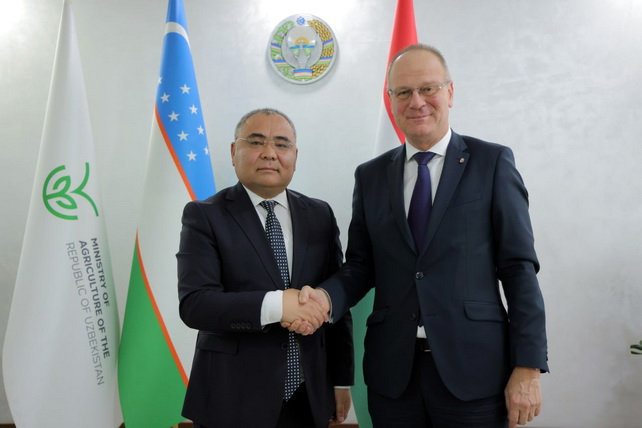
Uzbekistan and Hungary Expand Cooperation in Agriculture and Regional Development
Tashkent, Uzbekistan (UzDaily.com) — Uzbekistan and Hungary continue to deepen cooperation in agriculture and regional development. On 3 December, Uzbekistan’s Minister of Agriculture, Ibrokhim Abdurakhmanov, held a meeting with Hungary’s Minister of Public Administration and Regional Development, Tibor Navracsics.
During the talks, both sides discussed ways to elevate bilateral cooperation, expand joint initiatives in agriculture, and advance regional development projects.
The meeting began with an exchange of views on the current state of collaboration and the phased implementation of ongoing projects. Special attention was given to agricultural education, poverty reduction in rural areas, employment generation, and the creation of new economic opportunities. Practical results of modern support mechanisms for rural populations were also reviewed.
Minister Abdurakhmanov presented additional income sources for rural residents and highlighted innovative approaches applied in Uzbekistan. Emphasis was placed on supporting youth and startup projects aimed at engaging young specialists in the agricultural sector, creating favorable conditions for them to apply their knowledge in practice, and ensuring sustainable development in rural areas.
The practical value of Hungary’s experience in improving local self-governance and enhancing administrative efficiency was also highlighted.
As part of the knowledge exchange, it was proposed to establish working groups with experts from both countries to collaborate on institutional governance, digitalization of mahalla operations, and improving management efficiency.
Furthermore, potential cooperation in digital solutions for agricultural data management, monitoring agrotechnical processes, and optimizing land and water use was discussed.
At the conclusion of the meeting, the parties reached preliminary agreements on continued knowledge exchange, expert engagement, joint program development, and support for investment projects.