Stay up to date with the latest news
Subscribe to our telegram channel

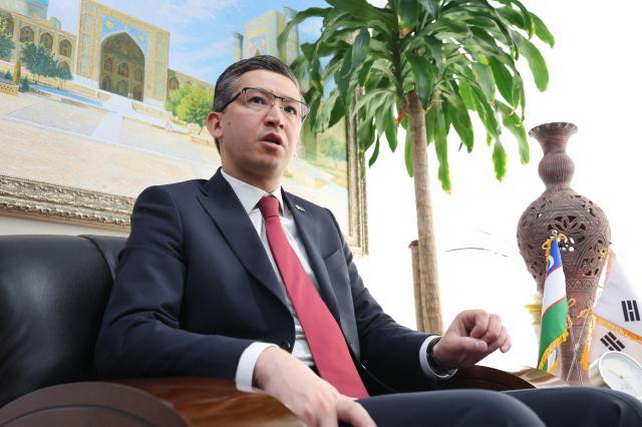
Uzbekistan Aims to Become Central Asia’s Key Transport and Logistics Hub Through Partnership with South Korea — Ambassador
Tashkent, Uzbekistan (UzDaily.com) — Uzbekistan is seeking to establish itself as a major transport and logistics hub in Central Asia, leveraging its strategic location and expanding infrastructure cooperation with South Korea, the country’s senior diplomat told the South Korean publication AJP.
“True diplomacy is when political dialogue transforms into production chains, investments, and jobs,” said Alisher Abdusalomov in an exclusive interview on Wednesday.
Landlocked, Uzbekistan heavily relies on rail networks for freight and passenger transport across Eurasia.
This strategy received a boost with the introduction of a high-speed train manufactured by the South Korean company Hyundai Rotem, specializing in defense and railway technology. The train, named Jaloliddin Manguberdi, is currently undergoing test runs on the Tashkent–Khiva line.
“High-speed rail is not only about speed of travel. It is speed of economic transformation,” Abdusalomov said, adding that the government is considering not only the purchase of trains but also the creation of comprehensive service centers for maintenance, overhauls, and local assembly of components.
“Acquiring equipment is the first step. Developing industrial competence is the strategic goal,” the diplomat emphasized. “Who maintains the infrastructure becomes its strategic center. We aim not just to operate modern trains but to enter the global railway industry.”
Infrastructure modernization is a key element of the Uzbekistan-2030 strategy, aimed at placing the country among the world’s top 50 economies. Achieving economic and social goals requires large-scale digital transformation, prompting the government to adopt South Korean solutions in e-government, smart logistics, and big data analytics across the region.
Cooperation also covers physical infrastructure through public-private partnerships, exemplified by the modernization of Urgench International Airport in collaboration with Incheon International Airport Corporation. Abdusalomov noted that the project will serve as a regulatory model for the planned New Tashkent International Airport and future smart city systems.
“Modern infrastructure starts not with concrete, but with a philosophy of management,” said the ambassador.
With global economies shifting toward digital and green technologies, demand for critical minerals such as copper and lithium has grown. South Korea currently leads the Minerals Security Partnership Forum (FORGE), aimed at strengthening global supply chains.
Uzbekistan has significant reserves of these resources but is moving away from traditional raw-material exports toward complete industrial value chains. The foundation was laid in 2019 with the establishment of a joint rare metals research center in Uzbekistan in cooperation with the Korea Institute for Rare Metals.
“Technological futures start with sustainable access to resources,” Abdusalomov said. “We are not talking about abstract prospects — we are already building joint scientific and industrial infrastructure.”
Resource integration is expected to be a central topic at the first South Korea–Central Asia Summit, aligning with South Korea’s initiative to connect the region through technological and industrial networks.
In 2017, South Korea was among the top four foreign investors in Uzbekistan but fell to around 10th place after inflows from China, Russia, Turkey, and EU countries. Restoring South Korea to the top three investors is now a key embassy objective.
To attract investment, Abdusalomov highlighted institutional incentives for foreign companies, including broad tax benefits, reduced customs duties, and state support for infrastructure development. He also emphasized macroeconomic stability, predictable exchange rates, and Uzbekistan’s status as the most populous country in Central Asia.
The ambassador stressed that political agreements expected at the upcoming summit require long-term vision:
“Strong states are measured not by the loudness of their statements but by the ability to think decades ahead and consistently implement decisions,” he said.
Officials from both countries are currently developing financial and institutional mechanisms to implement the proposed industrial, digital, and transport projects ahead of the first summit, scheduled for the second half of this year.