Stay up to date with the latest news
Subscribe to our telegram channel

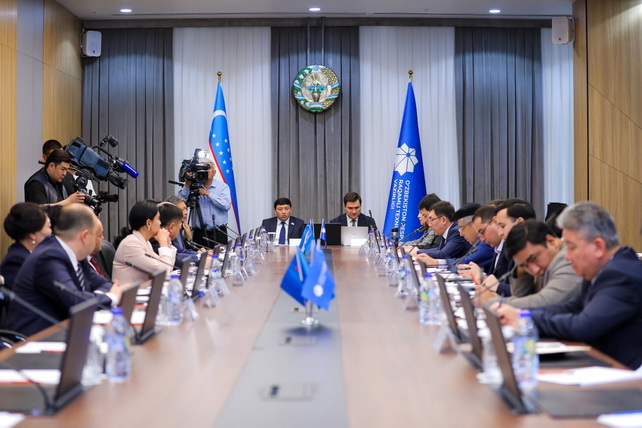
Uzbekistan Accelerates Space Sector, Plans Satellite Launch
Tashkent, Uzbekistan (UzDaily.com) — On 18 March, the Committee on Innovative Development and Information Technology of the Legislative Chamber of the Oliy Majlis, jointly with the Uzbekcosmos agency, held a roundtable on the current state of the space sector and its future development priorities.
The event was organized to review progress in implementing tasks outlined by the President of Uzbekistan in his Address to the Oliy Majlis and the nation.
The discussion brought together members of parliament, representatives of Uzbekcosmos, the Academy of Sciences, university researchers, industry experts, and media representatives.
The meeting focused on the integration of space technologies into the economy and the strengthening of the regulatory and legal framework.
As a result of systematic efforts, the use of Earth remote sensing data has reached a new level, supporting monitoring of agricultural land, water resources, urban planning, land cadastre, reservoir observation, and rapid detection of emergency situations.
Participants also reviewed laws and regulations adopted in recent years to support sector development and strengthen institutional capacity. These measures are creating a systemic approach to implementing space technologies and improving coordination among government bodies.
Particular attention was given to strategic initiatives defined for the first time in the country’s history: the launch of a national satellite and the training of Uzbekistan’s first cosmonaut. These projects are expected to serve not only as symbolic milestones but also as practical tools for advancing science, increasing youth interest in technology, and enhancing the country’s international profile.
The future space mission is expected to be linked to a concrete scientific program, which could stimulate new research projects and technological initiatives.
The roundtable also addressed prospects for international cooperation with leading space agencies, legislative aspects of the sector, and mechanisms for further improving the regulatory framework.
As a result, participants developed practical recommendations to support continued development of the space sector and ensure implementation of the President’s priorities.
Uzbekistan is planning to launch two Earth observation satellites with ultra-high resolution of 0.3 meters per pixel. The satellites will operate in orbit above 500 kilometers with an inclination of about 30 degrees and a service life of at least five years.
They will be capable of capturing black-and-white, color, and infrared imagery with a swath width of 10 kilometers and a daily coverage capacity of up to 30,000 square kilometers. With two satellites in orbit, the revisit time for the same area will be reduced to approximately 40 hours.
The project предусматривает 3–4 years for planning, assembly, testing, and launch, with mandatory involvement of local specialists at all stages. The primary control station will be located in Tashkent, with backup stations in Azerbaijan and Türkiye, and a virtual station in Norway.
At the same time, as noted by Mukhiddin Ibragimov, two satellites will not be sufficient to fully meet domestic demand, while further expansion of the satellite constellation is constrained by financial limitations.
The roundtable findings confirm that Uzbekistan’s space sector is entering a new strategic phase focused on technological advancement, international cooperation, and the development of national scientific capacity.