Stay up to date with the latest news
Subscribe to our telegram channel

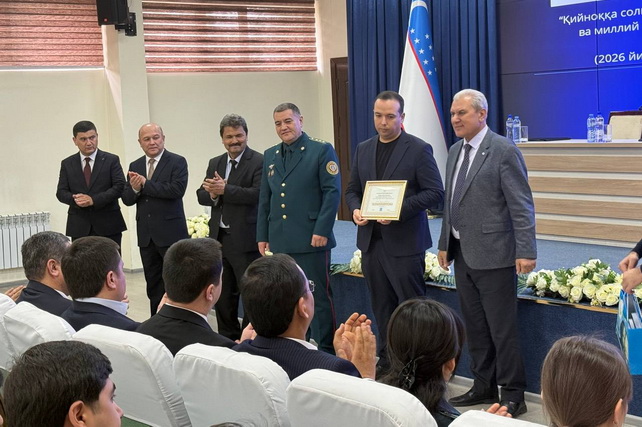
Tashkent Hosts Training Course on Combating Torture: International Practice and National Experience
Tashkent, Uzbekistan (UzDaily.com) — On 27–28 February, Tashkent is hosting a specialized training course titled “Combating Torture: International Practice and National Experience.”
The event is organized by the National Human Rights Center of Uzbekistan in collaboration with the General Prosecutor’s Office, the Supreme Court, and the Ministry of Internal Affairs of Uzbekistan.
The training is conducted in accordance with presidential decrees from 7 February 2023, “On Approval of the National Human Rights Education Program in Uzbekistan,” and 26 June 2021, “On Additional Measures to Improve the System for Detecting and Preventing Torture.”
The course brings together 65 employees from regional courts, prosecution and law enforcement agencies engaged in investigative, pre-investigative, and operational work, as well as representatives from penal institutions.
The primary goal is to deepen theoretical knowledge and develop practical skills for preventing and identifying cases of torture, in line with recommendations from UN treaty bodies and other international institutions.
Opening the course, Director of the National Human Rights Center, Academician Akmal Saidov, provided a detailed overview of the country’s reforms in torture prevention and emphasized their compliance with international standards. It was noted that the updated Constitution of Uzbekistan enshrines human rights and freedoms as the highest value, and their protection remains a priority of state policy.
The training highlighted Uzbekistan’s accession to the United Nations and ratification of the Convention Against Torture, as well as the systematic implementation of its provisions at the national level. The country regularly conducts training for law enforcement and judicial staff and strengthens public and ombudsman oversight mechanisms within penitentiary institutions.
During the course, Murodjon Turgunov, Director of the Institute of State and Law of the Academy of Sciences, presented a detailed analysis of the content and essence of the Convention Against Torture and Other Cruel, Inhuman, or Degrading Treatment or Punishment.
Alimjan Matchanov, Head of Faculty at the Ministry of Internal Affairs Academy, discussed international and national standards for preventing torture in relation to minors and women, as well as issues of presumption of innocence, legality of detention, and recording of complaints of abuse.
Lukmonjon Isakov delivered a report on the development of legislation related to the prevention of torture-related crimes, while Supreme Court Judge Sanobar Mamadalieva presented an analysis of judicial practice in relevant cases.
The first day also included practical exercises, where participants worked in groups to analyze specific cases and hone their skills in detecting signs of torture.
On the second day, Associate Professor of the MIA Academy, Kuvonch Kadirov, delivered a lecture on the content and significance of the “Nelson Mandela Rules.” Mekhmonali Suvonkulov presented a report on international standards for detention and arrest, prisoners’ rights guarantees, and accountability for committing acts of torture. International expert Azamat Shambilov conducted an online lecture on the revised Mandela Rules.
Farhod Khayitbaev, Head of Department at the National Human Rights Center, emphasized that Uzbekistan’s implementation of international obligations in the field of combating torture is closely linked to the National Human Rights Education Program. This program systematically enhances the qualifications of law enforcement personnel, strengthens knowledge, and fosters a sustainable culture of human rights protection.
Upon completion of the course, participants underwent final testing, and certificates were awarded to those who successfully demonstrated mastery of the material.
Such educational initiatives contribute to the continued strengthening of legal culture, the improvement of the national system for preventing torture, and the establishment of zero tolerance for any forms of treatment that degrade human dignity.