Rosatom Chief Showcases Advanced Solutions at Innoprom Central Asia Exhibition

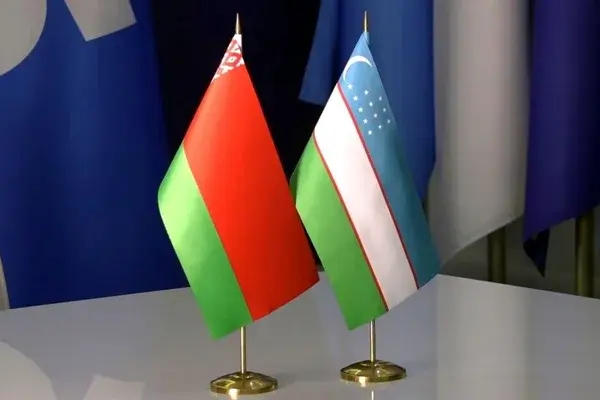
Tashkent, Uzbekistan (UzDaily.uz) — On 20 April 2026, Uzbekistan's Deputy Prime Minister Jamshid Khodjaev, Belarus Deputy Prime Minister Viktor Karankevich and First Deputy Chairman of the Russian Government Denis Manturov visited the stand of state nuclear corporation Rosatom at the sixth international industrial exhibition Innoprom. Central Asia, held in Tashkent.
Rosatom Director General Alexei Likhachev presented solutions in the fields of nuclear energy and electric mobility. The exhibit featured a model of an integrated nuclear power plant based on RITM-200N and VVER-1000 reactors, alongside electric mobility technologies including a lithium-ion cell, a lithium-ion battery module and a universal battery pack.
The integrated nuclear power plant format was formally approved for construction in Uzbekistan under a supplementary agreement signed on March 24, 2026 by Rosatom and the Uzatom agency. The project calls for building a small modular reactor plant and a large-capacity nuclear power station on a single site.
Upon completion of construction, the new plant configuration will cover up to 14 percent of the country's total electricity consumption. During the construction phase, approximately 13,000 workers will be employed simultaneously on site, while the operational phase of the integrated station will sustain around 2,000 permanent jobs. Particular attention during the stand visit was paid to the concept of an "atom city."
"Nuclear energy in Uzbekistan must become a driver of development across a wide range of sectors — from industry and science to education and social infrastructure. The city that will emerge near the plant will serve as a center not only for nuclear power but also for such promising fields as nuclear medicine, materials science, and sterilization technologies for agricultural produce, food products and medical devices. It is in such an atom city that a new community of scientists, technologists and researchers will take shape — people capable not only of acquiring cutting-edge knowledge but of making a genuine contribution to strengthening Uzbekistan's technological sovereignty and creating new growth engines for decades to come," said Alexei Likhachev.
Background
On May 27, 2024, during Russian President Vladimir Putin's state visit to Uzbekistan, a protocol was signed in the presence of both heads of state amending the intergovernmental agreement on cooperation in the construction of a nuclear power plant in Uzbekistan, expanding the bilateral framework to include a small modular reactor facility based on a Russian design.
At the same event, Atomstroyexport — the engineering division of Rosatom — and the Nuclear Power Plant Construction Directorate under Uzbekistan's Agency for Atomic Energy signed a contract for the construction of a small modular reactor plant in Uzbekistan.
On March 24, 2026, Rosatom and Uzatom signed a supplementary agreement to the contract providing for the construction of an integrated nuclear power plant in Uzbekistan.
The project will comprise two large-capacity power units based on Generation 3+ VVER-1000 reactors and two power units equipped with RITM-200N reactors rated at 55 MW each.
Electric mobility is one of the key areas of Rosatom's new business portfolio, covering the full production cycle from lithium mining through to the disposal of traction battery packs. Rosatom currently offers foreign partners energy storage systems, modern electric charging infrastructure, and is capable of producing more than 60 percent of all electric vehicle components in-house, including battery packs, electric motors, rare-earth magnets, microelectronic components, and polymer and composite materials.
Among the company's prospective charging solutions are booster charging stations with integrated storage capacity for fast charging in low-input-power conditions, highway stations designed for locations with no grid connection but available gas supply, and mobile charging units capable of servicing large parking areas across a wide zone.
The modular architecture of the electric vehicle battery — which through its internal configuration can be manufactured at voltages ranging from 300V to 800V — and the universality of its assembly allow for battery systems with a capacity of between 37 and 510 kWh, built from between one and twelve battery packs.
In late 2025, Rosatom commissioned Russia's first gigafactory for lithium-ion energy storage in the Kaliningrad region, with a second gigafactory in Moscow set to launch shortly.
Russia continues to develop international trade and economic relations with its foreign partners and to advance major international energy projects, with Rosatom playing an active role in this effort.