Stay up to date with the latest news
Subscribe to our telegram channel

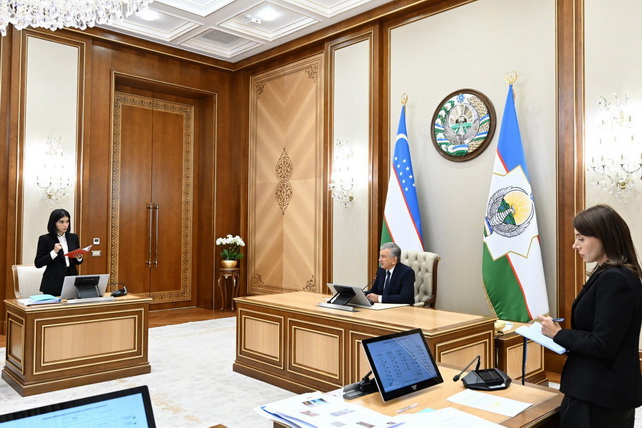
President Reviews Results of International Cultural Events and Tourism Development Projects in Uzbekistan
Tashkent, Uzbekistan (UzDaily.com) — President Shavkat Mirziyoyev of Uzbekistan reviewed a presentation on the outcomes of international cultural events, the next steps for tourism development, and the creation of major cultural and tourist infrastructure projects.
It was noted that in recent years the country has consistently strengthened its position in the international cultural arena.
In Samarkand, the 43rd session of the UNESCO General Conference was successfully held, attended by over 3,000 delegates from 190 countries. The session concluded with the development and approval of a roadmap for the practical implementation of Uzbekistan’s initiatives in the fields of cultural heritage protection, education, and creative industries.
Special attention was given to the country’s participation in EXPO 2025 in Japan. Uzbekistan’s pavilion, “Garden of Knowledge,” spanning 1,200 square meters, welcomed approximately one million visitors. The pavilion received widespread international coverage and ranked among the most visited. Preparations have also begun for EXPO 2030 in Saudi Arabia, where a pavilion of 3,600 square meters is planned.
The outcomes of the First Bukhara Biennial of Contemporary Art were summarized. Over 70 days, 14 restored cultural heritage sites across a 3.5-hectare area were utilized. The biennial featured 70 artists and curators from more than 40 countries, attracting around 1.8 million visitors, including over 100 high-ranking foreign guests. It was noted that Uzbekistan’s participation in the Venice Biennale since 2021 has contributed to increased tourist flows from Italy and expanded international professional contacts.
Major international concerts were held in the country: Jennifer Lopez performed in Tashkent, Andrea Bocelli in Samarkand, and Black Coffee in Khiva. During these events, hotel occupancy in host cities exceeded 90 percent, positively impacting tourism activity and service sector revenues.
In 2025, the number of tourists exceeded 11 million, export revenues from tourism reached $4.8 billion, and the number of countries whose citizens enjoy visa-free entry increased to 94.
At the same time, the need to transition the tourism sector to a project-based management system was emphasized, alongside the implementation of a unified mechanism for creating tourist products and enhancing coordination of major events.
Digitalization of the sector was highlighted as a priority. Plans include launching a National Tourism Platform integrating public and private information systems, introducing proactive digital services for tourists and entrepreneurs, expanding cashless payments, and analyzing tourist flows. Digitalization is expected to reduce the shadow economy and increase annual tourist fee revenues.
A new marketing strategy is being developed to promote Uzbekistan’s tourism potential in priority markets, including the United States, the Gulf countries, India, China, and Scandinavia. Goals include expanding Uzbekistan’s presence on international tourism platforms, developing digital content, and engaging major media outlets and key opinion leaders.
Among major cultural and tourism projects is the creation of the “Samarkand Heritage Trail,” a 6.6-kilometer route connecting the Registan ensemble, the Bibi-Khanym and Shakhi-Zinda complexes, and the Ulugh Beg Observatory.
Plans are also underway to build a new Silk Road Museum spanning 19,500 square meters, featuring inclusive spaces, exhibition halls, storage facilities, and educational areas. The Ulugbeg Observatory area will receive a redesigned landscape, a new museum building, immersive exhibition halls, a visitor center, and landscaped pedestrian pathways integrating archaeological sites.
Additionally, a master plan for Bukhara was presented, aimed at creating a comfortable urban environment, developing transport and tourism infrastructure, and establishing a historical and ethnographic park with a congress hall, amphitheater, library, food hall, commercial spaces, and a luxury hotel.
Following the discussion, the President emphasized the need to closely align cultural projects with tourism development objectives, ensuring their economic sustainability and high-quality management.