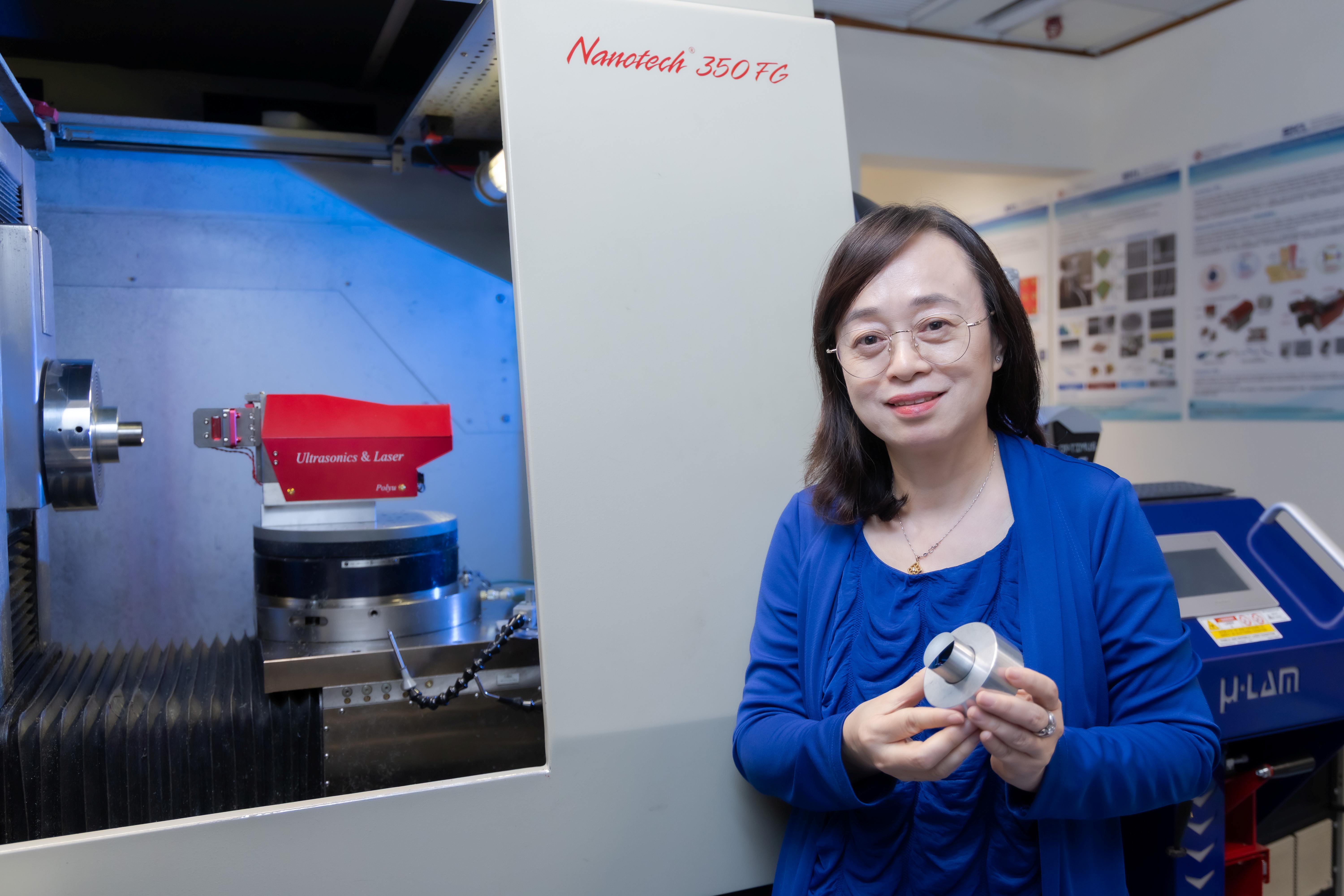
HONG KONG SAR - Media OutReach Newswire - 30 March 2026 - Machining, involving the precise cutting and shaping of materials, is a key manufacturing process. As industries increasingly adopt the use of high-performance materials with high strength and hardness, traditional machining methods often fall short in delivering the required precision. A research team at The Hong Kong Polytechnic University (PolyU) has developed a ground-breaking machining technology that combines laser and magnetic fields during diamond cutting, enhancing cutting smoothness and surface quality while reducing a material's subsurface damage and tool wear. This dual-field approach demonstrates exceptional manufacturing capabilities that surpass existing field-assisting cutting techniques, making possible ultra-precision machining of a range of challenging advanced materials.
Prof. Sandy To Suet, Professor of the PolyU Department of Industrial and Systems Engineering and Associate Director of the State Key Laboratory of Ultra-precision Machining Technology, and her research team, have developed an innovative and unique multi-energy field-assisted ultra-precision machining technology that enhances cutting smoothness and surface quality, while also reducing a material’s subsurface damage and tool wear, demonstrating exceptional manufacturing capabilities that surpass existing field-assisting cutting techniques.
The innovative and unique multi-energy field-assisted ultra-precision machining technology, known as in-situ laser-magnetic dual-field assisted diamond cutting (LMDFDC), has been developed by Prof. Sandy TO Suet, Professor of the PolyU Department of Industrial and Systems Engineering and Associate Director of the State Key Laboratory of Ultra-precision Machining Technology, and her research team. Relevant research findings are published in International Journal of Extreme Manufacturing.
Site field machining refers to the application of external energy fields, such as laser and magnetic fields, at the cutting site during the machining process. Existing field-assisting cutting techniques have certain limitations. For example, a laser field helps soften hard-brittle materials and makes them easier to cut, but often causes melting or craters due to overheating; a magnetic field can diminish cutting force and enhance heat dissipation to ease cutting process, but its effect is unstable across different materials and surface scratches caused by the exfoliation of hard particles in high-performance materials like high-entropy alloys (HEAs) cannot be avoided.
By combining laser and magnetic fields, LMDFDC synergises strengths of both fields and mitigates their respective drawbacks. The researchers compared this new approach with three other machining methods for HEA workpieces: laser-only, magnetic-only and cutting without any external field. Using a suite of advanced tools, they observed changes of the workpiece at multiple levels—from surface appearance to subsurface features and atomic-scale structures.
Results showed that, through thermo-magneto-mechanical multi-physical synergistic interactions, LMDFDC improves machinability to a degree not achievable with either field alone. In particular, the technology produces finished pieces with smoother surface and less damaged subsurface by using a magnetic field to enhance heat transfer and suppress laser-induced thermal damage, while the laser softens hard particles to avoid scratches and improve cutting stability. The dual-field coupling effect also prevents the formation of build-up on tool edges caused by severe friction, and rapid tool degradation from heat, significantly reducing tool wear and extending their lifespan.
In 2017, at the forefront of advanced manufacturing technology research, Prof. To led her team to propose the world's first magnetic field-assisted diamond cutting technique that enhances manufacturability of difficult-to-machine materials. She said, "As time progresses, single-field assisted machining technologies are proving increasingly inadequate for the precision manufacturing of new high-performance materials, especially the emerging HEAs with their excellent strength and stability that are highly desirable for advanced engineering applications in high-ends fields like aerospace and energy. LMDFDC marks a technological breakthrough in machining these new materials, opening up new avenues of ultra-precision manufacturing technology."
In addition to introducing a transformative dual-field assisted machining technology, the research also investigated what occurs, what changes and what improves in the materials when dual fields are applied. This deepens scientific understanding of material transformations during field-assisted processes and their underlying mechanisms, bridging a critical knowledge gap for designing future multi-field machining methods for various advanced materials.
"The research is among the first to thoroughly examine how laser and magnetic fields work together during ultra-precision machining, and how this combined action differs from using either field alone," Prof. To added. "The significance of the findings resides in propelling frontier academic developments in multi-physics coupled manufacturing theories while discovering innovative machining approaches.
Currently in the process of patenting the innovative LMDFDC technology, the research team plans to explore additional combinations of energy fields to support the development of more versatile and reliable multi-physics machining approaches.
The research was supported by the National Natural Science Foundation of China's General Program, as well as the General Research Fund of the Research Grants Council and the Mainland-Hong Kong Technology Cooperation Funding Scheme under the Innovation and Technology Fund of the Innovation and Technology Commission of the Hong Kong Special Administrative Region Government. Hashtag: #PolyU #Machining #UltraPrecisionMachining #DiamondCuttingTechnique #HongKong
The issuer is solely responsible for the content of this announcement.