Stay up to date with the latest news
Subscribe to our telegram channel

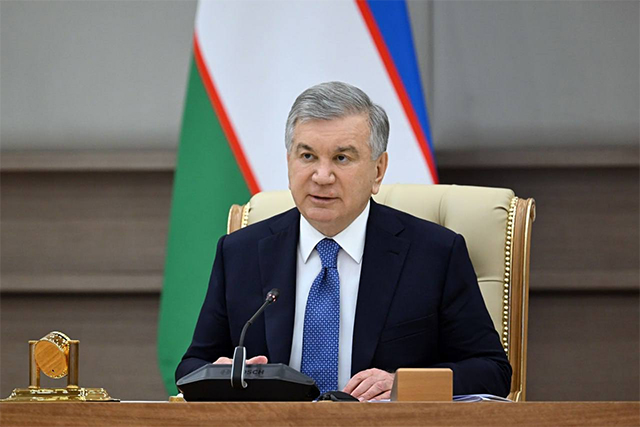
Mirziyoyev Sets Sport Development Priorities for Uzbekistan
Tashkent, Uzbekistan (UzDaily.com) — President of the Republic of Uzbekistan Shavkat Mirziyoyev has presided over a video conference dedicated to the priority tasks of further developing physical culture and sports in the country.
"Sport is not only competition — it is a powerful driver of a healthy lifestyle, discipline, patriotism and the strengthening of the country's international standing," the head of state said in opening remarks.
It was noted that over the past nine years, 1,774 modern sports grounds have been built across more than 1,500 mahallas, over 200 large sports facilities have been commissioned at the local level, and some 4,000 private sports clubs have opened.
The number of young people engaged in professional sport has doubled. The number of athletes on Olympic national teams has doubled as well, while representation in Paralympic sport has tripled.
In the past year alone, Uzbek athletes won 452 gold, 418 silver and 501 bronze medals at international competitions. More than 50 of them set new world and Asian records.
Currently, each of the 26 federations in Olympic sports disciplines is headed by a minister or senior official of a republican-level organization. Last year, regional governors — hokims — were appointed as presidential representatives for the development of the Olympic movement in their respective territories.
As noted at the meeting, had the relevant officials, hokims and heads of the 26 federations been more actively engaged — visiting the country's 207 higher education institutions, 15 Olympic and Paralympic centers, 310 sports schools and 16 sports boarding schools, and doing more to create conditions for training champions and securing Olympic qualification licenses — the results achieved could have been significantly higher.
The Zarbdor district was cited as a model example: last year, 34,000 young people from 23 mahallas were drawn into mass sport. Three new sports halls were built there, specializing in table tennis, taekwondo and volleyball. Two indoor football pitches and a fitness club were also created in partnership with private entrepreneurs.
Thanks to this improved infrastructure, Zarbdor district will this year host the national volleyball and table tennis championships for the first time.
It was also noted that 14 entrepreneurs from Kashkadarya region invested their own funds to build sports facilities in schools and mahallas worth 60 billion soums over two years.
At the same time, criticism was directed at the low level of activity in engaging the public in mass sport in a number of other districts, as well as inadequate attention from hokims to organizing competitions and developing sport more broadly. Officials were instructed to study the Zarbdor experience and replicate it across all regions.
An analysis was conducted of the state of sports clubs in schools and the deployment of coaches to mahallas.
It was noted, in particular, that in 15 Tashkent schools, sports clubs exist in name only — with just three or four students attending. Moreover, last year approximately a quarter of schoolchildren in Jizzakh, Kashkadarya and Fergana regions failed to meet minimum physical fitness standards.
Hokims were tasked with ensuring that every school has functional sports clubs and increasing student participation.
It was also pointed out that sports schools, instead of systematically seeking out talented youth across mahallas, continue to work with already-trained athletes who come to them of their own accord.
Samarkand was cited as an example: despite having sports infrastructure second only to the capital, and despite the potential to engage 100,000 young people in professional sport, actual figures are three times lower. In Navoiy and Surkhandarya regions, only half of the available capacity is being utilized.
Dissatisfaction was expressed at the fact that specialized sports schools are effectively no different from ordinary ones.
It was noted, in particular, that the combined results of four specialized sports schools in the city of Termez lag behind those of a single sports school in Jarqo'rg'on. Last year, the Jarqo'rg'on sports school won six medals at Asian and world championships, while the four specialized schools in the region together claimed just one.
The need was emphasized to revisit the approaches of directors, staff and coaches at every specialized sports school, to identify concrete growth targets, and to tie their salaries to the performance of their athletes.
Officials were instructed to introduce an additional incentive system: sports schools that achieve outstanding results will receive, on top of existing performance bonuses, a separate prize of 500 million soums.
It was noted that higher education institutions are not doing enough in the sports sphere, and that cooperation with federations and the assignment of individual mentors to talented students remains weak.
There are positive examples at some universities. Termez State University has established four clubs covering 18 sports disciplines and enrolling 5,000 students. Last year, its students won 18 medals at international competitions. The university's volleyball and handball teams compete in the top league, while its futsal and football teams play in the first league.
However, at Jizzakh Polytechnic Institute, the Tashkent Medical University branch in Termez, Karshi State Technical University and Bukhara State University, 70 percent of students failed to meet minimum physical fitness standards — a sign that sports clubs at these institutions exist in form only.
In response, the rectors of all 207 universities were instructed to study the experience of Termez State University and develop an annual sports action plan.
It was noted that the investments made in shooting sport infrastructure are already yielding results. Uzbekistan's shooters recently won three gold and two silver medals at the Asian Championships, with new Asian and world records set in air shooting events.
Progress was also recognized in football, wrestling, cycling, athletics and swimming.
Young athletes won nine medals in athletics and the country's first ever medal in swimming — a bronze — at the Asian Youth Games. Cyclists placed in the top three in Asia. In wrestling, a world championship gold medal was won for the first time in 25 years.
At the same time, it was criticized that fewer than 100 people are training at six fencing facilities in Jizzakh, that the potential in trampoline gymnastics and acrobatics is being underutilized, and that tennis and equestrian sports have produced no results.
It was noted that modern sports formats such as padel tennis and squash are gaining rapid popularity among young people worldwide. Yet officials have shown no initiative in engaging private entrepreneurs to develop these disciplines alongside tennis or in creating additional opportunities for youth.
A lack of initiative was highlighted within federations when it comes to seeking partners and funding and engaging entrepreneurs. The number of financially capable entrepreneurs in the country is growing each year, and many of them have an interest in sport and are ready to act as sponsors. Yet not a single federation has offered entrepreneurs a mutually beneficial partnership.
Officials were instructed to review the work of the secretaries-general and management of all 26 federations and replace those who do not meet the requirements of their positions.
Athlete rehabilitation after injury and muscle condition assessments are currently conducted mostly abroad. Federations are compelled to bring in foreign sports physicians, pharmacologists and nutritionists at high cost.
It was noted that modern protocols for treating sports injuries such as bone fractures and ligament damage have not yet been adopted domestically, and that trauma, cardiology and therapy centers are not cooperating with federations.
Going forward, each specialized medical center will work in coordination with sports federations. Monthly health diagnostics will be conducted for members of national teams, covering injury risk assessment, scientific analysis of physical workloads and the provision of medical recommendations to coaches.
From the new academic year, Tashkent Medical University will begin training specialists in sports nutrition, physiology and psychology, while the Pharmaceutical Institute will train specialists in healthy eating. The Sports Medicine Science Center at the Olympic Village will serve as a practical training base for students.
Officials were also tasked with drafting a resolution containing a program for the localization of sports goods production.
The President put forward a series of new initiatives designed to take the ongoing reforms in the sports sector to a new level.
Henceforth, the effectiveness of mass sport in mahallas will be assessed not only by participation rates, but also by the health indicators of residents.
A "health balance" will be drawn up in one district of every region. Sports Minister A. Ikramov, Mahalla Association Chairman K. Kuranbayev and First Deputy Director of the National Social Protection Agency Sh. Mirziyoyev were instructed to establish a corps of "healthy lifestyle volunteers" drawn from among the most active members of the sporting community.
These volunteers will promote sport and healthy living principles in mahallas. Under this system, the ten most exemplary mahallas in each district will be provided with sports uniforms and equipment free of charge.
It was noted that high-intensity training formats that require no specialist equipment or infrastructure — such as CrossFit — are gaining popularity worldwide. By May 1, CrossFit clubs must be organized in all schools and technical colleges. From next year, CrossFit will be incorporated into the Five Initiatives system.
Where a mahalla increases sports participation and improves public health indicators — including reductions in cardiovascular disease and diabetes — the volunteer and the mahalla chairman will receive an annual bonus of up to 15 million soums. The coach responsible for mass sport in that mahalla will receive a monthly salary supplement of up to 200 percent.
It was stressed that every minister, sector head, bank chief, and regional and district governor must lead by personal example when it comes to sport and must create appropriate conditions for their staff.
As part of this effort, one day per week is to be designated a "sports day," during which sports events will be held across all ministries, agencies and organizations. Where no gym is available, agreements must be signed with existing sports facilities or federations, and at a minimum two competitions per year must be organized across four sports disciplines, with prizes awarded to winners.
A new system has been introduced for engaging the public in sport and identifying talent based on the chain: mahalla – school – sports institution – federation.
A tripartite agreement will be concluded between university rectors, federation heads and district governors. Under this agreement, district governors will ensure that sports clubs have access to schools, technical colleges and other sports facilities outside of study hours.
Officials were tasked with linking all 9,000 mahallas to the 26 sports federations and ensuring that school clubs are equipped with the necessary sporting equipment.
It was noted that second- and third-year students at sports universities should be engaged in running clubs on a part-time basis, while fourth-year students should participate on a full-time basis, as part of a dual education model. Such students will be assigned to clubs as coaches and will automatically receive a coaching certificate.
Students who study at the university three days a week will spend the remaining days running clubs at designated schools and working with young people. Fifty percent of club revenues will go directly to the student-coach.
Graduates of the dual education program will also receive a referee's certificate alongside their degree.
From this year, annual republican competitions will be held among ministries, industries, banks and local government bodies.
Additional opportunities for mass sport will also be created for the workforces of private sector companies.
Entrepreneurs' expenditure on building and equipping sports halls and grounds for their employees will be deductible from their corporate income tax base, while the income and social tax on coaches hired for this purpose will be set at one percent.
Overall, the Ministry of Sport and regional governors have been tasked with doubling the number of people who exercise regularly this year — through the new system — and bringing that figure to one million people.
As in football, it was emphasized that a transparent and digital system must be created for the Five Initiatives and for tracking the number of people who exercise on a regular basis.
Officials were instructed to develop an artificial intelligence platform that will analyze the results of athletes and coaches and generate individualized training plans.
Scientific work in sport will henceforth be directed exclusively at addressing practical, real-world challenges. Researchers whose work leads to improved sporting results and medals at international competitions will receive prizes of 100 million soums.
Special attention was paid to the development of the Olympic and Paralympic movement and to improving the athlete selection system in professional sport.
From this year, the number of disciplines at the Presidential Olympiad will be doubled to 21, and the competition will now also include para-sport events.
Each district and regional governor will organize a local "District/Regional Governor's Olympiad," with winners earning the right to compete at the Presidential Olympiad.
Directors of regional Olympic Committee offices will simultaneously be appointed sports advisers to regional governors.
Seven elite sports schools in the capital will be closed, and in their place an Olympic National Teams Center will be established at the Olympic Village. Fifty-six specialized sports schools in the regions will also come under the management of this center.
The training and professional development system for adaptive sports specialists will also be reformed. The Tashkent branch of the Herzen Russian State Pedagogical University will become the lead institution for inclusive sport.
Sports Minister A. Ikramov, First Deputy Director of the National Social Protection Agency Sh. Mirziyoyeva and Paralympic Committee Chairman M. Tashkhojayev were instructed to submit the relevant draft resolution.
The President underlined the importance of dedicated specialists who accompany Paralympic athletes around the clock and contribute to their achievements.
Going forward, participants in training camps and republican and international competitions who accompany Paralympic athletes will have their transport and accommodation costs reimbursed. They will receive a monthly salary equivalent to the wage rate of coaches at sports schools.
A recently adopted presidential decree has created favorable conditions for entrepreneurs wishing to sponsor sport. An entrepreneur who provides sponsorship to a federation equivalent to 20 percent of its annual budget will have the right to join its governing bodies. An entrepreneur who covers 20 percent of a professional football club's annual expenditure will be eligible to take the club under reliable management.
"Uzbekistan's sport must be not only a guarantee of public health and high achievement, but also a source of revenue," the head of state emphasized.
As an example, it was noted that matches in the national football championship are sometimes held during working hours, resulting in lower-than-expected attendance. Were matches to be played at weekends or after 7 p.m. on weekdays — with additional entertainment, musical and cultural events organized around stadiums, convenient transport links provided, and affordable ticket packages offered to visiting fans — clubs could generate two to three times more revenue, spectators would enjoy a richer leisure experience and entrepreneurs would gain additional income.
Officials were instructed to develop a program of measures aimed at substantially increasing stadium attendance.
It was also noted at the meeting that 39 open-air and indoor sports facilities across the regions are in need of repair and are not being used to their full capacity. Local and sectoral officials were tasked with preparing a draft resolution on transferring these facilities to public-private partnership arrangements on favorable terms, in order to convert them into modern sports complexes.
More than 100,000 young people currently train regularly in non-Olympic sports disciplines, forming a well-prepared reserve pool for Olympic events such as judo, wrestling, taekwondo, fencing, weightlifting and others. The Ministry of Sport and hokims were tasked with organizing sections for non-Olympic sports at sports schools in order to engage more young people.
A proposal to establish a Confederation of Non-Olympic Sports of Uzbekistan was also approved.
"I want to draw attention to one more matter: last week, a new law was adopted that clearly defines the responsibilities and obligations of every minister, federation head and hokim in the field of physical education and sport. From now on, the requirements and expectations placed on these officials will strictly correspond to their established responsibilities," the President stated.
During the meeting, the head of state heard reports from sector officials and regional governors, and held a dialogue with entrepreneurs and athletes.