Stay up to date with the latest news
Subscribe to our telegram channel

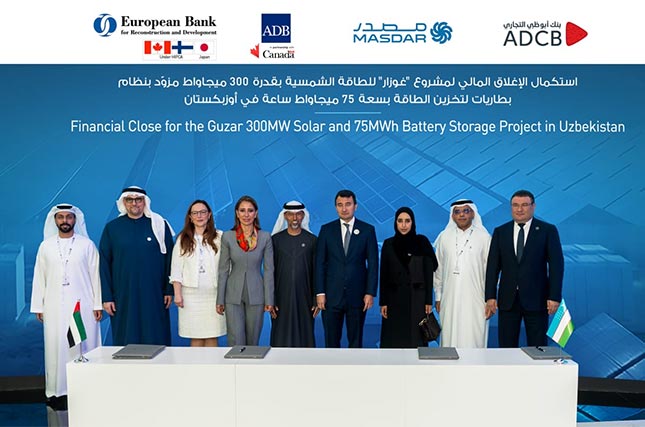
Masdar Secures International Financing for New Renewable Energy Project in Uzbekistan
Tashkent, Uzbekistan (UzDaily.com) — Abu Dhabi Future Energy Company PJSC (Masdar), a global leader in clean energy, has announced financial close on a funding package exceeding US$225 million for the development of a 300 MW solar power plant and a 75 MWh battery energy storage system (BESS) in the Guzar district of Kashkadarya region, Uzbekistan.
The bulk of the financing, up to US$195.5 million, is provided by the European Bank for Reconstruction and Development (EBRD). This package includes contributions from Canada and Finland through the High Impact Partnership for Climate Action (HIPCA) Fund, as well as resources from the Japan–EBRD Cooperation Fund. Additional financing of US$30 million comes from the Asian Development Bank (ADB), including support from the Leading Asia’s Private Infrastructure Fund 2 (LEAP 2) and the Canadian Climate and Nature Private Sector Fund in Asia (CANPA) under its management. Transaction hedging is provided by Abu Dhabi Commercial Bank.
The financial close was marked by a signing ceremony held at the Masdar Pavilion during Abu Dhabi Sustainability Week. Participants included UAE Minister of Energy and Infrastructure Suhail Mohamed Al Mazrouei, Uzbekistan’s Deputy Prime Minister Jamshid Khodjaev, Minister of Energy Jurabek Mirzamahmudov, and Masdar CEO Mohamed Jameel Al Ramahi. Agreements were signed by Masdar COO Abdulaziz Alobaidli alongside representatives from EBRD, ADB, and ADCB.
Commenting on the milestone, Masdar CEO Mohamed Jameel Al Ramahi said the company is pleased to achieve financial close for another major renewable energy project in Uzbekistan. He noted that since 2021, Masdar has been actively collaborating with Uzbek partners, delivering over 2 GW of renewable capacity to date and supporting the country’s ambitious clean energy transition goals. Al Ramahi emphasized that Uzbekistan’s abundant solar and wind resources, combined with a favorable regulatory environment, make it an attractive market for Masdar’s global strategy of achieving 100 GW of installed capacity by 2030.
Under a public-private partnership agreement with National Electric Networks of Uzbekistan (NEGU), Masdar will design, construct, and operate the solar plant and energy storage system. Once operational, the project is expected to avoid more than 400,000 tons of CO₂ emissions annually and supply electricity equivalent to the needs of approximately 60,000 households. It will contribute to Uzbekistan’s national target of increasing the share of renewables in electricity generation to 54% by 2030.
To date, Masdar’s total investment in Uzbekistan exceeds US$2 billion. The company has already delivered the country’s first large-scale solar project — the 100 MW Nur Navoi Solar Plant. In November 2025, Masdar also signed an agreement with Uzenergosotish JSC to provide energy storage services as part of the largest standalone BESS project in Uzbekistan, with 300 MW capacity and 600 MWh storage in Navoi region.
The CIS region is considered a strategic market for Masdar in its global portfolio expansion, with active projects not only in Uzbekistan but also in Azerbaijan, Kazakhstan, and other countries in the region.