Stay up to date with the latest news
Subscribe to our telegram channel

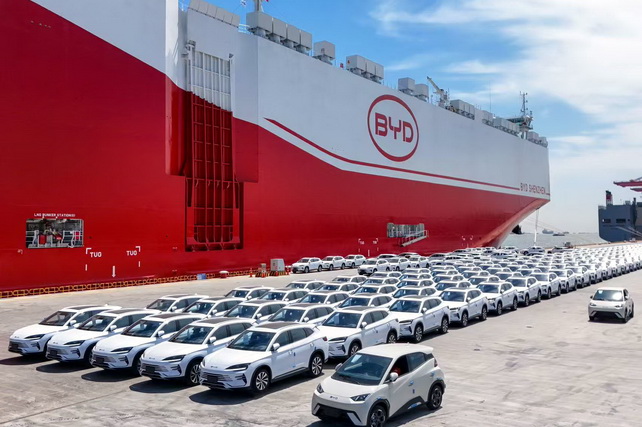
China Becomes Global Leader in Auto Sales in 2025
Tashkent, Uzbekistan (UzDaily.com) — The global automotive industry, which for decades has been defined by competition among major manufacturers, is entering a new phase of transformation. According to 2025 results, China has for the first time become the world’s largest automobile market by sales volume, overtaking Japan and signaling a redistribution of global influence in the sector.
Citing data from Japan’s Nikkei, total sales by Japanese automakers fell to around 25 million vehicles, marking the lowest level in recent years. At the same time, Chinese companies sold nearly 27 million vehicles, taking the global lead for the first time since 2000.
Experts note that this shift reflects not only a change in leadership by volume but also a deeper structural transformation of the industry. According to analysts at Mizuho Bank, the current trend indicates the beginning of a broader restructuring of the global automotive landscape.
A key driver of China’s growth has been the transformation of its export structure. Industry associations report that in 2025 exports of new energy vehicles reached 3.43 million units, a 70 percent increase, accounting for about 41 percent of total shipments.
At the same time, the share of traditional internal combustion engine vehicles fell to 43 percent. Chinese manufacturers are therefore shifting from quantitative expansion to qualitative growth, increasing exports of high-margin products and strengthening their position in the electric vehicle segment.
Improved financial performance has also supported the sector. In 2025, several Chinese electric vehicle manufacturers reported their first profits, marking the end of a phase of heavy investment and a transition toward sustainable growth models.
Positive trends are also visible in related industries. CATL, one of the world’s largest battery manufacturers, reported significant profits, underscoring the strength of the entire value chain.
Experts note that the automotive industry is highly dependent on economies of scale, where large production volumes are necessary to cover high fixed costs and ensure stable profitability.
Traditional automakers are facing increasing pressure amid China’s rise. Nissan has seen declining sales in the Chinese market in recent years, Toyota has forecast lower profits, Ford expects losses in its electric vehicle segment, and Volkswagen has been forced to adjust pricing strategies to maintain market share.
Analysts attribute these challenges to delayed adaptation to the rapid growth of the electric vehicle segment and shifting consumer preferences.
Chinese companies are significantly increasing investment in research and development. Leading players such as BYD, Geely, and Great Wall Motors have sharply raised spending on innovation.
According to a Roland Berger report, China is approaching the status of a global technological leader in the automotive industry, gradually shedding its image as a producer of low-cost goods.
Amid global digitalization and electrification, the automobile is increasingly evolving from a means of transport into a high-tech platform — a mobile intelligent terminal. Competition is expanding beyond the product itself to include ecosystems such as software, services, and infrastructure.
Experts emphasize that future leadership will depend not only on production volumes but also on the ability to innovate across the entire value chain.
Thus, China’s achievement should be seen not as an endpoint but as the starting point of a new phase of global technological competition in the automotive industry.