Stay up to date with the latest news
Subscribe to our telegram channel

A New Module “Expenses Funded by Personal Income Taxes” Launched on the “Open Budget” Portal
Tashkent, Uzbekistan (UzDaily.com) — Uzbekistan is introducing a new tool to enhance the transparency of budget data: the “Expenses Funded by Personal Income Taxes” module will be launched on the informational portal “Open Budget.”
This module will allow citizens to access detailed information on the amounts they have paid in income, property, and land taxes, as well as how these funds are allocated and spent in the state budget.
The new mechanism is being implemented as part of the Presidential Decree aimed at reducing the shadow economy and modernizing the fiscal system. The module is scheduled to become operational in January 2026.
The approach is based on international best practices employed in countries such as the United Kingdom and the United States, where similar tools help enhance budgetary transparency and strengthen citizens’ trust in public institutions.
Through this service, users will be able to view, in a personalized format, the exact amounts of taxes they have paid and the specific sectors to which these budgetary expenditures have been directed.
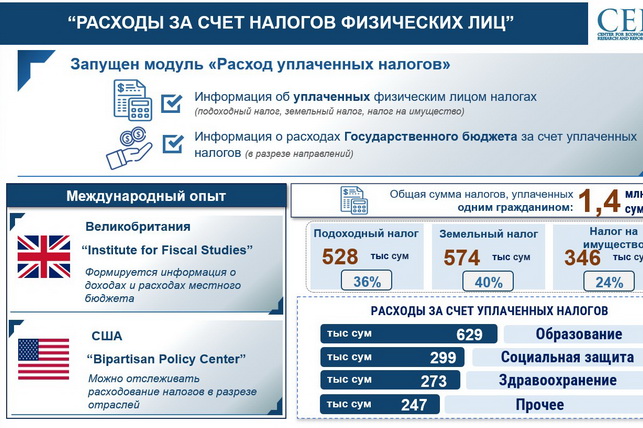
For example, for a monthly tax payment of 1.4 million soums, the tax structure may be as follows: income tax — 528 thousand soums, land tax — 574 thousand soums, property tax — 346 thousand soums.
Correspondingly, the distribution of expenses could include: education — 629 thousand soums, social services — 299 thousand soums, healthcare — 273 thousand soums, and other sectors — 247 thousand soums.
The introduction of this tool is expected to increase the accountability of government agencies, strengthen citizens’ trust in policy decisions, and broaden public participation in monitoring the use of budget funds.
The State Tax Committee will ensure the automated generation of personalized tax information in compliance with legislation on personal data protection.
The implementation of these measures represents an important component of wide-ranging reforms aimed at improving tax administration, reducing the shadow economy, and enhancing fiscal transparency in the country.