Stay up to date with the latest news
Subscribe to our telegram channel

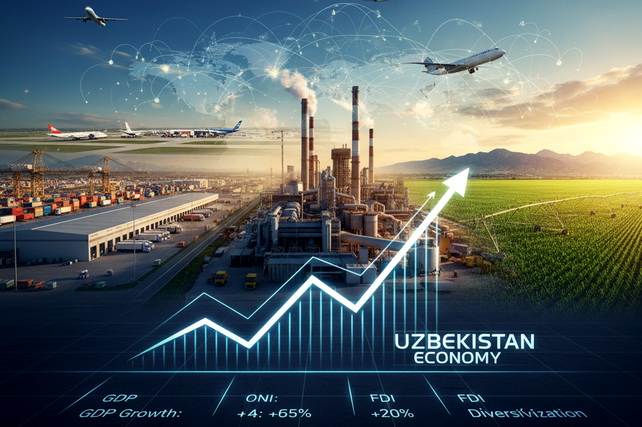
Uzbekistan’s Industrial Output Exceeds 1.1 Quadrillion Soums in 2025
Tashkent, Uzbekistan (UzDaily.com) — In January–December 2025, industrial enterprises in Uzbekistan produced goods worth 1.1 quadrillion soums, exceeding the same period in 2024 by 6.8%, according to the National Statistics Committee.
As of 1 January 2026, there were 59.8 thousand industrial enterprises operating in the country.
The largest number of these enterprises were in food production, with 11.9 thousand (20%), other non-metallic mineral products at 8.3 thousand (13.8%), clothing at 6 thousand (10%), fabricated metal products at 4.8 thousand (8%), furniture at 4.1 thousand (6.9%), textile products at 3.7 thousand (6.2%), and rubber and plastic products at 2.8 thousand (4.7%).
Analyzing industrial output per capita, the national average was 29.1 million soums. The highest figures were recorded in Navoi region (176.9 million soums), the city of Tashkent (65.9 million soums), Tashkent region (54.3 million soums), and Andijan region (30.9 million soums). Industrial output per capita growth across the country reached 104.8%, with Jizzakh region at 112.1%, Namangan at 107%, Surkhandarya at 106.9%, and Syrdarya at 106.8%, significantly exceeding the national average.
In the structure of industrial production for 2025, the largest share belonged to manufacturing at 947.2 trillion soums, or 86% of total output. The mining and quarrying sector accounted for 77.0 trillion soums (7%), electricity, gas, steam, and air conditioning supply for 70.8 trillion soums (6.4%), and water supply, sewage, waste collection, and disposal for 6.1 trillion soums (0.6%).
During January–December 2025, the country produced 42.3 billion m³ of natural gas, 655.7 thousand tonnes of crude oil, 8.9 million tonnes of coal, 1,200.2 thousand tonnes of gasoline, 1,158.1 thousand tonnes of diesel fuel, 20.2 million tonnes of Portland cement, 592.9 thousand tonnes of yarn, and 1,227.5 thousand tonnes of flour from soft wheat and spelt.
Within the manufacturing sector, the share of food, beverages, and tobacco production was 19.6%, textiles, clothing, leather, and related products 15.8%, fabricated metal products, machinery, vehicles, and other equipment 18.5%, and chemicals, rubber, and plastic products 6.9%. Among manufacturing branches, high-tech production accounted for 1.1%, medium-high-tech 19.5%, and medium-low-tech 39.3%.
Electricity generation in 2025 reached 104% of the previous year’s level, while thermal energy production by large enterprises reached 88.6%. During the same period, textile waste increased by 14.2%, and services for wastewater removal, transportation, and treatment grew by 16%.