Stay up to date with the latest news
Subscribe to our telegram channel

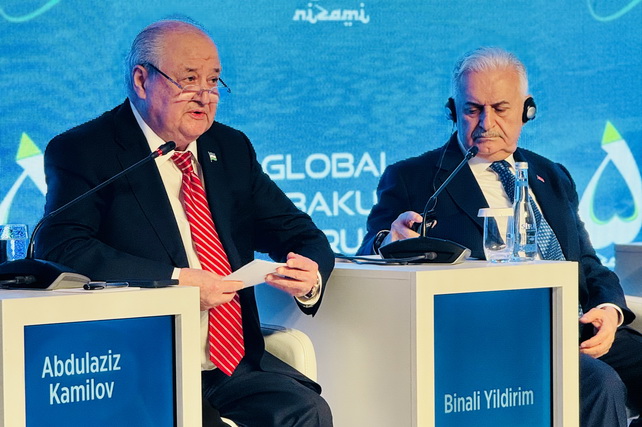
Uzbekistan Sees Azerbaijan as Integral to Regional Unity
Tashkent, Uzbekistan (UzDaily.com) — Uzbekistan’s delegation, led by Presidential Advisor for Foreign Policy Abdulaziz Kamilov, participated in the XIII Global Baku Forum held on 12–14 March under the auspices of the International Center of Nizami Ganjavi.
The forum brought together around 400 distinguished participants from dozens of countries under the theme “Overcoming Divisions in a Transitional World,” focusing on contemporary challenges such as the transformation of international security architecture, the crisis of multilateral diplomacy, and sustainable development amid global uncertainty.
Leaders and top officials from major international institutions attended the opening ceremony and panel sessions, including Azerbaijani President Ilham Aliyev, heads of state from Albania, Montenegro, and Timor-Leste, senior UN officials, including Deputy Secretaries-General M.A. Moratinos and A. Rossbach, as well as leaders of UNCTAD, WHO, and other major organizations.
In his address, Kamilov emphasized that relations between Uzbekistan and Azerbaijan are experiencing unprecedented growth and are evolving into a genuine strategic partnership. This rapprochement is grounded in the Treaty of Allied Relations and the personal, trust-based dialogue between Presidents Shavkat Mirziyoyev and Ilham Aliyev.
Kamilov highlighted the transformation of Central Asia, noting that “thanks to President Mirziyoyev’s peace-building efforts and the sincere support of regional states, Central Asia has shifted from a zone of contradictions to a space of shared development.” He added that regional trade has doubled and mutual investments have grown fivefold in recent years.
The advisor also pointed out similar positive processes strengthening stability and economic development in the South Caucasus. He welcomed the restoration of Azerbaijan’s territorial integrity and the signing of a peace agreement with Armenia, noting that “a stable South Caucasus is a strategic gain for all of Eurasia, creating new opportunities to connect the economic, infrastructure, and transit potential of our regions.”
Kamilov recalled that President Mirziyoyev was among the first leaders to recognize the potential of such integration, citing his initiative to invite Ilham Aliyev to the Central Asian leaders’ Consultative Meetings as a historic step toward enhanced interregional connectivity. According to Kamilov, Uzbekistan regards Azerbaijan as an organic and indispensable part of the region.
This approach is grounded not only in shared historical and cultural ties but also in a consolidated, long-term vision for a shared future. “Azerbaijan’s integration into the Central Asian community opens broad opportunities for creating a unified geopolitical and economic space from Central Asia to the South Caucasus,” he said.
Practical steps in this strategy include the development of new transport corridors and reliable supporting infrastructure. Kamilov highlighted the Middle Corridor as the shortest route linking China and Central Asia with the Caucasus and Europe, emphasizing its role in regional economic stability and integration into global value chains.
He also noted the potential to connect the Middle Corridor with the China–Kyrgyzstan–Uzbekistan railway and the Trans-Afghan route, as well as the strategic significance of the Zangezur Corridor, which he described as a critical segment linking Europe, the South Caucasus, and Central Asia into a single logistics hub.
Kamilov expressed confidence that interlinking these routes will create a multi-layered, diversified system of main transport corridors spanning East Asia, the Middle East, and Europe, fostering balanced integration into the global economy, access to new markets, and long-term Eurasian stability.
For reference, the Nizami Ganjavi International Center is a leading Azerbaijani think tank specializing in international relations, regional security, and inter-civilizational dialogue. Its distinctive multi-level format brings together current and former heads of state, representatives of international organizations, and experts.