Stay up to date with the latest news
Subscribe to our telegram channel

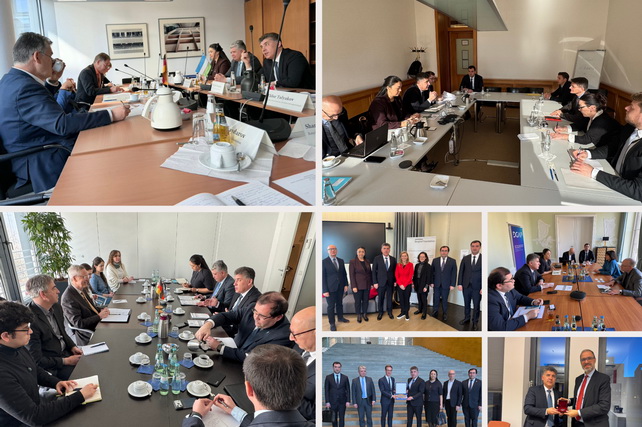
Uzbekistan and Germany Strengthen Cooperation Between Think Tanks
Tashkent, Uzbekistan (UzDaily.com) — From 4 to 7 March 2026, a delegation of Uzbek experts conducted a working visit to Germany, organized jointly with Uzbekistan’s diplomatic mission in Berlin.
The delegation included leaders and specialists from the Institute for Strategic and Interregional Studies under the President of Uzbekistan, the International Central Asia Institute, and the “Strategy of Development” Center.
During their visit, the Uzbek delegation held discussions with representatives of various German state institutions, including the Bundestag, the Federal Chancellery, the Ministry of Foreign Affairs, the Federal Ministry for Economic Affairs and Energy, and the Eastern Committee of German Business.
In addition to official meetings, the delegation participated in expert discussions and roundtables with leading German analytical centers, including the Global Public Policy Institute, the Center for East European and International Studies, the German Council on Foreign Relations, and major research foundations such as the Science and Policy Foundation, the Carnegie Endowment for International Peace, the Berghof Foundation, the Konrad Adenauer Foundation, and the Marshall Foundation.
The primary purpose of the visit was a thorough exchange of views on key global and regional issues, an analysis of current interactions between Germany and Central Asian countries, and the development of concrete steps to deepen Uzbek-German cooperation.
Participants noted that the current stage of political dialogue between Uzbekistan and Germany is highly active and based on mutual trust and consideration of each party’s interests, confirmed by regular high-level visits.
In the Bundestag, particular attention was given to expanding interparliamentary cooperation. Both sides emphasized that strengthening direct links between legislators would ensure the effective implementation of previous agreements and provide a platform for exchanging experience in lawmaking and public administration.
Economic partnership was another central topic. German officials praised Uzbekistan’s consistent policies focused on industrial modernization, digital transformation, and the development of a green economy. Representatives of the Federal Ministry for Economic Affairs and Energy noted that Uzbekistan’s development strategy enjoys support among German business circles, and creating transparent and predictable business conditions has increased German investor interest in the Uzbek economy.
Over the past decade, bilateral trade volume has nearly tripled, reaching a record $1.42 billion in 2025. German exports to Uzbekistan are largely investment-oriented, with more than 55% consisting of high-tech equipment and vehicles. Michael Harms, Executive Director of the Eastern Committee of German Business, described Uzbekistan as an emerging industrial hub in the region, providing a reliable platform for joint investment projects.
The parties emphasized the need to move from traditional trade to deeper industrial cooperation, focusing on technology transfer and the adoption of European standards in Uzbekistan. Such collaboration supports both sides’ strategic interests by diversifying foreign economic ties and strengthening the resilience of international production and logistics chains.
Priority areas include attracting German high-tech expertise, joint development of renewable energy, and the creation of reliable transport and logistics routes, including strengthening the transit potential of the Middle Corridor.
Migration cooperation was also discussed, with both sides highlighting mutually beneficial arrangements. Skilled Uzbek workers are seen as a valuable resource to address Germany’s labor shortage, estimated at over 1.7 million positions. This partnership provides Uzbek citizens with legal and safe access to the German labor market while ensuring their rights are protected. Uzbek specialists gain professional skills, which constitute long-term investment in human capital and technological modernization.
German experts also praised Uzbekistan’s regional policy aimed at strengthening cooperation among Central Asian countries. Berlin recognized Tashkent’s initiatives in the framework of Central Asian heads’ advisory meetings as creating a solid foundation for a new regional interaction architecture. Analysts from the German Council on Foreign Policy emphasized that Central Asian countries’ commitment to multilateral cooperation, international law, and democratic development creates favorable conditions for expanding EU engagement in the region.
The “Central Asia + Germany” format was highlighted as increasingly important, allowing Berlin to maintain systematic dialogue with a dynamic region of over 80 million people and a combined GDP exceeding $560 billion. The Federal Chancellery underlined the importance of establishing permanent mechanisms for ongoing political, economic, and expert dialogue.
Following the visit, both sides concluded that Uzbekistan and Germany have significant potential to further develop their strategic partnership. Expanding technological cooperation and improving logistics were identified as key growth areas. The synergy in these sectors is considered crucial for enhancing technological resilience and the competitiveness of both economies amid global uncertainty.
More broadly, the Tashkent-Berlin partnership is viewed as a key factor in strengthening Central Asia–EU ties. Both parties agreed to continue regular dialogue between leading analytical centers and to advance joint applied research on pressing bilateral issues.