Stay up to date with the latest news
Subscribe to our telegram channel

Uzbek Scientist Develops Eco-Friendly Microbial Fertilizers Boosting Yields by Up to 20%
Tashkent, Uzbekistan (UzDaily.com) — Fertilizer use in Uzbekistan exceeds the global average by 74%, contributing to increased environmental risks, accelerated soil degradation, and higher production costs in the fruit and vegetable sector.
In response to these challenges, leading microbiologist and Deputy Director of the International Center under the Ministry of Agriculture of Uzbekistan, Dr. Dilfuza Egamberdieva, has developed unique environmentally safe microbial fertilizers.
Field trials under extreme conditions have demonstrated yield increases of up to 20% while simultaneously restoring soil quality, according to the World Bank Office in Uzbekistan.
Dr. Egamberdieva is a beneficiary of the “Modernization of the National Innovation System of Uzbekistan” (MUNIS) project, implemented by the Ministry of Higher Education, Science, and Innovation with funding of US$50 million from the World Bank. The MUNIS project aims to strengthen the country’s scientific potential, accelerate the commercialization of innovative products and services, integrate technologies into the private sector, and develop modern state policies in science, technology, and innovation.
Thanks to the MUNIS grant and additional private-sector investment, Dr. Egamberdieva established Ecobiome LLC—a modern laboratory and the first industrial production line in Uzbekistan for liquid biochar-based microbial fertilizers.
The company’s products are already used by farmers and agricultural enterprises, enhancing crop yields and improving soil quality. The laboratory has created 10 jobs, including 8 positions for women.
Since the launch of MUNIS, the grant system has supported the creation of 190 innovative products and services, generating around 260 jobs for project beneficiaries. The initiative has also contributed to improving Uzbekistan’s ranking in the Global Innovation Index, moving up 14 positions to 79th place out of nearly 140 countries.
The project has helped local scientists and entrepreneurs attract over US$13 million in private investment to scale up innovative businesses and commercialize new products. For Dr. Egamberdieva, this has transformed scientific research into industrial production, bringing microbial fertilizers to market as a commercially viable solution.
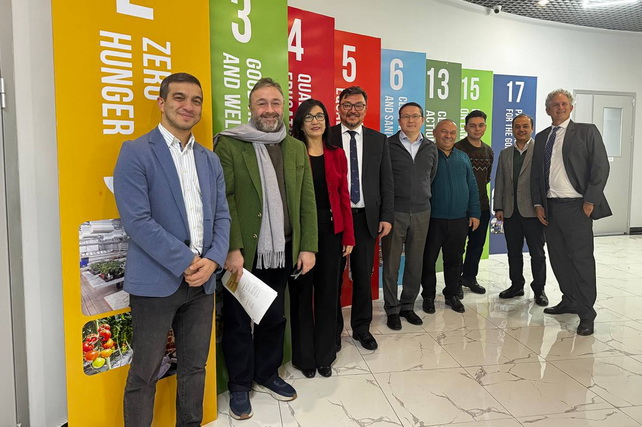
Earlier, Najy Benhasin, Regional Director of the World Bank for Central Asia, visited Ecobiome LLC to review the company’s achievements under Dr. Egamberdieva’s leadership and the work of other MUNIS project beneficiaries.