Stay up to date with the latest news
Subscribe to our telegram channel

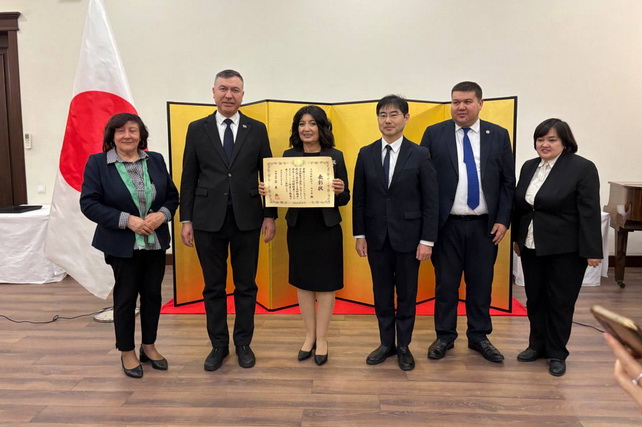
Uzbek Educator Awarded Honorary Certificate by Japan’s Ministry of Foreign Affairs
Tashkent, Uzbekistan (UzDaily.com) — Malika Ibragimova, Associate Professor of the Department of Japanese Philology at the Uzbekistan State University of World Languages, has been awarded an honorary certificate by the Minister of Foreign Affairs of Japan for her contributions to the development of the Japanese language and the strengthening of humanitarian ties between Japan and Uzbekistan.
The award ceremony took place on 6 February 2026 at the residence of the Japanese Ambassador to Uzbekistan.
The honorary certificate from the Ministry of Foreign Affairs of Japan is granted to individuals and organizations for outstanding contributions to strengthening friendly relations between Japan and foreign countries, including promoting Japanese language education and intercultural exchange.
Speaking at the ceremony, Deputy Head of the Japanese diplomatic mission in Uzbekistan, Counselor Shinichiro Nakamura, noted Malika Ibragimova’s high professional level and significant contribution to the development of Japanese philology in the region. He emphasized that she is one of the leading specialists in Japanese language teaching in Uzbekistan.
Malika Ibragimova began her teaching career in 1993 at the Tashkent State Institute of Oriental Studies. From 2000 to 2010, she served as Head of the Department of Japanese Language and, between 2000 and 2002, led the Association of Japanese Language Teachers.
Since 2014, she has been teaching Japanese at the Uzbekistan State University of World Languages, preparing a significant number of specialists.
In addition to teaching, Malika Ibragimova actively participates in translation work at official events, including high-level meetings, making a substantial contribution to the development of bilateral cooperation between Japan and Uzbekistan.
“Learning a language is, first and foremost, learning the culture and values of a country. Ultimately, the foundation of international relations is built on human connections. I am confident that graduates who have studied Japanese under Professor Ibragimova will become an important bridge between Japan and Uzbekistan,” noted Shinichiro Nakamura.
In her remarks, Malika Ibragimova emphasized the importance of language as a tool for personal development:
“Every year, students from different regions of the country join our program. Studying Japanese — one of the most complex languages in the world — instills diligence, discipline, and responsibility. I am proud that, in teaching the language, we are nurturing a generation capable of combining the best qualities of Uzbek and Japanese cultures.
Among our graduates are government officials, entrepreneurs, educators, translators, and university lecturers in Japan. That is our greatest reward.”
The Uzbekistan State University of World Languages remains one of the country’s leading educational centers for training specialists in Japanese philology.
In 2014, the Faculty of Oriental Languages established a Department of Japanese Language, which today attracts strong interest from applicants across Uzbekistan.