Stay up to date with the latest news
Subscribe to our telegram channel

The Largest Abu Dhabi Sustainability Week in History Concluded with Renewed Commitment to Advancing Sustainable Progress
Tashkent, Uzbekistan (UzDaily.com) — Under the patronage of His Highness Sheikh Mohamed bin Zayed Al Nahyan, President of the United Arab Emirates, the 2026 Abu Dhabi Sustainability Week (ADSW) concluded its largest edition in history, reaffirming the commitment to accelerate the implementation of practical solutions and promote sustainable development.
Held under the theme “Nexus of the Future: All Systems in Action,” the world’s largest platform on sustainability over five intensive days called on leaders in energy, finance, food, water, and nature to rethink how these global systems are interconnected, scalable, and mutually reinforcing.
ADSW 2026 was the most ambitious edition ever. Fifteen heads of state and government, alongside over 400 ministers and senior officials—more than double the number from the previous year—gathered in Abu Dhabi from January 11 to 15, together with business and civil society leaders, to advance dialogue on sustainable development. Organized by Masdar, a global leader in clean energy, the week drew more than 60,000 participants, a 20 percent increase compared to last year.
The event featured over 240 thematic sessions with more than 800 speakers, addressing key trends such as the transformation of global energy systems, food, nature, and water security, as well as the impact of artificial intelligence and other advanced technologies. New engagement formats were introduced, including AI-based platforms for gathering insights and connecting participants, alongside showcases of breakthrough clean technologies shaping global sustainability.
Mohamed Jameel Al Ramahi, CEO of Masdar, noted that ADSW 2026 was the largest and most ambitious gathering in the event’s history. According to him, leaders from government, finance, business, and civil society united in Abu Dhabi, recognizing that the systems shaping our future must evolve faster, interact more effectively, and enable large-scale implementation of solutions. In an era of rapid technological change, including the accelerating influence of artificial intelligence, ADSW provided a critical platform for aligning ambitions with practical action. He emphasized that the dialogue initiated during the week would extend beyond the event, fostering year-round collaboration, investment, and project implementation, and expressed anticipation of seeing the outcomes at ADSW 2027.
The opening ceremony on January 13 at the ADNEC Exhibition Centre featured His Highness Sheikh Mohamed bin Zayed Al Nahyan. High-level guests included President Faustin-Archange Touadéra of the Central African Republic, President Michel Randrianarivo of Madagascar, President Daniel Chapo of Mozambique, Vice President Lucia Witbooi of Namibia, President Bola Tinubu of Nigeria, President Ferdinand Marcos of the Philippines, President Bassirou Diomay Faye of Senegal, President Aleksandar Vučić of Serbia, President Dr. Patrick Herminie of Seychelles, President Cyril Ramaphosa of South Africa, Prime Minister Edi Rama of Albania, Prime Minister Judith Suminwa Tuluka of the Democratic Republic of Congo, Prime Minister Irakli Kobakhidze of Georgia, Prime Minister Milojko Spajić of Montenegro, and Deputy Prime Minister of Uzbekistan Jamshid Khodjaev.
The opening address was delivered by Dr. Sultan bin Ahmed Al Jaber, UAE Minister of Industry and Advanced Technology and Chairman of Masdar. He highlighted the tectonic shift in the global economy driven by artificial intelligence, the UAE’s leadership in energy provision for growth, and the country’s innovative approach to partnerships. Dr. Al Jaber described the arrival of a new era of human progress powered by computational and digital capabilities, underpinned by energy, portraying the UAE as a “corridor to the future.”
The week concluded with the Zayed Sustainability Prize ceremony, recognizing innovative solutions developed by change-makers across six categories: healthcare, food, energy, water, climate action, and global schools. Eleven awards were presented to leading organizations and educational institutions worldwide, personally handed out by His Highness Sheikh Mohamed bin Zayed.
A central highlight of ADSW 2026 was the ADSW Summit on January 13–14, which featured over 100 speakers across more than 30 sessions, including keynote presentations, panel discussions, and informal dialogues. The summit allowed energy, business, and technology leaders to identify practical solutions and lay the groundwork for long-term partnerships. During the leadership segment over both days, heads of state and government discussed pressing challenges and opportunities for sustainable development.
The ADSW Dialogues program, held January 13–15, brought together global leaders, policymakers, and industry experts with support from partners such as ADNOC, BlackRock, the Global Centre for Climate Finance, Global Infrastructure Partners, and the UAE Ministry of Foreign Affairs. Key discussions included the Next Leap format, chaired by Dr. Al Jaber, Larry Fink, Chairman and CEO of BlackRock, and Adebayor Ogunlesi, Chairman and CEO of GIP, which convened global leaders to align on investment-ready and scalable infrastructure solutions accelerating partnerships and investments in the Global South.
The Next Watt dialogue, organized by Masdar, united CEOs of leading renewable energy developers, including Mohamed Jameel Al Ramahi, with key electricity suppliers and buyers to identify practical ways to meet the rapidly growing demand for electricity through clean and reliable sources. The Green Hydrogen Summit on January 15 provided a platform for key stakeholders to accelerate the development of a global hydrogen economy, discussing demand creation, investment attraction, global transportation, and the current market landscape.
The World Future Energy Summit, the largest event within ADSW, ran from January 13 to 15 at ADNEC Centre, featuring 515 exhibitor brands and 16 national and innovation pavilions. Participants could attend conferences with more than 300 industry experts, explore nine exhibition halls showcasing breakthrough products and solutions, and experience advanced technologies in areas such as the Greenhouse startup zone, FUSE AI, and the green hydrogen innovation hub.
ADSW 2026 introduced new platforms for deeper engagement with key issues, including the inaugural Global South Utilities Forum on January 14, which brought together government representatives, developers, financiers, and energy buyers from the Global South and the UAE to explore investment, innovation, and implementation of sustainable energy and water infrastructure in Africa, Asia, and Latin America. The forum featured a ministerial dialogue on transforming public policy into investment-ready infrastructure projects, as well as sessions on accelerated technology adoption, renewable energy development, energy storage, autonomous solutions, and the increasing role of industrial consumers beyond traditional utilities.
The week also hosted the Blue Forum, organized by Masdar and the Sino-International Entrepreneurs Federation ahead of the 2026 UN Water Conference in the UAE in December. This event united governments, multilateral organizations, development banks, businesses, and civil society to unlock transformative potential for water security, technology adoption, resilience, and sustainable growth.
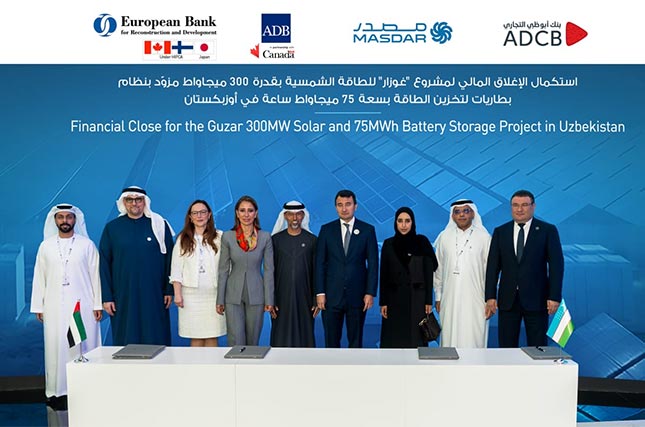
Masdar, as the host of ADSW, marked 20 years of leadership in clean energy, announcing that its total renewable energy project portfolio reached 65 gigawatts, up from 51 gigawatts at the beginning of 2025, covering two-thirds of the path toward its 100-gigawatt target by 2030. Of this, 45 gigawatts are already operational, under construction, or firmly committed, with an additional 20 gigawatts in an advanced project pipeline. During the week, Masdar also strengthened its presence in key markets, including Uzbekistan, Oman, and Sharjah, and expanded operations in Africa through its first power purchase agreement in Angola.
Special attention during ADSW 2026 was given to empowering youth and women. The Youth 4 Sustainability Forum and Youth Hub, held January 13–15, brought together more than 3,500 young people worldwide, engaging 95 speakers from government, industry, and academia through initiatives such as Youth Connect and Talent Connect. During the event, participants for the 2026 Future Sustainability Leaders and Sustainability Ambassadors programs were announced, and the final stage of the Out-of-Labs competition showcased AI-based solutions addressing real-world challenges at the intersection of technology and sustainability.
The annual WiSER forum, held on January 14 under the theme “Inclusive Pathways to Transformational Growth,” gathered over 120 influential participants to advance dialogue on women’s leadership in sustainable development and inclusive growth. Discussions focused on inclusive finance, policy and governance reform, innovation scaling, skills development for the future economy, rethinking leadership models, and strengthening inclusive strategic foresight for long-term resilience.
The week began with the 16th Annual Assembly of the International Renewable Energy Agency (IRENA) on January 11–12, which hosted over 1,500 delegates, including ministers, senior officials, CEOs, and partners from around the world. The assembly addressed key issues in energy transformation, inclusive development, and long-term sustainability in both developing and developed countries.
On January 15, the annual Global Centre for Climate Finance meeting, held in collaboration with Masdar, brought together over 280 specialists and more than 20 speakers to discuss advancing climate finance initiatives. Key ADSW 2026 partners included the Abu Dhabi Department of Energy, Global South Utilities, ADNOC, World Wide Technology, Emirates Global Aluminium, EMSTEEL, Aldar, Dubai Electricity and Water Authority, TotalEnergies, and the Department of Municipalities and Transport.