Stay up to date with the latest news
Subscribe to our telegram channel

Terrorism, Drugs and Corruption Remain Key Challenges for Uzbekistan — State Security Service
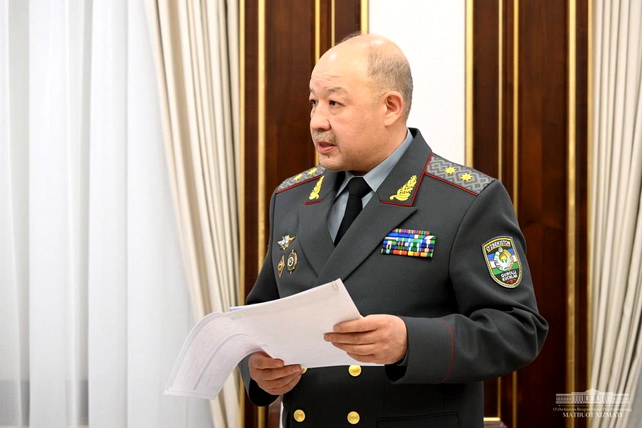
Tashkent, Uzbekistan (UzDaily.com) — Chairman of the State Security Service of Uzbekistan (SSS) Bahodir Kurbanov briefed President Shavkat Mirziyoyev on current national security threats and measures to neutralize them during an expanded meeting of the Security Council held on 13 January.
According to Kurbanov, the challenges outlined by the president in his address to the Oliy Majlis and the people of Uzbekistan remain relevant not only for the country itself but for the entire region. He noted that incoming operational intelligence fully confirms these assessments.
Among the key threats, the SSS chief identified terrorism, the spread of destructive and radical ideas, and cross-border risks. He stressed that the virtual space, primarily social media platforms, has become the main channel for disseminating extremist ideology, negatively affecting the religious environment in society.
At the same time, the threat of transnational crime persists, including drug trafficking, illicit arms circulation and the illegal movement of goods across the state border.
Addressing border security, Kurbanov reported that in 2025 Uzbekistan demarcated 1,482 kilometers of its state border with Tajikistan and Turkmenistan and installed 790 border markers. As part of engineering reinforcement, 453 kilometers of protective fencing and 287 kilometers of border roads were built, while 44 electronic surveillance and alarm systems were commissioned.
As a result of these measures, the number of border violations decreased by one and a half times, while the volume of seized smuggled goods increased by 20%.
Kurbanov also pointed to the need to expand and modernize infrastructure at nine border crossing points. He said the number of people and vehicles crossing the border has been growing by an average of 15% annually amid economic growth, expanding foreign trade and rising tourism flows.
A separate part of the report focused on illicit drug trafficking. Law enforcement agencies seized 1.7 tonnes of narcotics in 2024, while in 2025 this figure rose to 3.6 tonnes. The number of people detained for drug-related crimes increased from 2,600 to 4,500, and the number of dismantled clandestine drug laboratories grew from eight to fifteen.
Of particular concern, Kurbanov said, is the growing spread of synthetic drugs among young people. In 2025 alone, more than 180 kilograms of synthetic substances and over one million doses of psychotropic drugs were seized. He emphasized that addiction to such substances develops extremely quickly after initial use.
Turning to corruption-related threats, the SSS chairman reported that cases of abuse of office, bribery and extortion continue to be recorded within government and law enforcement bodies. In 2025, a total of 1,083 employees implicated in corruption and other crimes were dismissed from state institutions, with 661 individuals prosecuted and convicted.
At the same time, Kurbanov noted that manifestations of everyday corruption persist in government structures, driven by the human factor and insufficient digitalization of administrative processes.
In light of the designation of 2026 as the Year of Extraordinary Measures to Combat Corruption, he said the main focus would be on digitalizing processes with high corruption risks, eliminating legal loopholes and fostering an atmosphere of zero tolerance for corruption in society.
Kurbanov also reported on improvements to legal and organizational mechanisms aimed at countering religious radicalization. In particular, criminal liability has been introduced for the illegal religious education of minors in so-called “hujras.”
Addressing the president, he emphasized that it was precisely on Mirziyoyev’s initiative that measures were adopted to protect children and young people from the threat of radicalism, noting that previously relevant agencies, including the SSS, had not paid sufficient attention to this issue.
In addition, the SSS chairman informed the Security Council of the establishment of a new special unit equipped with a Turkish-made Bayraktar unmanned aerial vehicle and reported on the level of technical equipment of the border troops.
Following the meeting, President Mirziyoyev instructed that Uzbekistan’s Defence Doctrine and National Security Concept be updated to reflect the transformation of modern risks and threats.
As the head of state подчеркнул, the new doctrine should ensure the preservation of Uzbekistan’s status as a non-aligned country, reliance on multilateral diplomacy, and the development of a strategy based on high technologies, military self-reliance and the strengthening of regional stability.