Stay up to date with the latest news
Subscribe to our telegram channel

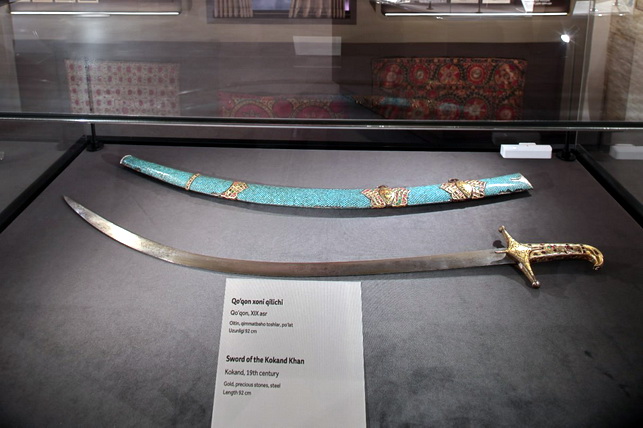
Sword of the Khan of Kokand Returns to Uzbekistan from London
Tashkent, Uzbekistan (UzDaily.com) — A 19th-century sword belonging to the Khan of Kokand has been repatriated from London and is now on display at the Center of Islamic Civilization in Uzbekistan. The artifact, a masterpiece of both military engineering and decorative art, marks a significant addition to the nation's preserved cultural heritage.
Crafted from high-grade steel with gold flourishes and encrusted with precious gemstones, the sword measures 92 centimeters in length. Researchers note that authentic blades from the reign of Khudayar Khan are exceedingly rare; only two other comparable specimens are known to exist, both currently held in Russian museum collections.
This specific exhibit was manufactured in Shahrisabz—then part of the Emirate of Bukhara—and is directly linked to the name of Khudayar Khan. Its gold hilt and scabbard, adorned with vibrant blue precious stones, signify its status as more than a weapon; it served as a symbol of sovereign authority and a prestigious diplomatic gift.
During the 18th and 19th centuries, the Khanate of Kokand stood as a formidable political and military power in Central Asia. By the mid-19th century, the state maintained a professional standing army that grew from 11,000 troops to over 40,000 by the 1860s. Specialized workshops in Kokand, Tashkent, Margilan, and Andijan produced advanced weaponry, including artillery and firearms developed through complex processes involving both local masters and foreign specialists.
The sword held a primary place in the Kokandian arsenal, designed for both slashing and thrusting maneuvers. Curved blades, which became synonymous with Eastern martial traditions starting in the 6th and 7th centuries, were favored for their durability and balance in close-quarters combat. The sword-making quarters of Kokand were world-renowned for tempering high-quality steel into blades that balanced lethal functionality with high aesthetic standards.
The Center of Islamic Civilization presents the artifact as a vital link to Uzbekistan’s material history. Beyond its role as a weapon, the sword’s ornate craftsmanship reflects the advanced metallurgical skills and the refined aesthetic culture of the region during the Kokand period. It stands today as a testament to the administrative and military sophistication of the 19th-century Khanate.