Stay up to date with the latest news
Subscribe to our telegram channel

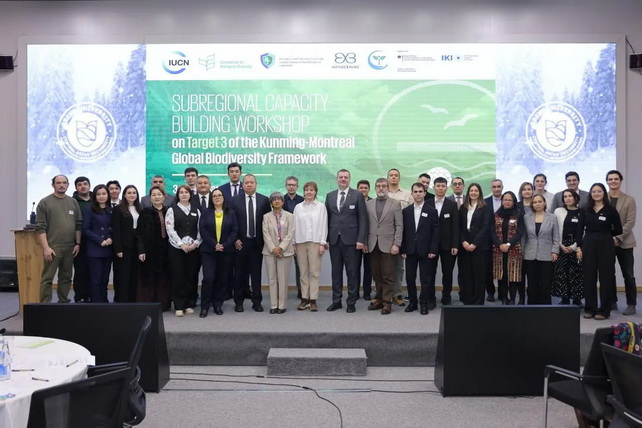
Subregional Seminar on Supporting the Implementation of Goal 3 of the Global Biodiversity Framework Held in Tashkent
Tashkent, Uzbekistan (UzDaily.com) — From 3 to 6 February 2026, the Central Asian University for Environmental Studies and Climate Change (Green University) is hosting a subregional seminar focused on supporting countries in implementing Goal 3 of the Kunming–Montreal Global Biodiversity Framework.
The event is organized by the International Union for Conservation of Nature (IUCN) in cooperation with the Secretariat of the Convention on Biological Diversity (CBD), with support from Uzbekistan’s National Committee on Ecology and Climate Change.
The seminar aims to assist Central Asian countries, as well as Armenia, Azerbaijan, Belarus, and the Russian Federation, in strengthening national biodiversity conservation actions. Participants are identifying national priority measures, assessing existing gaps and opportunities, and enhancing regional cooperation to accelerate biodiversity protection through effectively managed protected and conserved areas.
Goal 3 of the Global Biodiversity Framework targets the conservation of at least 30 % of terrestrial, freshwater, and marine ecosystems by 2030, through protected areas, other effective area-based conservation measures (OECMs), and recognition of indigenous and local community territories.
“Effective implementation of Goal 3 requires aligning technical and scientific knowledge with national policies and legal frameworks,” noted Marianela Araya, a program officer at the CBD Secretariat for invasive alien species, biodiversity, and health. She emphasized that subregional knowledge exchange is designed to close implementation gaps, share experiences, and better utilize the framework’s tools and guidance.
Protected areas play a critical role not only in safeguarding wildlife and ecosystems but also in human well-being. Healthy ecosystems provide access to clean water, support food systems, reduce the risks of natural disasters such as floods and landslides, contribute to climate regulation, and generate livelihoods for millions of people. Maintaining ecosystem integrity and reducing pressure on wildlife supports the “One Health” approach, mitigating risks associated with biodiversity loss, including the emergence and spread of zoonotic diseases.
Delegates from Central Asian countries, Armenia, Azerbaijan, Belarus, Kazakhstan, Kyrgyzstan, Tajikistan, Turkmenistan, Uzbekistan, and the Russian Federation are participating in the seminar. The event is designed to foster dialogue, joint learning, and coordination of actions toward achieving Goal 3.
“Over the past seven years, Uzbekistan has expanded its protected area network from 4 % to more than 14 % of the country’s territory, adding five million hectares,” noted Jusipbek Kazbekov, Deputy Chair of the National Committee on Ecology and Climate Change. He stressed that despite reaching 14.1 %, the country plans to continue expanding protected areas, focusing on ecological connectivity, effective management, and active engagement of local communities.
The seminar promotes mutual learning, cross-border collaboration, and strengthening regional coherence in implementing Goal 3 commitments.
“Advancing Goal 3 requires not only ambition but also practical tools, knowledge, and collaboration to translate commitments into real action on the ground,” said Madhu Rao, Chair of the IUCN World Commission on Protected Areas (WCPA). She added that through its expert commissions, IUCN is ready to support countries in strengthening conservation and protected area systems by applying science-based standards, best practices, and tools such as the IUCN Green List. Effectively and equitably managed protected and conserved areas are essential not only for biodiversity conservation but also for supporting livelihoods, human well-being, and resilience to global challenges.
The seminar is also supported by IUCN in its role as the official subregional Technical and Scientific Cooperation (TSC) center of the CBD for Central Asia. TSC centers provide countries with access to tailored scientific knowledge, tools, expert support, and capacity-building opportunities, accelerating implementation of the Kunming–Montreal Global Biodiversity Framework. By strengthening regional and national capacities, promoting innovation and technology transfer, and mobilizing resources, the centers facilitate collaboration aligned with national and regional priorities to achieve concrete biodiversity outcomes.
The event is financially supported by the German Federal Ministry for the Environment, Nature Conservation, and Nuclear Safety through the International Climate Initiative (IKI) and the 1Health4Nature project — “Enhancing landscape resilience to zoonotic disease emergence through strengthened protected area systems in Central Asia.” Additional support comes from the Republic of Korea through the Peace and Biodiversity Dialogue Initiative, the French Biodiversity Agency, and the High Ambition Coalition for Nature and People.