Stay up to date with the latest news
Subscribe to our telegram channel

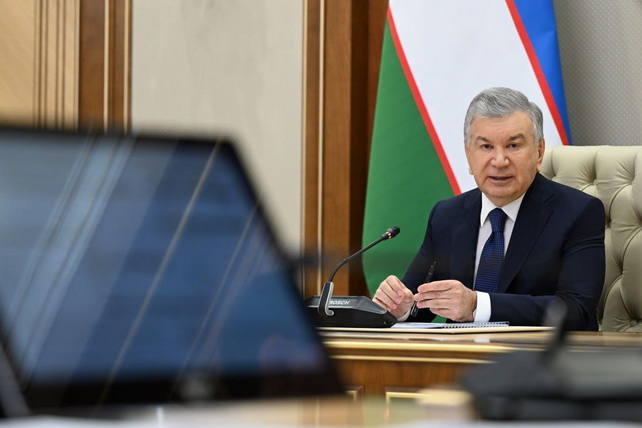
President Presented with Reform of Agricultural Subsidies and Credit System
Tashkent, Uzbekistan (UzDaily.com) — President Shavkat Mirziyoyev reviewed a presentation on improving the organization of financing for cotton and grain production, as well as the implementation of a new system for subsidizing the agricultural sector.
The briefing began with an overview of funds allocated to the sector this year and their effectiveness.
In total, 29 trillion soums have been directed to finance cotton and grain production, purchase agricultural machinery, and implement water-saving technologies. Additionally, farmers received 2.35 trillion soums in subsidies.
It was noted that subsidies covering 10% of cotton production costs, provided to 3,430 farms and clusters, enabled cultivation on 151,000 hectares using their own resources, saving 1.9 trillion soums.
Farmers who fully repaid their cotton loans this year were offered a 4-percentage-point rebate. As a result, 9,002 farms repaid preferential loans early, totaling 2.5 trillion soums.
For the next year, 34.2 trillion soums are planned for cotton and grain harvests, subsidies, and other expenses. An additional US$200 million is expected to be mobilized to purchase 800 cotton harvesters. New support mechanisms were also discussed.
It was proposed to allocate 5 trillion soums in 2026 for agrotechnical measures, including expenditures on film and hoses. Subsidies covering 5% of the value of sold cotton could be provided to farmers using at least 50% of their loan limit, potentially benefiting 4–4.5 thousand farms and saving 2.5–3 trillion soums.
Currently, all farmers receive loans at a uniform interest rate regardless of their financial discipline. A new model, “Better discipline – cheaper credit,” proposes reducing rates by 2 percentage points for farms with an “A” rating and by 1 point for those with a “B” rating, reducing the burden on responsible borrowers.
Additionally, farmers cultivating wheat with their own funds may receive a 10% subsidy on the value of their products.
The President emphasized that incentivizing farmers, strengthening their trust and economic interests, is a key pillar of agricultural development. Consequently, support measures will be gradually expanded.
Following the Presidential Decree of November 22, “On Measures to Radically Improve the System of State Support for the Agricultural Sector,” the Ministry of Agriculture established the Agency for Payments in the Agricultural Sector. The presentation addressed the organization and implementation of tasks assigned to this agency.
Currently, 52 types of subsidies exist in agriculture. Under the new system, the process will be significantly simplified: human factors and bureaucracy will be reduced, all procedures will move to a digital format, and subsidies will be provided through the Agroportal. Information systems of more than ten ministries and agencies will be integrated into the Agrosubsidy platform.
For 2026, 1.3 trillion soums in subsidies will be provided proactively, without applications. The remaining funds will follow a simplified procedure, eliminating several approval and documentation stages, significantly speeding up access to financial support.
The Head of State gave specific instructions to further improve financing mechanisms, ensure targeted and timely subsidies, fully digitize processes, and create favorable conditions for farmers.