Stay up to date with the latest news
Subscribe to our telegram channel

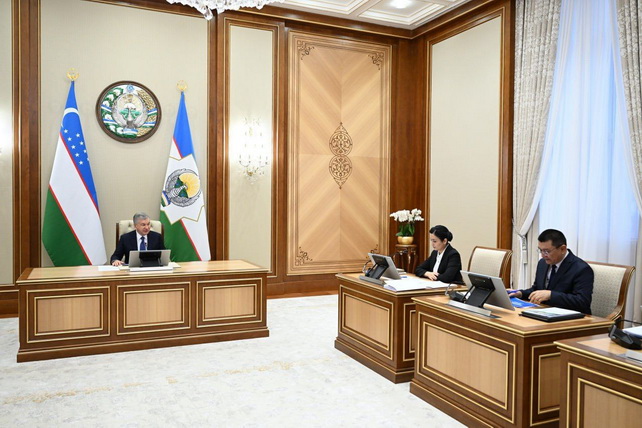
President of Uzbekistan Reviews Measures to Purge Corruption from the Judicial System
Tashkent, Uzbekistan (UzDaily.com) — On 12 February, President Shavkat Mirziyoyev received a report from the Chairman of the High Judicial Council on the state of the judicial system and ongoing anti-corruption measures.
Under Article 9 of the Law “On the High Judicial Council of the Republic of Uzbekistan,” the council’s head is required to annually brief the President on factors hindering the administration of justice, as well as on the state of anti-corruption efforts within the courts.
This issue has gained particular significance following the President’s 26 December 2025 address to the Oliy Majlis and the people of Uzbekistan, in which he declared that corruption undermines ongoing reforms and announced a “state of emergency” in the fight against it.
The High Judicial Council emphasized that the judiciary, as an independent branch of government, must serve as a model for a fully corruption-free system. The council bears direct responsibility for ensuring judicial independence and protecting judges from any external pressure.
In 2025, the President issued a decree significantly expanding the council’s powers, including the establishment of the Academy of Justice to train highly qualified judicial personnel.
Over the past year, the High Judicial Council appointed 135 new judges, reappointed 286 judges, and created a corps of 241 investigative judges. Extensive work was conducted to ensure discipline and adherence to professional standards. During this period, the mandates of 59 judges were terminated early: 19 judges were dismissed for violating their oath or the Code of Judicial Ethics, three were subject to criminal prosecution, and 58 were demoted.
Following professional performance assessments, 33 judges were deemed unfit for future appointments, and 266 judges faced disciplinary action. Five submissions were sent to the General Prosecutor’s Office regarding interference in judicial activities. To facilitate rapid reporting, the council established an online mechanism for submitting complaints about violations of judicial independence.
To strengthen institutional independence, more than 6,000 orders issued by regional court chairpersons were reviewed. The audit revealed that 314 judges in 231 orders were assigned non-judicial functions, all of which have now been corrected.
The council is studying international best practices for implementing judicial administration to relieve judges of administrative duties, transferring personnel, logistical, and organizational responsibilities to dedicated bodies. In this context, a Disciplinary Board of Judges has been proposed to ensure impartial and objective enforcement of disciplinary measures.
Additional initiatives focus on increasing transparency, including mandatory asset declarations by judges and their families, compliance controls within court administrations, and a clear and open procedure for hiring judicial staff. Gender equality was also discussed as part of broader state policy supporting women, with plans for events on 10 March — International Women Judges’ Day.
President Mirziyoyev endorsed the proposals and provided guidance to continue systematic reforms aimed at strengthening judicial independence, protecting judges, and removing obstacles to effective and fair justice.
#Shavkat Mirziyoyev