Stay up to date with the latest news
Subscribe to our telegram channel

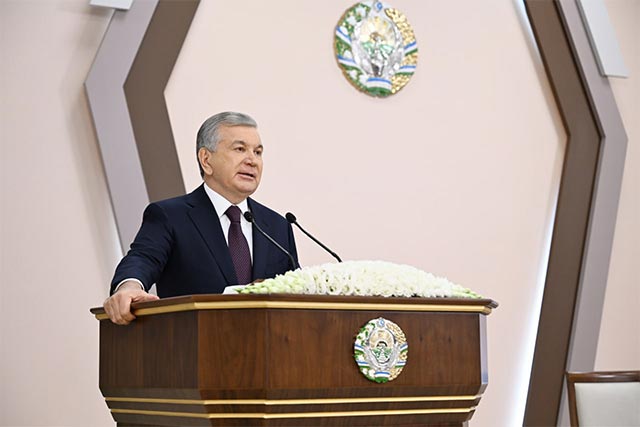
President of Uzbekistan Announces Poverty Reduced to 5.8% and Unemployment to 4.8%
Tashkent, Uzbekistan (UzDaily.com) — Under the chairmanship of President Shavkat Mirziyoyev, a videoconference meeting began to discuss the main objectives for reducing poverty and ensuring employment in 2026.
Before addressing the agenda, the head of state briefly reviewed the results of 2025.
It was noted that last year, the country’s economy grew significantly above initial forecasts, expanding by 7.7%, with the gross domestic product exceeding $147 billion. Growth rates across all sectors of the economy surpassed those of 2024. Foreign investment reached $43 billion, while exports totaled $33.8 billion.
Despite high economic activity and rising consumer demand, inflation fell from 9.8% in 2024 to 7.3%.
“Why do I cite these figures? Because the more sustainable the economic growth, the greater the opportunities for financing infrastructure development. Ultimately, this drives job creation, higher incomes, and improved living standards,” emphasized the President.
Over the past year, 366,000 families were lifted out of poverty. As a result of measures to support employment and income growth, the poverty rate fell from 8.9% to 5.8%, and unemployment decreased from 5.5% to 4.8%.
“All of this reflects the results of our reforms and demonstrates that trust between the state and the people is steadily strengthening. However, there is still much work ahead. We have declared 2026 the ‘Year of Mahalla Development and Social Welfare’ and set ambitious goals to improve mahalla infrastructure.
The mahalla clearly shows where reforms are effective and where they are not. If unemployment and low-income families persist in a mahalla, it means reforms have not reached it. If the so-called ‘seven’ and banking structures fail to resolve people’s problems, it means the system is not functioning in that area.
No minister, regional or district hokim, or banker has the right to hide behind the ‘seven.’ The resources and financial tools are available; the programs and solutions have been approved. What is lacking is responsibility and personal accountability,” the President stressed.
He noted that local hokims and the so-called “mahalla seven” lack methodological knowledge and practical experience to effectively use available opportunities, and responsible ministries and agencies do not provide them with sufficient support.
It was emphasized that successful initiatives and experience created by citizens and entrepreneurs—such as livestock farming in the Arnasay district, banana cultivation in Shurchinsky, pomegranate farming in Kuvinsky, and beekeeping in Bostanlyk—could serve as practical models for other districts with similar specializations. However, this potential is underutilized.
“Such examples exist everywhere, but there is no system to train others and expand the reach of these practices,” the head of state said.
Officials were instructed to study mahallas with high unemployment and poverty levels within one month and prepare a methodological guide for implementing best practices. Local hokims will be responsible for ensuring execution, providing employment, increasing citizen incomes, and addressing the most pressing social issues.
“In general, this year, the activities of every ministry and hokimiat will be directly linked to the mahalla, and decisions made must clearly indicate the changes they will bring at the mahalla level,” the President emphasized.
For the current year, the key targets include providing stable employment for one million people, lifting 181,000 families out of poverty, increasing the number of poverty-free mahallas by 2.5 times to 3,500, and reducing unemployment and poverty to 4.5%.
Based on a study of districts across 20 criteria—including infrastructure, living standards, business activity, and financial capacity—37 “difficult” districts were identified. In addition, each district underwent analysis to select 903 “critical” mahallas with high poverty levels. It was found that one-third of families living in poverty and 21% of the unemployed are concentrated in these 37 districts and 903 mahallas.
In addition, implementation work on the “New Uzbekistan” initiative has already begun in 33 more districts and 330 “critical” mahallas.
“If we focus our main efforts on these 70 districts and 1,000 ‘critical’ mahallas, we will be able to reduce the poverty rate in the country by 3%,” the head of state noted.
Residents and entrepreneurs in these “critical” districts and mahallas most often request improvements in infrastructure—roads, water supply, and electricity—rather than tax benefits. In this regard, 20 trillion soums have been allocated to regional budgets this year for infrastructure development, with 12 trillion soums specifically directed to the “critical” districts and mahallas.
Funds returned from the national budget to local budgets have been doubled, providing hokims with 4.2 trillion soums. Regional hokims will now be able to allocate 10 billion soums for each “critical” district and 1 billion soums for each of the 903 mahallas.
Furthermore, an additional 50 billion soums will be allocated to each “critical” district and 2 billion soums to each “critical” mahalla. This means that district hokims and local councils will receive another 4 trillion soums to support these districts and mahallas.
“Hokims must understand: these funds must serve to halve poverty and unemployment through improved infrastructure. District hokims will communicate with the population, providing detailed explanations for each mahalla, including how many people will be employed and how many families will be lifted out of poverty.
Once such funds are allocated, the hokim assumes full responsibility to the people and is accountable for the results. The effectiveness of the hokimiat will be evaluated by the people themselves,” the President emphasized.
The focus is now on developing territories based on their comparative advantages in industry, agriculture, and the service sector. The head of state illustrated this system using the Furkat and Dekhkonobod districts as examples.
The Ministries of Economy and Finance, together with the Ministry for Poverty Reduction and Employment, have been instructed to analyze the “comparative advantages” of the 70 districts and 1,000 “critical” mahallas and prepare specific programs for infrastructure projects that stimulate job creation and income growth, ensuring their funding.
In each district, industrial zones and clusters of 1–2 hectares will be established, combining 5–10 mahallas, creating employment opportunities for 100,000 people.
Experts from France, the United Kingdom, Spain, and Türkiye are being involved to develop the master plans for these territories. At the same time, approximately 7,000 specialists in Architecture graduate each year from 18 Uzbek higher education institutions.
It has been decided that hokims will engage these graduates to help develop master plans for the 903 “critical” mahallas, pairing them with foreign experts. This will serve as both practical training and a learning platform for young professionals.
A competition will be held for students to develop master plans for the mahallas. The best student teams, whose projects give mahallas a modern appearance, will be awarded prizes starting from 100 million soums. This approach aims to form a corps of young, modern architects and urban planners.
In the “critical” districts and mahallas, detailed plans have been made to ensure employment and income growth. Above all, it was noted that these areas need stable electricity supply.
To achieve this, a 300 kW mini-solar power plant will be constructed in each of the 903 mahallas, which will be transferred to the mahallas as a non-repayable asset.
The revenue generated from “green” energy will allow each mahalla to create an economic asset, generating an additional 400–500 million soums.
These “green” revenues will be directed toward implementing “green” initiatives. In other words, the funds will be used for energy-efficient renovations of homes in need, reducing electricity costs, and improving quality of life.
Members of low-income families residing in these mahallas will be engaged in operating the solar power plants. As part of the energy-efficient renovation program, 6,700 households with members having Group I disabilities and without able-bodied family members will be covered.
These measures will also be implemented in 1,000 additional model mahallas with a high level of specialization. The mini-solar power plants will be transferred to the mahallas fully operational for a period of seven years on interest-free leasing terms.
The President emphasized the need to deepen the specialization of mahallas to reduce unemployment and poverty.
In highly specialized mahallas, the standard of living is significantly higher, and the number of social assistance recipients is twice as low.
Currently, the 903 “priority” mahallas have 100,000 hectares of household and leased land. If the mahalla leaders, with the support of the “seven-member team,” ensure water supply, provide seeds and seedlings, and systematically implement specialization, this will significantly increase incomes and improve living conditions for the local population.
For example, in the Akoltin mahalla of Nishan District, thanks to water supply from a pump, 280 households that had not cultivated their household plots for 25 years began generating incomes of 50–60 million soums. Residents of the mahalla who successfully applied this experience are now requesting improvements to internal roads. The President instructed that 1.5 billion soums be allocated for this work tomorrow.
“Let the head of another mahalla take up the task, systematically organize specialization according to the residents’ skills, and increase household incomes three to fourfold—I am ready to allocate an additional 2 billion soums for improving roads, water supply, and irrigation networks. This will create a new, unique ‘social contract’ between the state and the mahalla,” the President noted.
Additional financial mechanisms will also be introduced to encourage specialization in the mahallas. In particular, owners of household plots and peasant farms will receive:
Reimbursement from the budget of half the cost of certified seedlings;
Subsidies for trellises depending on the type of fruit, ranging from 20,000 to 70,000 soums;
Compensation for implementing drip irrigation on household plots—160,000 soums per 100 square meters.
If experienced farmers organize the cultivation of export-oriented products for every ten households in the mahalla, they will receive 2 million soums; if this is achieved on at least 30% of the mahalla’s household plots, an additional bonus of 75 million soums is provided.
This year, 2,000 hectares of forest land will be allocated free of charge for ten years to 4,000 low-income families for planting mulberry trees on 50-sotka plots. Low-income families forming mulberry cooperatives will receive a subsidy of 4 million soums.
Additionally, families in need wishing to raise silkworms will be provided with interest-free loans of up to 20 million soums for preparing facilities and purchasing equipment.
This year, 140 trillion soums in loans are planned for the development of small and medium-sized businesses.
“It must be said openly: currently, bank loans are offered under the same conditions for all districts and cities. Can one really compare opportunities and conditions in Olmazor and Bozatov? However, for family entrepreneurship, both districts currently receive the same loans at 17.5%. Now, for the 37 ‘priority’ districts, loans under this program will be provided at 12%,” the President said.
In each district, the maximum amount of concessional credit for family entrepreneurship will increase 1.5 times, reaching 50 million soums. For imported and certified breeding livestock, loans of up to 100 million soums can be obtained. For organizing mini-hotels, small freezers, product storage, and mini-processing technologies, loans of up to 150 million soums will be available without collateral.
In border and enclave districts, for 562 entrepreneurial projects, the maximum loan amount will increase to 1 billion soums.
To support this, an additional 2 trillion soums will be allocated this year to the family entrepreneurship programs on top of the planned 3.6 trillion soums.
To deepen mahalla specialization, banks will provide 17 trillion soums in loans this year. In this process, 4% of the loan for production cultivation is covered, and for processing projects, 6% is covered.
“Assistants to the hokims have learned to identify proactive individuals and implement micro- and small-scale projects in the mahallas, gaining experience. Now they will organize work in their mahallas based on a ‘project approach,’” the President noted.
The system for training hokim assistants in the “project approach” is being introduced, starting with the ‘priority’ mahallas. For each district, a portfolio of projects to be implemented under the ‘project approach’ is being formed.
The starting prices for available land and state-owned properties in the ‘priority’ mahallas will be reduced two to three times for subsequent sale.
One hundred “priority” mahallas that demonstrate the best results in creating jobs and increasing incomes will receive funding of 1 billion soums each. Assistants to the hokims from these mahallas will be sent on one-month advanced training courses to China, Türkiye, Korea, and Malaysia.
The experience gained in the capital to enhance the effectiveness of the “mahalla seven-member team” will now be implemented in all districts and cities.
From now on, a hokim’s assistant, a women’s activist, or a youth leader is appointed and dismissed based on the recommendation of the mahalla head and the decision of the district hokim.
In the capital, regional centers, and major city-districts, an attractive business climate has been established, supporting the development of a sustainable class of entrepreneurs.
For example, 50 districts and cities with high entrepreneurial potential account for 62% of the country’s industrial output and 57% of the service sector. Three years ago, the additional income of local budgets in these districts amounted to 875 billion soums; today, it is expected to increase 8.5 times, reaching 7 trillion 400 billion soums.
It was therefore emphasized that the hokims of these 50 districts must actively use their opportunities and improve infrastructure to increase revenues.
In the capital, business plans have already been developed for 12 districts, which will allow an additional 5.5 trillion soums to be brought into the budget. For instance, in Olmazor District, an additional 525 billion soums in local budget revenue is expected this year.
A two-kilometer section of the Kaykovus Canal passes through eight mahallas in the Old City. Now, the assistants to the hokims of these eight mahallas are forming a single “project group” to develop a comprehensive concept for the development of trade, service, and recreational infrastructure along the canal.
Using the same model, “project groups” of hokim assistants are being formed in the areas of tourism, education, healthcare, urban renovation, lake territories, and busy streets.
The entire country is participating in a large-scale population and agricultural census.
So far, out of 7,613,000 households, 4,776,000 have been registered, though the process is moving slowly in Tashkent, Fergana, Surkhandarya, Bukhara, and Tashkent Regions.
“This is the first event of this scale in 37 years. The census allows us to determine the real situation of each mahalla and each family, plan further steps, and, most importantly, implement effective mechanisms aimed at improving the population’s standard of living,” the Head of State noted, urging all citizens to actively participate in the census.
At the meeting, reports and proposals from district hokims, mahalla heads, and hokim assistants were also heard and discussed.
#Shavkat Mirziyoyev