Stay up to date with the latest news
Subscribe to our telegram channel

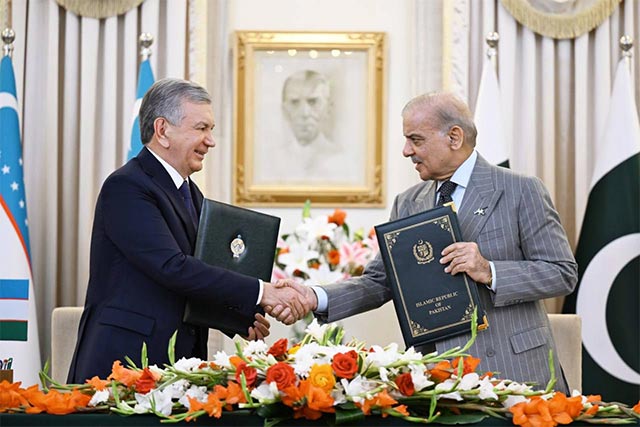
One Heart, Two Nations: How Uzbekistan and Pakistan Are Rewriting Their Shared Destiny
Tashkent, Uzbekistan (UzDaily.com) — A new era is quietly and confidently unfolding, filled with hope and promise. For us, Uzbekistan has never been a distant country marked only by borders on a map. It has lived in our hearts since childhood, shaped our stories, guided our prayers, and defined our sense of belonging. Long before diplomacy acquired formal language, our souls already recognized Uzbekistan as familiar and close. Today, as Pakistan and Uzbekistan move into a renewed and deeper partnership, that childhood affection has naturally matured into a strategic purpose.
We write not merely as professionals, policymakers, or former officeholders, but as sincere admirers and brothers who have always considered Uzbekistan our second home—perhaps even our first in spirit. This bond is not recent; it is centuries old and deeply rooted in shared history and civilization. It began when Zahir-ud-Din Muhammad Babur, the son of the Fergana Valley, crossed mountains and rivers and entered the plains of the Indus. In 1519, Babur reached the Chenab River in what is now Pakistan, and from that moment onward, history flowed from Uzbekistan to South Asia. Culture followed, faith deepened, and a shared civilizational journey began—one that never truly ended.
When Uzbekistan emerged as an independent and sovereign nation in September 1991, liberated after decades of constraint, we felt a joy that words can scarcely describe. From that very moment, we became among its strongest advocates outside its borders, not for material gain, but out of love, history, and a deep sense of destiny. Over the years, we have visited Uzbekistan many times, and each visit has felt like returning home. The warmth of its people, the dignity of its state institutions, and the pride embedded in its reform journey have always been deeply moving. Every street of Tashkent, every echo of Samarkand, and every horizon of Bukhara has reaffirmed our belief that Uzbekistan is not merely a country, but a living soul.
For decades, we carried a dream that was simple yet powerful: to connect Uzbekistan and Pakistan through railway lines, dual carriageways, and the free movement of people. It has always been our hope to one day drive from Peshawar to Tashkent in our own cars in just a few hours—not as tourists, but as a family. For us, connectivity has never been only about infrastructure; it is emotion made physical and history translated into motion.
Uzbekistan may be landlocked, but it has never been isolated. Geography imposed constraints, yet vision dissolved them. Under the transformative and pragmatic leadership of President Shavkat Mirziyoyev, Uzbekistan has accomplished what few nations dare to attempt. It has reformed deeply, opened carefully, and grown inclusively, turning structural limitations into strategic advantages. We may well be among the very few outside Uzbekistan who celebrated with genuine jubilation when the country recorded a historic GDP growth of 7.7 % in 2025—not because of numbers alone, but because that growth symbolized dignity restored and potential unlocked.
Uzbekistan is now decisively diversifying beyond energy dependence, strengthening manufacturing, expanding services, reforming markets, and improving its overall business environment. Millions have been lifted out of poverty, and this success is no accident. It is the outcome of leadership-driven transformation. In our professional assessment, Uzbekistan is entering a decisive phase of accelerated development through 2030, with a clear national ambition to reach a GDP of approximately US$300 billion, reduce poverty to below four %, and attract massive foreign investment that reshapes its productive base.
Economic fundamentals strongly support this trajectory. GDP growth is expected to remain robust, with forecasts of around approximately 7.5 % in 2026, driven primarily by industry, construction, and services, while growth in 2026 is projected at around 6.7 % despite global uncertainty. Over the next five years, the government aims to attract nearly €166 billion in foreign investment, a powerful signal of confidence and openness to the world.
Energy transformation is central to this vision. Under the Generation Expansion Plan for 2020–2030, Uzbekistan plans to add nearly 15 gigawatts of new capacity, including 5,000 megawatts of solar power and 3,000 megawatts of wind energy. This green transition is foundational rather than symbolic, designed to lower production costs, enhance energy security, and align the country with global sustainability and climate goals. At the same time, digital transformation is accelerating through cooperation with leading technology companies such as Huawei, BYD, and ZTE, which are supporting the development of technology parks, high-tech industries, and advanced manufacturing ecosystems, including plans for 50,000 electric vehicle charging stations by 2033.
Water and agriculture, critical to long-term resilience, are also undergoing modernization. Through 2031, major irrigation projects will line 259 kilometers of canals with concrete and upgrade 470 hydraulic structures to improve water efficiency and climate adaptation. These reforms aim to strengthen food security, stabilize rural incomes, and support sustainable growth, while broader economic reforms are expected to generate one million high-income jobs, ensuring that development remains inclusive and socially balanced.
In this broader transformation, enhanced cooperation with Pakistan holds strategic importance. The two countries naturally complement each other in logistics, textiles, manufacturing, pharmaceuticals, and agro-processing. Pakistan offers Uzbekistan the nearest access to warm-water ports at Karachi and Gwadar, while Uzbekistan brings reform momentum, industrial ambition, and regional reach. Together, they form the backbone of a powerful north–south economic corridor.
President Shavkat Mirziyoyev’s visit to Pakistan on 5 February 2026, therefore, marked a genuine turning point. Multiple memoranda of understanding were signed, and a protocol was concluded to raise bilateral trade to US$2 billion within five years. A joint working group was established to develop a five-year roadmap covering trade, investment, research, technology, agriculture, and industrial cooperation. This institutional architecture is durable, forward-looking, and grounded in economic realism.
Yet, above all else, connectivity remains the central pillar of our vision. We continue to dream of a modern railway and a dual carriageway linking Tashkent and Peshawar—a corridor that shortens distance, deepens trust, and carries not only goods, but ideas, values, and shared aspirations. Such connectivity would dramatically reduce costs, cut transit time, enhance competitiveness, and provide Uzbekistan direct access to the Arabian Sea, while granting Pakistan seamless entry into Central Asia. Geography would finally serve prosperity rather than constrain it.
More importantly, connectivity would heal regions by stabilizing supply chains, encouraging investment, creating jobs, and building shared stakes in peace. Infrastructure would become diplomacy in motion. Having worked for decades in development, policy, and sustainability across major international institutions, our experience has taught us one enduring truth: regions rise when they connect, while isolation breeds fragility.
Uzbekistan and Pakistan are, in essence, one heart in two bodies. Our faith connects us, our culture binds us, our history unites us, and our future demands partnership. The love we feel for Uzbekistan is not diplomatic or transactional; it is personal, emotional, and enduring.
We have waited decades for this moment, and now it has arrived. A new era has begun—not merely of relations, but of belonging. May the railway come soon, may the road be smooth, and may the journey from Peshawar to Tashkent finally become a drive of hours rather than a dream deferred across generations. When that happens, history will smile, because two nations that were always close will have finally chosen to walk, drive, and move forward together.
Mian Nasser Hyatt Maggo
Former President, Federation of Pakistan Chambers of Commerce & Industry (FPCCI), Pakistan
Engineer Arshad H. Abbasi
Development Expert, Environmentalist & Policy Analyst
Former Consultant to UNDP, USAID, World Bank, ILO,
Planning Commission of Pakistan & WWF