Stay up to date with the latest news
Subscribe to our telegram channel

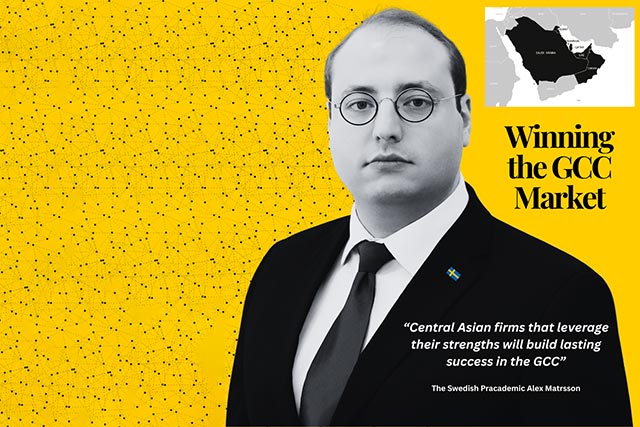
Nuanced Framework for Winning the GCC Market
Tashkent, Uzbekistan (UzDaily.com) — In an exclusive interview, the Swedish pracademic and international business strategist Mr. Alex Matrsson advocates that the Gulf Cooperation Council (GCC) countries, Saudi Arabia, United Arab Emirates, Qatar, Kuwait, Bahrain, and Oman, remain one of the most strategically significant regions for international expansion, offering both a high-income consumer base and robust trade infrastructure. For Central Asian firms, whose home markets are increasingly integrated into global value chains, the GCC presents opportunities that extend beyond transactional trade to long-term strategic positioning. However, entry into this market is not trivial. Variations in regulatory regimes, cultural norms, market expectations, and competitive intensity require firms to adopt a nuanced, multidimensional approach to internationalization, and he emphasizes that understanding the subtleties of each market is critical before committing resources.
A phased, knowledge-driven engagement is critical for reducing uncertainty and fostering sustainable operations. “Firms that leap too quickly often underestimate the complexities of local markets,” explains Mr. Matrsson. He argues that starting with intermediaries or regional distributors allows companies to systematically accumulate experiential insights into market preferences, compliance requirements, and competitive behaviors. This stepwise learning process, Mr. Matrsson adds, provides a foundation for scaling operations and informs the choice of deeper commitment mechanisms, whether through localized subsidiaries, joint ventures, or direct investments. Firms that neglect this accumulation of contextual knowledge risk misalignment between product offerings and market expectations, which can compromise both brand equity and market penetration.
Equally critical is the strategic leverage of networks and relational capital. Central Asian firms often face information asymmetries and institutional complexities when entering the GCC. Mr. Matrsson highlights that engaging with established local partners, diaspora networks, and regional trade associations enables firms to access tacit knowledge and navigate institutional and cultural barriers. According to Mr. Matrsson, these relational mechanisms function as both accelerators of market entry and buffers against transactional uncertainty, providing pathways for early legitimacy and trust-building with customers, regulators, and supply chain stakeholders. Firms that strategically cultivate these networks, Mr. Matrsson notes, frequently outperform entrants that rely solely on transactional or arm’s-length market strategies.
The choice of operational configuration is a critical determinant of success. In high-complexity markets such as Saudi Arabia or Qatar, where regulatory oversight and quality standards are stringent, establishing joint ventures or wholly-owned subsidiaries allows firms to retain control over critical processes and protect proprietary capabilities. Mr. Matrsson observes that such configurations facilitate consistent delivery, safeguard intellectual property, and enable the full capture of firm-specific advantages. Conversely, in markets characterized by efficient logistics and regulatory clarity, flexible arrangements, such as agent-based distribution, can achieve effective market coverage at lower risk and cost.
Mr. Matrsson emphasizes that strategic decision-making in this domain requires careful calibration of environmental risk, cost considerations, and the firm’s own resource endowments. Central Asian firms also face the imperative of leveraging unique capabilities and differentiating assets to compete effectively. Natural resource-derived products, high-quality agricultural goods, and technologically innovative services can serve as anchors for positioning in high-value segments of the GCC. “The firms that identify what makes them irreplaceable will survive and thrive,” notes Mr. Matrsson. Firms that align these capabilities with discernible market demand, such as premium food products in the UAE, specialized construction materials in Qatar, or renewable energy technologies in Saudi Arabia, can establish competitive differentiation, enhance brand recognition, and build resilience against commoditization pressures. In the GCC, where consumer expectations often demand premium quality and innovation, Mr. Matrsson underscores that a resource-based approach allows firms to carve out defensible niches.
Moreover, the rise of digital infrastructure within the GCC provides a powerful lever for accelerated market engagement. Technology-driven firms, especially in fintech, e-commerce, and digital services, can leverage online platforms to achieve rapid regional scale. Mr. Matrsson points out that digital routes bypass many traditional barriers, enabling Central Asian firms to test multiple markets simultaneously and build early brand recognition. That said, digital expansion still requires alignment with local regulations, such as data privacy laws, and partnerships with regional digital platforms to ensure seamless market entry, he cautions.
In conclusion, the Swedish pracademic and international business strategist Mr. Alex Matrsson accentuates that Central Asian firms targeting the GCC must embrace a multifaceted strategic framework, combining incremental market learning, purposeful relational engagement, careful design of entry structures, and a deliberate focus on unique resource endowments. “Success is not just about entering a market; it’s about orchestrating multiple dimensions of strategy in concert,” concludes Mr. Matrsson. By orchestrating these dimensions, firms are not merely entering a new market; they are building a resilient, adaptive platform for sustained global growth.
About Mr. Alex Matrsson
Mr. Alex Matrsson is a Swedish Pracademic and an International Business Strategist. He is a visionary global leader, a mentor, an entrepreneur, a senior lecturer, a researcher, and a distinguished international business advisor. He is the number one International Business Strategy graduate in Sweden. He has extensive experience initiating, running, and managing businesses across the global value chain, as well as working internationally with investors, SMEs, MNCs, government agencies, universities, and multidisciplinary research institutes. Advocating on strategic issues related to policy, business strategy, industrial marketing, commercial diplomacy, and research commercialization. When it comes to higher education, Mr. Matrsson believes in serendipity, innovation, and the power of synergy-making. Therefore, these concepts jointly constitute the springboard for his knowledge dissemination endeavors. He implements a pragmatic approach that is rigorous in nature. He systematically ensures the successful delivery of core business concepts, while simultaneously developing the students' ability to become reflexive thinkers. He aims to enable the students to operationalize their "state-of-the-art" knowledge constructively—so that they can become an invaluable source of prosperity, driving forward the "social" and "economic" well-being for their local communities, their regions, and the larger society, worldwide. His scientific endeavors consolidate around trade promotion, emerging markets, business resilience, and the network approach to internationalization. Mr. Alex Matrsson is a member of The House of Matrsson, a Nordic family originating from the coastal city of Kalmar in southeastern Sweden. Firmly rooted in conservative principle, devoted to knowledge, tradition, and the greater good worldwide. Finally, on a personal level, his wide-ranging interests include blue whales, Arabian horses, classical music, ethical capitalism, religion, culture, the Nordics, the GCC region, and Central Asia—particularly Kazakhstan.