Stay up to date with the latest news
Subscribe to our telegram channel

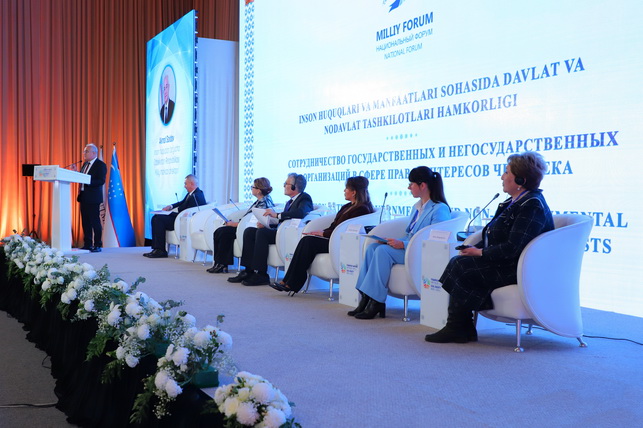
National Forum Discusses Cooperation Between Government Agencies and NGOs in Human Rights
Tashkent, Uzbekistan (UzDaily.com) — A National Forum of Non-Governmental Non-Profit Organizations was held in Tashkent, organized by the National Association of NGOs of Uzbekistan and the Public Fund for Supporting Civil Society Institutions, with participation from the National Center for Human Rights, the Ministry of Justice, and several state and public organizations.
The forum focused on cooperation between government agencies and NGOs to protect and promote human rights and interests.
The event aimed to discuss mechanisms for state-civil society interaction, enhance public oversight, and expand NGO participation in governance processes.
The forum was held as part of the implementation of Uzbekistan’s National Human Rights Strategy and the 2025 Civil Society Development Concept.
Participants reviewed the results of the 2024 National Forum, including proposals to improve the regulatory framework for public oversight and social partnership, as well as the operation of a unified electronic platform ensuring transparency in the allocation of state subsidies, grants, and social contracts.
In this context, the forum discussed the law adopted in August 2025, which defines the obligations of state bodies to consider public oversight conclusions and allows NGOs to receive government contracts.
It was noted that the Public Fund has fully implemented an electronic platform for posting subsidies, grants, and social contracts. Four grant competitions have been conducted so far this year.
During the plenary session, participants addressed current directions for state-public sector cooperation, including the development of mechanisms for NGO participation in safeguarding citizens’ rights and freedoms.
The forum also considered Uzbekistan’s reporting to the UN Human Rights Council and treaty bodies, as well as the implementation of national action plans in response to their recommendations.
Special attention was given to the adoption of international human rights standards, including updates to national legislation and the development of preventive mechanisms in line with UN recommendations.
Sectoral sessions included experts and representatives of active NGOs, discussing reform continuity, the role of public oversight, and prospects for expanding collaboration between state and non-state institutions.
Additionally, the National Association of NGOs signed memorandums of cooperation with the National Committee for Ecology and Climate Change, the Research Institute of Criminology, and the International Press Club.
At the conclusion of the forum, recommendations were prepared to improve mechanisms of cooperation between government bodies and NGOs in human rights protection, support civil society initiatives, and strengthen public oversight.
A comprehensive set of measures to further develop social partnership was approved at the final session.