Stay up to date with the latest news
Subscribe to our telegram channel

Mirziyoyev: Investments in Surkhandarya Reach US$5 Billion, Plans to Attract Additional US$10 Billion from Foreign Partners
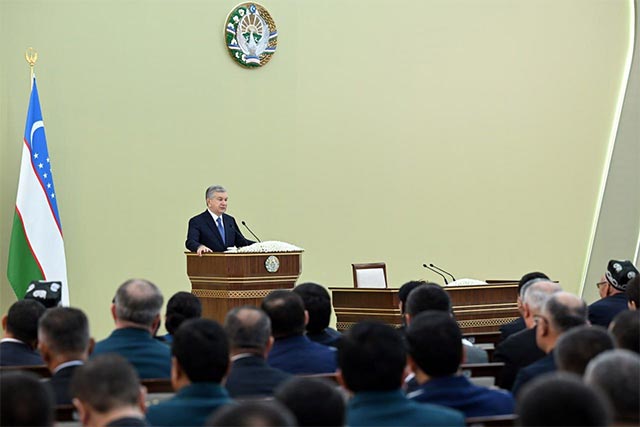
Tashkent, Uzbekistan (UzDaily.com) — Under the chairmanship of President Shavkat Mirziyoyev, a meeting was held on the comprehensive development of Surkhandarya region.
“Surkhandarya is not only a land with beautiful nature but also a region of people with strong spirit, high energy, and solid moral values. Developing Surkhandarya strengthens the southern pillar of the New Uzbekistan,” the President noted.
During the period under review, over 8,000 projects worth US$5 billion have been launched in the region. Investment and trade agreements with China, the USA, Russia, India, Austria, Hungary, and other countries have been reached for an additional US$10 billion.
Over the past nine years, preschool education coverage has increased from 28% to 68%. Twenty-three new schools were built, 448 schools underwent major renovations, and 102,000 additional student places were created.
During this period, 688 multi-story residential buildings were commissioned, housing 32,000 families. Residential complexes “New Uzbekistan” were organized in Angor, Boysun, Jarkurgan, Sariasiya, and Terme districts.
The Topalang Reservoir water supply project improved drinking water provision for Terme city and 10 districts, serving 563,000 people.
The regional and district hokims have been tasked with increasing investment to US$3 billion and export volumes to US$1 billion this year.
Reducing poverty to 2.8% and unemployment to 4.5% is a priority, with cities Terme, Angor, Denov, Jarkurgan, Qizirik, and Muzrabot targeted to become “poverty- and unemployment-free zones.”
Industry’s share of the regional economy has increased fivefold to 10% over nine years, but this is still deemed insufficient. Despite 100 million tons of coal reserves, only about 1% is currently extracted annually. This year, coal extraction will begin at the Sandjar deposit in Boysun and Oksuv in Oltinsoy, with Fangart planned next year.
South African company Sosol expressed interest in producing polypropylene, polyethylene, and rubber from coal. Chinese investors plan to invest US$1 billion in Korakon, Jemsonit, Chukur, and Bayram-1 deposits in Sariasiya. These resources provide a raw material base for electrical engineering, construction materials, chemical and metallurgical industries, and automotive production. Projects of at least US$200 million are to be planned around these deposits.
At the Bezaktop site in Boysun, natural stone reserves remain unstudied; geological work will begin to evaluate potential for competitive-quality extraction compared to Iran, Türkiye, and Italy.
The Terme International Trade Center reported over 800,000 Afghan visitors last year, with exports reaching US$320 million. Plans include expanding the center to 1,000 hectares, doubling export targets to US$600 million this year and US$1 billion next year, and creating 10,000 new jobs. Law enforcement and special prosecutors will oversee operations, and trade/services in the center will be considered exports with zero VAT.
The region has 49,000 hectares of private plots, 35,000 of which yield 3–4 harvests annually. In the Terme district, the “School of Private Plots” trains farmers to achieve up to five harvests per year. Similar schools will be established in Angor, Uzun, and Denov, training 10,000 people annually. Two innovative schools per district are planned across Surkhandarya.
Lemon orchards will cover 5,000 hectares in Denov, Oltinsoy, Sariasiya, and Uzun districts. A three-year plan is in place for export-oriented grape production on 6,000 hectares in Oltinsoy. In Uzun, the national brand of dried dates and figs, developed with Japanese experience, will be promoted.
Greenhouse production in Surkhandarya costs 2–3 times less than in other regions. Inspired by Spain’s Almeria region, solar-heated greenhouses will be built on 1,000 hectares this year, with land leased free for five years and underground water fees waived for three years.
Surkhandarya’s pastures are another underutilized resource. For example, Boysun has 197,000 hectares of pasture. With restored pumps on the Darband River, 10,000 hectares could be irrigated — 1,500 hectares for potatoes, the remainder for fodder crops.
To develop the land reserves, the initial price will be set at 1% of the standard valuation and offered at auction.
Entrepreneurs who win the auction will receive a 10-year loan with a four-year grace period at an annual interest rate of 14%. A subsidy of up to 120 million soums is provided for water supply infrastructure for every ten hectares of land.
Under the three-year program, 58,000 hectares of pasture are planned to be brought into use, supporting the grazing of 300,000 sheep and goats.
In Surkhandarya, where the annual demand for poultry meat reaches 45,000 tons, there is not a single large-scale poultry complex. This year, 18 poultry and breeding projects with a total investment of US$60 million are scheduled to be launched in the region.
Thanks to the early arrival of spring, the beekeeping season in Surkhandarya begins ahead of schedule. Developing the genetics of queen breeding bees in the region will provide a “qualitative leap” for the industry. Accordingly, instructions have been issued to import queen bees and establish 30 projects producing 150,000 breeding bee packages.
One of the most pressing issues in Surkhandarya remains the road and transport infrastructure. Two years ago, in partnership with the Asian Development Bank, a project was launched to convert 111 kilometers of the road connecting Boysun and Denov to cement concrete, at a cost of US$183 million. Once this section is completed, freight traffic is expected to double, and travel time will be reduced from three hours to 1.5 hours.
The 178-kilometer highway connecting the country with Afghanistan and Tajikistan has not undergone major repairs for 30 years. Officials have been instructed to begin construction within three months.
A passenger train from Tashkent to Terim currently takes over 14 hours. Agreements have been reached with Korean partners for the supply of modern high-speed trains. This year, the design work for the “Toshguzor — Boysun — Kumkurgan” section for high-speed movement is to begin, along with the electrification of the 103-kilometer “Kumkurgan — Quduqli” section.
New flights are planned along the Terim — Istanbul and Terim — Dubai routes.
Approximately 100,000 people travel daily by car from Shorchi, Denov, Sariasiya, Sherobod, and Boysun to the regional center. Initially, 125 buses delivered to Surkhandarya will be assigned to these routes.
By the end of the year, a project to provide centralized drinking water to 56,000 residents of Muzrabot will be completed for the first time in history. A sewerage project will also begin in the centers of Muzrabot, Oltinsoy, Angor, Qizirik, and Boysun.
It was also noted that a scientifically sound solution has been found in partnership with experts to address a technologically complex issue at the large gas processing complex “25th Anniversary of Independence.”
“Our goal is not only to prevent an accident but to launch a project that will give a powerful boost to Surkhandarya’s economy,” the President stated.
Tourism in Surkhandarya has the potential to generate annual revenues of US$1 billion. The region is home to over 150 cultural heritage sites, including Al-Khakim at-Termizi, Sultan Saodat, Kokildor Ota, Kyrk Kiz, and others. Excellent opportunities for mountaineering, trekking, and ecotourism have been created in Hisor, Boysun Mountain, Kohitang, and Bobotog.
The 26-century-old historical heritage of Old Terim has still not been fully studied. By leveraging the tourism potential of Buddhist cultural sites—Fayoztepa, Koratepa, Dalvarzin, and Zurmala—the region could attract up to 500,000 tourists annually from Japan, Korea, China, and Thailand.
Officials have been tasked with developing tourist routes in collaboration with Japanese tour operators, as well as launching projects for the creation of a museum, an Uzbek-Japanese cuisine center, and a Japanese garden.
In Surkhandarya, over 8,000 young people regularly practice wrestling. This year, a modern training and educational facility for wrestlers is to be constructed at the Zamondosh camp in Denov.
It was noted that students at the wrestling-focused Boysun boarding school need access to education on-site. Starting with the new academic year, the boarding school will offer both sports training and academic classes simultaneously.
Yesterday, the Head of State visited Jarkurgan and reviewed the activities of a private learning center where young people are trained in foreign languages and information technology. This single center has already prepared over 8,000 young people. Given that youth make up 60% of the country’s population, it was emphasized that the number of such educational centers must be significantly increased.
To expand the network of these centers, it will be necessary to provide premises, assist with loans, protect their interests, and implement modern standards. Accordingly, an Association of Learning Centers will be established. This year, the association will receive US$100 million, which will be used to provide preferential loans, subsidies, and rent compensation to entrepreneurs seeking to establish such centers.
The meeting also included discussions with regional leaders, youth, and veterans, as well as reports from local hokims and responsible officials.
#Shavkat Mirziyoyev